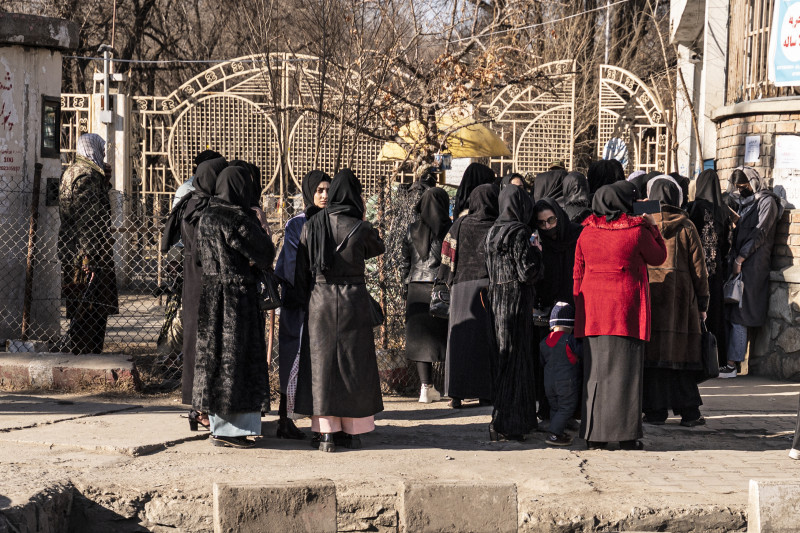
KABUL – Hundreds of young women were stopped by armed guards yesterday from entering Afghan university campuses, a day after the nation’s Taliban rulers banned them from higher education in another assault on human rights.
Despite promising a softer rule when they seized power last year, the hardline Islamists have ratcheted up restrictions on all aspects of women’s lives, ignoring international outrage.
A team of AFP journalists saw groups of students gathered outside universities in Kabul, barred from entering by armed guards and shuttered gates.
“The Taliban are scared of women’s progress. We can raise educated children in society and they are scared of that,” said 19-year-old Wajiha Kazimi, who survived an attack on an education centre in the capital earlier this year.
The Taliban authorities wanted to “suppress” women, said Setara Farahmand, 21, who was studying German literature at Kabul University.
“They only want women to stay at home and give birth to children. That’s it, they don’t want anything more for them.”
Male students also expressed shock at the latest edict, with some in the eastern city of Jalalabad boycotting their exams in protest.
“It really expresses their illiteracy and low knowledge of Islam and human rights,” said one male university student, asking not to be named.
At least two male university lecturers in Kabul announced they were quitting in protest.
Most private and government universities are closed for a few weeks over winter, although campuses generally remain open to students and staff.
“We are doomed. We have lost everything,” said one Kabul student, who asked not to be identified.
Deeply alarmed
The decision to bar women from universities came late Tuesday in a terse announcement from Neda Mohammad Nadeem, the minister for higher education.
“You all are informed to immediately implement the mentioned order of suspending the education of females until further notice,” he said.
Yesterday, the foreign ministers from a host of governments including all Group of Seven members, the Netherlands, Norway, Spain, Switzerland and the European Union warned the move would have “consequences for how our countries engage with the Taliban”.
The Islamic Cooperation Organisation (OIC) said the ban was “seriously denting the credibility of the government”.
Muslim nation Qatar – which has played a key role in facilitating talks between the West and the Taliban – said everyone deserves the right to education and urged Afghanistan’s rulers to review the decision “in line” with Islamic teachings.
The decision comes less than three months after thousands of girls and women were allowed to sit for university entrance exams across the country.
“Just think of all the female doctors, lawyers and teachers who have been, and who will be, lost to the development of the country,” said United Nations High Commissioner for Human Rights Volker Turk in a statement.
After the Taliban takeover in August last year, universities were forced to implement new rules including gender-segregated classrooms and entrances, while women were only permitted to be taught by professors of the same sex or old men.
Serious differences
The Taliban adhere to an austere version of Islam, with the movement’s supreme leader Hibatullah Akhundzada and his inner circle of clerics against modern education, especially for girls and women.
But they are at odds with many officials in Kabul – and among their rank and file – who had hoped girls would be allowed to continue learning following the takeover.
“The latest decision will increase these differences,” a Taliban commander based in northwest Pakistan told AFP on condition of anonymity.
Most teenage girls across the country were banned from secondary school in March, severely limiting university intake.
Since the ban, many teenage girls have been married off early – often to much older men chosen by their fathers.
Several families interviewed by AFP last month said the school ban, coupled with economic pressure, meant securing their daughters’ future through marriage was better than them sitting idle at home.
Women have also been pushed out of many government jobs – or are being paid a fraction of their former salary to stay at home. They are also barred from travelling without a male relative and must cover up outside of the home, ideally with a burqa.
International pressure
In November, women were prohibited from going to parks, fairs, gyms and public baths.
The international community has made the right to education for all women a sticking point in negotiations over aid and recognition of the Taliban regime.
Afghanistan’s neighbour Pakistan said that engagement with the Taliban was still the best path forward, though Foreign Minister Bilawal Bhutto Zardari admitted Tuesday while on a visit to Washington that he was disappointed.
“I still think the easiest path to our goal – despite having a lot of setbacks when it comes to women’s education and other things – is through Kabul and through the interim government,” he said.
In the 20 years between the Taliban’s two reigns, girls were allowed to go to school and women were able to seek employment in all sectors, though the country remained socially conservative.
The authorities have also returned to public floggings and executions of men and women in recent weeks, as they implement an extreme interpretation of Islamic shariah law. – AFP, December 22, 2022

.JPG)