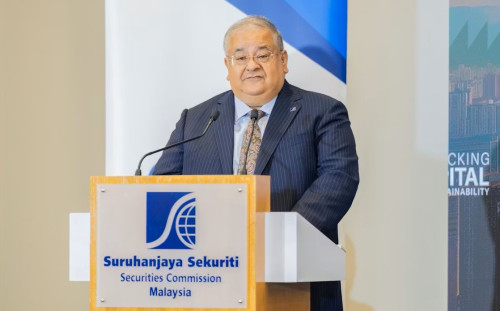
_president_Datuk_Seri_Wong_Siew_Hai.jpg)

PENANG’S once-booming semiconductor industry has entered a state of uncertainty following Washington’s decision to impose a 25% import tariff — a move that has sparked widespread apprehension among global chipmakers despite reported exemptions for semiconductor products.
While Malaysia’s chip exports have, for now, been spared from the latest round of tariffs set by US President Donald J. Trump, industry leaders are holding back on investment and expansion plans, awaiting greater clarity.
Malaysia Semiconductor Industry Association (MSIA) president Datuk Seri Wong Siew Hai confirmed that firms in the sector are adopting a wait-and-see approach, citing concern over the volatile global trade environment.
“We are hoping that the US would continue to exempt semiconductors from tariffs beyond August 1, the deadline for higher levies announced by US President Donald J. Trump,” Wong said in a recent interview. “Everyone is waiting to see how it all plays out.”
Describing the situation as “fluid,” Wong pointed to the uncertainty caused by the US government’s shifting stance on tariffs. Despite current exemptions, there are growing concerns that import duties on semiconductors may eventually be enforced.
Negotiations are currently underway between Malaysia’s Ministry of Investment, Trade and Industry (MITI) and their US counterparts in an effort to secure a mutually beneficial outcome.
The US is Malaysia’s third-largest market for semiconductor exports, with the country accounting for around 10% of global chip packaging. Electrical and electronic products comprise roughly 40% of Malaysia’s total exports.
Wong added that the industry is already experiencing increased operational costs following Malaysia’s expansion of the Sales and Service Tax (SST) on 1 July, although the financial impact varies between companies.
While he did not offer precise figures, Wong, who is based in Penang, acknowledged that firms would need to adapt to the new fiscal landscape: “It’s something that companies will have to live with.”
To cushion the impact and reinforce Malaysia’s position in global semiconductor supply chains, the federal government has pledged RM25 billion to support the sector. Malaysia aims to double its chip exports to RM1.2 trillion by 2030, solidifying its standing as the world’s sixth-largest semiconductor exporter.
Nonetheless, industry insiders have privately urged Penang’s state authorities to clarify their strategic direction and position as a major chip-making hub, warning that uncertain conditions are already influencing business decisions.
There is also growing concern over workforce preparedness, with calls for more skilled labour to meet the demands of evolving technologies in the sector.
The industrial slowdown is having ripple effects across related sectors. Northern region hoteliers report a noticeable dip in occupancy rates, particularly from corporate clients and factory-linked business travellers. Reservations for industry-related conferences and meetings have also declined, reflecting a broader cooling within the manufacturing and electronics sectors in Penang. - July 15, 2025