Business

Costa Rica president calls off IMF talks after protests

He invited political, business, trade union and academic sectors for talks on a potential economic solution

Updated 5 years ago · Published on 05 Oct 2020 11:54AM

Costa Rica president calls off IMF talks after protests
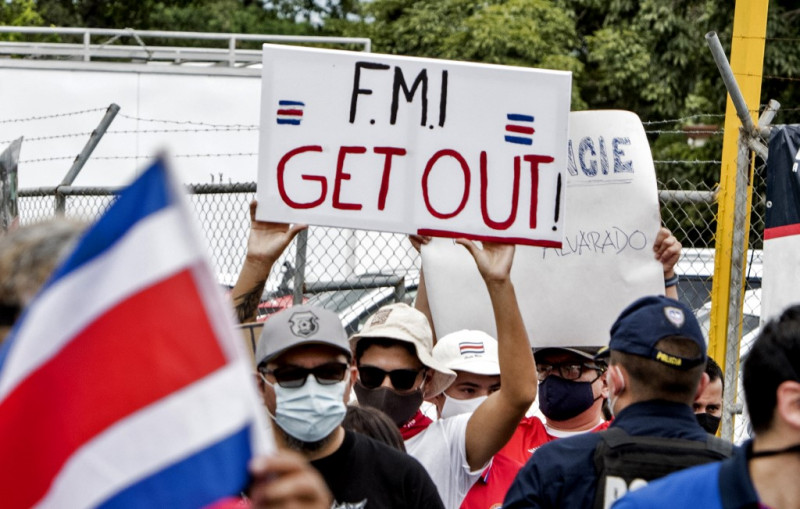
A man holds up a sign during a protest against the government's proposal to increase taxes to reach a credit agreement with the International Monetary Fund (IMF), outside the house of Costa Rican President Carlos Alvarado in San Jose, on September 20, 2020. – AFP pic, October 5, 2020

SAN JOSÉ – Costa Rican President Carlos Alvarado yesterday withdrew a negotiation proposal with the International Monetary Fund and called for a national dialogue after a wave of protests in the country.

He invited political, business, trade union and academic sectors for talks on a potential economic solution as the country struggles under a fiscal deficit that is projected to hit 9.7% of gross domestic product this year owing to the impact of the coronavirus.

"Today I call on the sectors that support the industrial channels to open a national dialogue to solve the economic emergency that the country is facing," Alvarado said in a speech broadcast on radio and television.

He added that, given public sentiment and "the need to take viable actions, the government will not go ahead with its proposal" of negotiation with IMF, which had been criticised by the opposition – the majority in Congress – for emphasising temporary taxes instead of cuts in public spending.

Alvarado's message came after the country was rocked by road blocks in several regions in protest at the IMF negotiations.

The protests, which began on Wednesday, turned violent in the past few days, and several police officers were injured while trying to lift the blockades.

Alvarado said he was withdrawing the negotiation proposal "for the purpose of dialogue and to balance the responses that the country needs to resolve the situation."

But he warned that the time for such a negotiation is "not unlimited."

"The worst thing is to do nothing, and only wait for a more severe crisis to hit us," Alvarado added. – AFP, October 5, 2020


Related News

Malaysia / 6d

Six per cent growth proves Malaysia's economy remains resilient - PM

Opinion / 1w

LHDN’s uneven hand: Tough on MSMEs, soft on the shadows

Opinion / 2w

Lessons From Negeri Sembilan - Charles Santiago

Opinion / 2w

The last dredge

Malaysia / 3w

Play chess, not checkers: Why Negeri Sembilan matters

Opinion / 1mth

Why Bersama is not Malaysia’s best hope

Spotlight

Malaysia

Private university CFO charged over alleged RM6.56m CBT

World

Unleashed 60kg dog in Hong Kong mauls poodle, bichon frise to death (video)

Malaysia

Three family members killed after Immigration truck runs red light

Malaysia

Woman, believed to be foreigner, allegedly causes disturbance at KLIA (video)

Opinion

Has DAP chosen the path to a slow death?

Malaysia

Three years of bullying at school puts 15-year-old at risk of hearing loss

By Alfian Z.M. Tahir

Malaysia

Police officer's wife cries, pleads for leniency after misusing disabled child's account

Malaysia

Organised cybergroups likely behind rise in racial hate on social media

You may be interested

Business

Oil prices hold above US$84 as Middle East tensions persist

Business

Tey Por Yee and four others ordered to pay RM103.75m in SC civil suit

Business

FMM urges input tax credits as government reviews GST features for SST