KUALA LUMPUR – Fitch Ratings has affirmed Malaysia’s long-term foreign currency issuer default rating (IDR) at “BBB+” with a stable outlook.
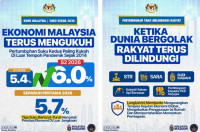
In a note released today, Fitch said Malaysia’s economy is gradually recovering from a contraction of 5.6% in 2020 caused by the Covid-19 pandemic even though social distancing measures have been tightened over recent months.
“We expect gross domestic product (GDP) growth of 4.5% in 2021 and 6.3% in 2022, as the output gap narrows and the vaccine roll-out gathers pace, which should allow the services sector to benefit from pent-up demand,” it said.
Fitch said the government’s social distancing measures have been accompanied by material relief measures, including social security payments, wage subsidies, grants to small and medium enterprises (SMEs), allocation for the procurement of vaccines, corporate loan guarantees, and a repayment moratorium on certain bank loans.
“As a result of this relief spending and reduced government revenue, we expect the fiscal deficit to rise to 6.5% of GDP in 2021 from 6.2% in 2020,” it said.
As the pandemic has caused a significant rise in Malaysia’s general government debt, in line with its rating peers, Fitch forecast the debt to reach 78.1% of GDP in 2021, from a pre-pandemic level of 65.2% in 2019.
“The debt figures used by Fitch include officially reported ‘committed government guarantees’ on loans, which are serviced by the government budget, and 1Malaysia Development Bhd’s net debt, equivalent in December 2020 to 12.7% and 1.4% of GDP respectively,” it said.
On this basis, Fitch said the debt burden is significantly higher than the median of 57% for sovereigns in the BBB rating category.
“Malaysia’s gross debt is over 400% of revenue, around three times the peer median,” it said, expecting the debt ratio to decline slightly to 77% of GDP in 2022, and for this trend to continue, facilitated by the resumption of strong GDP growth.
On the medium-term fiscal outlook, the rating firm said it remained subject to heightened political volatility.
“We expect a gradual reduction in the fiscal deficit, which is forecast to average 5.2% of GDP over 2021 through 2023 (above the government’s average target of 4.5%) as growth lifts revenues and Covid-19-related spending measures lapse,” it said.
In terms of general government revenue, it is expected to remain low at 18.2% of GDP in 2021 (BBB median: 26.6%), dependent on crude oil production, which the government expects to generate 16% of total revenue this year, a reduction from 25% in 2020, when Petroliam Nasional Bhd provided a special dividend.
According to Fitch, the low revenue base is exacerbated by the removal of the goods and services tax in 2018, which was replaced with a narrower sales and services tax and has in recent years led the government to draw on special dividends of government-linked companies.
“Lingering political uncertainty weighs not only on the policy outlook, but also on investment and prospects for an improvement in governance standards, in Fitch’s view,” it said.
Fitch said this year, the government has been able to implement pandemic-related policies and provide relief measures.
“Malaysia has been running consistent annual current account surpluses for more than two decades and Fitch expects it to continue to do so in the next few years, although the surplus is likely to narrow to 3.6% of GDP in 2022 from 4.1% in 2021 as import compression will likely gradually dissipate,” it said.
According to Fitch, the share of the government’s foreign currency-denominated debt is also low, at around 3% of total debt.
In addition, it said the government is still relatively dependent on foreign financing, although foreign holdings of domestic debt proved remarkably stable during the pandemic at around 25% of the total, supported by a deep and developed domestic bond market.
“Malaysia’s external liquidity, as measured by the ratio of the country’s liquid external assets to its liquid external liabilities, at just below 100%, is weaker than the BBB median of 127.3%,” it noted.
Meanwhile, Fitch said monetary policy is likely to remain supportive of economic activity, after Bank Negara Malaysia (BNM) reduced its policy rate by a total of 125 basis points (bps) since the start of the pandemic.
“The window for further policy rate cuts appears to be limited given the approaching United States Federal Reserve tapering and an increase in inflation in Malaysia, albeit from the base effect from low fuel prices last year,” it said.
“We expect BNM to start its tightening cycle in 2022 with a policy rate hike of 25bps,” it said.
In terms of the second six-month loan moratorium that Malaysia imposed on all retail and SME loans on an opt-in basis in July, Fitch opined that this would further delay recognition of non-performing loans (1.6% of total loans in May) into 2022.
“This will also allow banks to report modestly improved earnings and capitalisation in 2021 amid our expectation of muted loan growth of around 4%.
“It will take time, however, for banks’ credit costs and profitability to fully normalise,” it said. – Bernama, July 19, 2021