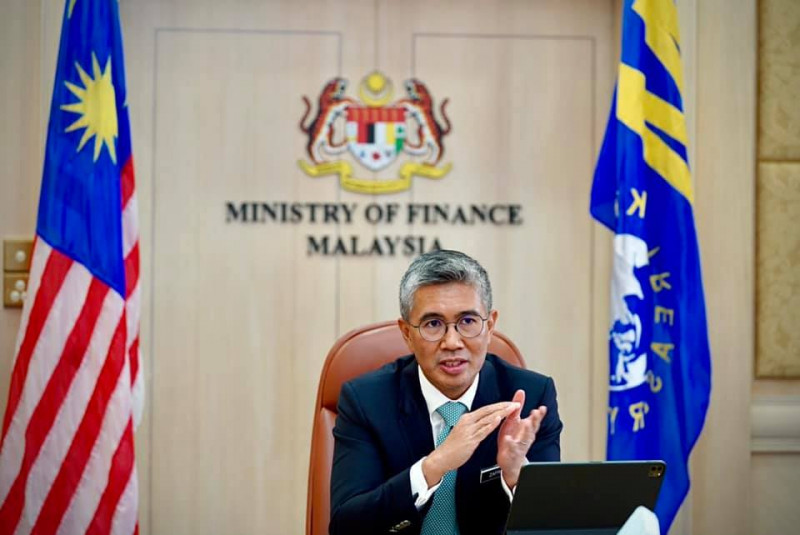
KUALA LUMPUR – The affirmation of Malaysia’s sovereign rating by Fitch Ratings demonstrates the national economy’s resilience in an uncertain environment, said Finance Minister Datuk Seri Tengku Zafrul Tengku Abdul Aziz.
In a statement today, he said Malaysia’s foreign-denominated long-term issuance rating being affirmed at BBB+ also reflects the country’s strong medium-term growth prospects and fundamentals, as well as stable current account surplus supported by diversified markets and export products.
Malaysia has consistently recorded a current account surplus for over two decades, with the largest registered last year at RM184.8 billion, equivalent to 4.2% of gross domestic product.
The position is also supported by ample international reserves, large external bank and corporate assets, and a net foreign exchange position of RM1.1 trillion, or 77.0% of GDP as at end-March 2021, he said.
“These factors are supported by a flexible foreign exchange policy that strengthens Malaysia’s ability to deal with external shocks.
“Furthermore, Malaysia’s retention in the FTSE Russell’s World Government Bond Index is a testament to the developed capital markets, as well as the strong and resilient macroeconomic fundamentals.”
To protect the people and businesses since the onset of the Covid-19 pandemic, assistance has been provided through eight stimulus packages and government relief worth RM530 billion, plus the RM322.5 billion Budget 2021.
Tengku Zafrul said under the Budget’s measures and packages, RM300 billion can still be spent to support economic recovery through the various phases of the National Recovery Plan.
He said the success of the vaccination drive is crucial to the nation’s economic recovery, and given this, it will be intensified.
Other factors driving the country’s economic recovery include better external demand by major trading partners and the implementation of infrastructure projects with high multiplier effects, he said.
“They also include the country’s economic fundamentals, which remain strong despite the challenging situation, as well as a strong and diverse economic structure.
“In particular, Fitch said Malaysia’s manufacturing and export sectors will continue to take advantage of the surge in global demand for the country’s export products, such as electrical and electronic goods, crude oil, and personal protective equipment.”
Going forward, he said, the national agenda will focus on digitalisation and the use of technology, and improving the prospects and resilience of the economy in the long run.
In the medium term, the government is committed to implementing continuous structural reforms that will enable Malaysia to attract high-quality investments, and generate skilled and high-income jobs.
Tengku Zafrul said Putrajaya is committed to ensuring the country’s fiscal sustainability and medium-term fiscal consolidation.
“Guided by the Medium-Term Fiscal Framework and supported by the gradual implementation of the Medium-Term Revenue Strategy that aims to increase and diversify the country’s revenue base, the government will be able to continue fiscal consolidation once the nation recovers from the pandemic.
“This will allow for the balancing of short-term fiscal needs with fiscal and economic sustainability.”
The fiscal deficit has gone down from 6.7% of GDP in 2009 to 3.4% in 2019. – Bernama, July 19, 2021