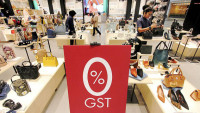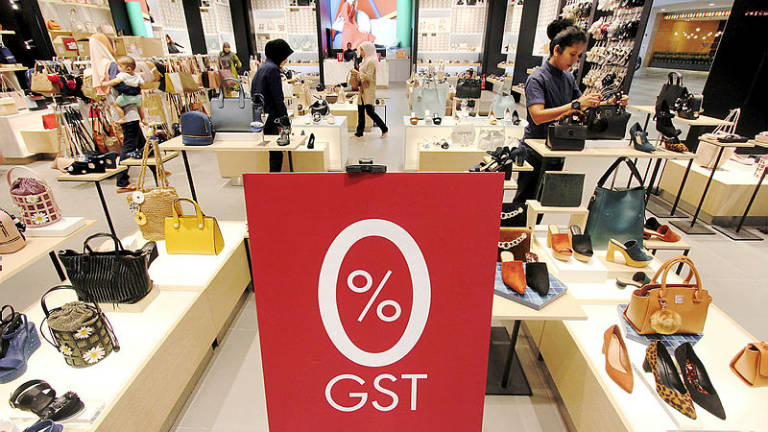

GEORGE TOWN – A civil society activist and a former federal lawmaker have joined the bandwagon of those supporting the reintroduction of the goods and services tax (GST), saying that it can stimulate the economy once the government has more funds to spend.
Penang Warisan coordinator Jeff Ooi told The Vibes that the GST is an all-encompassing, consumption-driven tax, so everybody who spends will have to contribute to the taxation system.
“The more you spend, the more GST you incur. It is that simple. Of course, the poor will not spend as much as the wealthy so the rich pay more,” he said adding that the current system of sales and services tax (SST) is not as efficient.

Unlike GST, SST does not tax everyone down the supply chain.
With more funds available in their coffers, the government can allocate additional funds, which will help boost the macroeconomic aspects of the country, said the former Jelutong MP.
However, despite supporting its reintroduction, Ooi stressed to The Vibes that now is not the time to reimpose the tax because of hyperinflation, which is impeding growth and domestic consumption.
GST will have to wait until the economy rids itself of all the impediments arising from reopening after some two years of lockdowns and limited activities.
“Also, the GST rate needs to be reflective of what the B40 and M40 income classes can afford. It cannot be pegged at its previous rate of 6%, because of the need to make consumerism items and services affordable and to protect pricing of essential goods,” he said.
Country would be in better state if GST was still around, says NGO
Sharing Ooi’s perspective, Centre of Integrity, Professional Governance and Advancement president Myocho Kan also spoke in support of GST, but took note that there are more challenges than just timing the reintroduction perfectly.
He observed that based on its unpopular past, there is a need to convince taxpayers of the system’s transparency, competency and accountability to protect their interests.
At the moment, only 16.5% of Malaysia’s 15 million strong workforce, or around 7% of the total population, are taxpayers, leading to a nation being pressured by a heavy bill of expenses.

Kan added that this was evident based on the country’s yearly expenditure, wherein more than 51% is allocated for non-economic generating activities such as pension, salary, and emolument, among others.
The income threshold needs to be relatively adjusted to factor in depreciation factors such as inflation, dispensable income, and currency devaluation, he added.
“People should not fear tax, but people must abhor misappropriation of tax income. Corruption aside, wastage of taxpayer money is a serious issue. GST should not be looked at in isolation but holistically in terms of its correlation to the cost of living and doing business.
The issue is not about GST but how tax income is spent and tallied. You don’t blame a Ferrari for crashing when the driver doesn’t know how to control and manage a high-powered vehicle.
“GST is that high-powered vehicle that will go up in smoke if it falls into the wrong hands. Imagine if GST is rationalised, the country will not be as bad as it is now,” he argued, adding that abolishing GST in the past was a reckless move.
Kan described the act as “chopping a fruit tree when the first harvest is not sweet”.
This time around, the analyst advised, the government must set up an oversight body with the authority to oversee the collection and implementation of GST while refunding contributors who paid in excess.
“This must be done seamlessly and this body must be answerable to the finance minister and perhaps even Parliament.
“We also need professionals and not politicians to realise the dream of an efficient tax system and using of its funds effectively for nation-building.” – The Vibes, July 21, 2022