
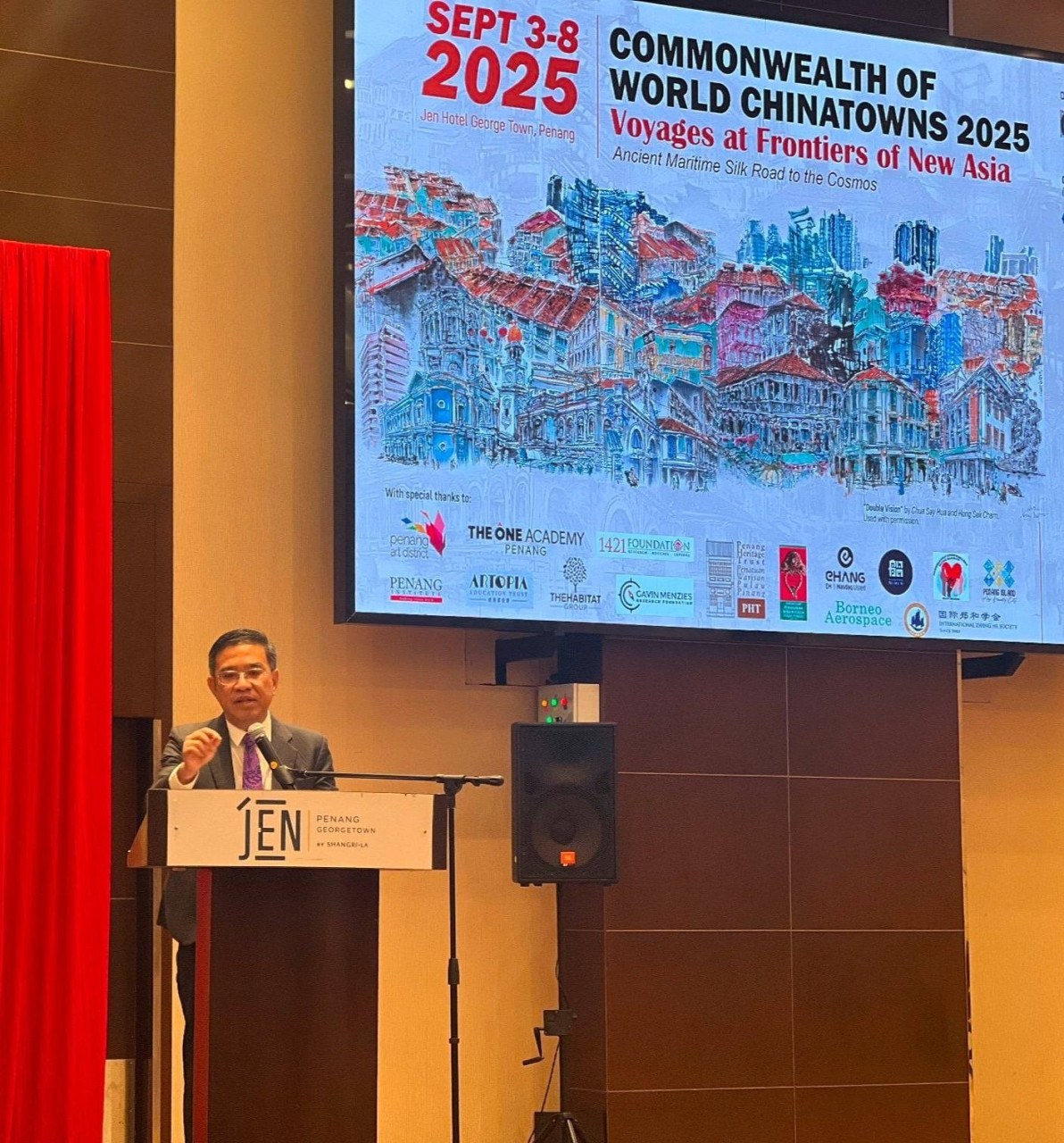
CHINATOWNS across the world must move beyond their traditional roles and evolve into vibrant platforms for capital, cultural, and technological exchange, said Penang state executive councillor Wong Hon Wai at the inaugural Commonwealth of World Chinatowns (CWC) conference.
Representing Chief Minister Chow Kon Yeow at the opening ceremony, Wong called for a shift in how Chinatowns are perceived.
“They should not be frozen in time as just restaurants, herbal outlets and kungfu classes inspired by the late Bruce Lee,” he said.
Instead, he envisioned them as springboards for technology transfer and business collaboration, while continuing to conserve and promote Chinese heritage through cultural expressions such as lion and dragon dances, and dragon boat races.
The CWC conference, held at Jen Hotel in George Town, was the result of a technocratic brainstorming session involving former Singapore Foreign Minister George Yeo in Penang last year. Penang-born, Singapore-based Winfred Khoo took the lead in organising the event.
Wong noted that the descendants of the Chinese diaspora have significantly evolved, with many now emerging as industrialists and entrepreneurs designing semiconductors that power the digital economy.
“This is the evolution of the diaspora spirit,” he said.
Chinatowns, he added, have left their mark globally — from Kolkata in India to Jakarta in Indonesia — with their business enclaves continuing to celebrate Chinese culture and tradition.
Wong also observed that the CWC draws inspiration from the long-standing Chinese settlements in Penang and Singapore, and their multicultural connections to China, Asia, and beyond.
“The platform is about creating a global form of collaboration,” he said.
The conference also featured noted Singaporean architect and intellectual Prof Tay Kheng Soon, who advocated for deeper economic integration between Malaysia and Singapore.
He argued that the move need not stem from political convenience but should be seen as a pragmatic response to shifting global dynamics — particularly China's rise and the perceived decline of Western powers.
“There is a need for regional consolidation in the face of challenges from a world increasingly polarised and amid a wobbly global trade status,” said Prof Tay. - Sept 6, 2025