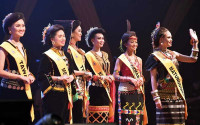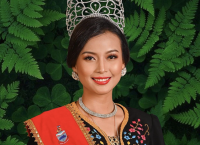
THE Unduk Ngadau may be one of the most anticipated events held during the month-long Kaamatan Harvest Festival.
The Unduk Ngadau, or Runduk Do Tadau, translate to "the reflection of the sun through a water droplet from morning dew on a padi plant".
Corresponding to the legend, the winner of the beauty pageant is the embodiment of the “huminodun”, a beautiful maiden sacrificed to end a great famine that struck the earth.
It is a story of overcoming hardships – involving gods, magic, sacrifice, and the blind obedience of a filial child.
The legend revolves around a family of gods: father Kinoingan, mother Suminondu and daughter Pinozubung.
It is Pinozobung who later transforms to become Huminodun.
The backdrop of this mythical legend is set against the land that was struck by great famine, bringing suffering to the people.
Kinoingan was worried that his people would starve and decided to go out in search of a solution on how to end the great famine.
But Suminondu instinctively knew that the only way to save or heal the world from this great calamity was to sacrifice their only daughter, Pinozobung.
While Kinoingan was away, Suminondu took Pinozubung to the mountains. When they reached the peak, they took a rest and took turns massaging each other's heads.
The daughter attended to her mother first and when they switched, the daughter fell asleep, lulled by her mother’s soothing touch.
Seeing her daughter peacefully sleeping, the distraught Suminondu took out a sacred dagger – that could kill gods like themselves – to sacrifice her daughter.
But just as she was about to kill her, Pinozubung was awakened by the glare of the knife, reflected by the sun.
“Ina, nukuo tu mangan zou diau taboko!?” (Mother, why do you want to stab me?!)
Suminondu stayed her hand and explained through her anguished tears: “I had given birth to you... but now, the only way for the world to be healed is through the flow of your blood. It must flow on this land.”
Pinozubung listened carefully and heeded what her mother must do for the sake of their people.
Before she was sacrificed, Pinozubung detailed in a song how each part of her body would turn into crops for food.
Her head would turn into a coconut, her teeth would turn into the kernel of corn and so on.
After killing her, Suminondu returned home and the land began to heal – food crops started to grow, the padi fields on their land began to flourish.
When Kinoingan returned home, he immediately looked for his beloved daughter, who was visibly absent from the house.
“Nombo ih pinozobung?" (Where are you, Pinozobung?)
Suminondu revealed to him what she had done, insisting that sacrificing their child was the only solution to this curse.
In a fit of rage on learning this awful truth, Kinoingan went out and started destroying the padi crops on their land.
But as he was about to strike down the padi, the spirit of Pinozubung spoke.
“Apa’, nokuo tu sinduahan zou diau? (Father, why are you hurting me?)
Pinozubung had now become the “Bambarayon” (spirit of the padi) and is now known as the “Huminodun.”
Huminodun went on, telling Kinoingan: “I am now living in this plant. Please do not hurt me.
“Go home and prepare seven Tajau (large porcelain vases) and on the seventh day, open it.
“My spirit is in the padi now. You have to respect this,” she said.
Kinoingan went home and did as Huminodun told him to. On the seventh day, along with Suminondu, he opened the Tajaus one by one.
Beautiful maidens emerged from the first six vases they opened.
A bright light shone from the seventh vase when it was finally opened. And the reincarnation of Pinozobung – who would henceforth be known as Huminodun – stepped forth.
As the legend goes, Suminondu went on to pass on the “Rinait”, the mantra of knowledge, and this story of Huminodun to the Bobohizans or the Bobolians, the traditional priestesses of the Kadazan, Dusun, Murut people. – The Vibes, May 30, 2021
*The story of Huminodun differs in each district in Sabah. This is the Penampang version as told to the writer by Joanna Kitingan.