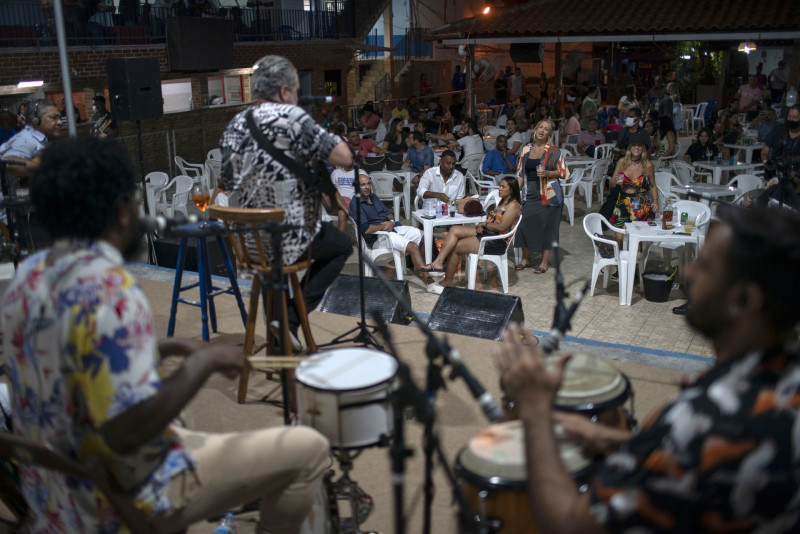
FEW things say Rio de Janeiro like a "roda de samba" legendary jam session where musicians sit in a circle gushing out Brazil's most beloved music and a tight crowd of beer-guzzling revelers surrounds them.
But the coronavirus pandemic has forced the performers who keep this tradition alive to adapt.
"We don't sit in a circle anymore. We play on a stage in front of the audience," said Moacyr Luz, 62, founder of the Samba do Trabalhador (Worker's Samba), which held a Monday evening roda de samba (samba circle) for 15 years until the pandemic hit.
Luz, a giant of Brazilian music who is up for a Latin Grammy this year, said playing samba without a crowd was like a footballer scoring a goal without celebrating.
"It doesn't feel natural. But at least the samba is flowing. We're living in a time of transformation, so everybody has to adapt," the gray-bearded songster told AFP.
Luz and his band are just coming off a seven-month hiatus during which their only shows were online. This month, they began playing in the flesh again - with social distancing measures - at Renascenca, a famous club on Rio's north side.
The thrumming sounds of "cavaquinho" mini-guitars, "cuica" drums and tambourines still rock the crowd.
But the crush of people surrounding the band - up to 1,500 of them in the past - has given way to neatly separated plastic tables with small groups of guests.
Tickets are limited to about 300 per show, and sell out fast online.
Guests have their temperatures checked at the door and must wear face masks when not seated at their tables.
"People used to crowd in around the musicians. Now, you lose that contact, the heat of the roda, the feeling that you're right there playing with them," said Dalia Melo, 42, at a recent show with her husband.
"But the important thing is that it's back."
Matter of mental health
Rio, a tropical paradise of postcard beaches and all-night parties, has been hit hard by the pandemic, which has claimed more lives in Brazil than any country except the United States, with a death toll of nearly 160,000.
Local authorities put the city of seven million people on lockdown in March. They have been allowing a gradual reopening since June.
Live music was among the last activities allowed to resume, with no dancing and half the audience.
But the restrictions do not stop the crowd from belting out the songs with Luz.
For true "cariocas," as Rio residents are known, the effect is therapeutic.
"Samba is part of Brazilian culture. It's associated with so many good things: It's the unity of a people, it's the continuation of a tradition. It brings immeasurable happiness," said fan Cristina Barreto.
"Being here is a matter of mental health. It feeds the soul and gives you strength to keep confronting all this."
Sense of loss
The pandemic has been hard on Luz.
His longtime friend and collaborator Aldir Blanc, one of Brazil's greatest lyricists, died of Covid-19 in May, aged 73.
"I've learned about loss. We lost our audiences, record launches, tours. I lost my main songwriting partner, Aldir Blanc, who wrote more than 100 songs with me," Luz said.
He wants activity in the city to resume so that musicians can work.
He accepts that this inevitably involves distancing measures for now, but dreams of a return to pre-pandemic normal.
"I can't wait to be able to hug people again, to not be afraid of showing affection," he said.
The crisis has not destroyed his creative spirit: He has written more than 30 songs recently, including some about the pandemic.
"So much green, so much sea / But I can't touch it," says one.
"So many tables, so many bars / But I can't sit down / So many mouths, so much love / But I can't kiss them."
But then it transforms into a song of hope, with the lyrics: "I know all this will pass." – ETX Studio, October 31, 2020