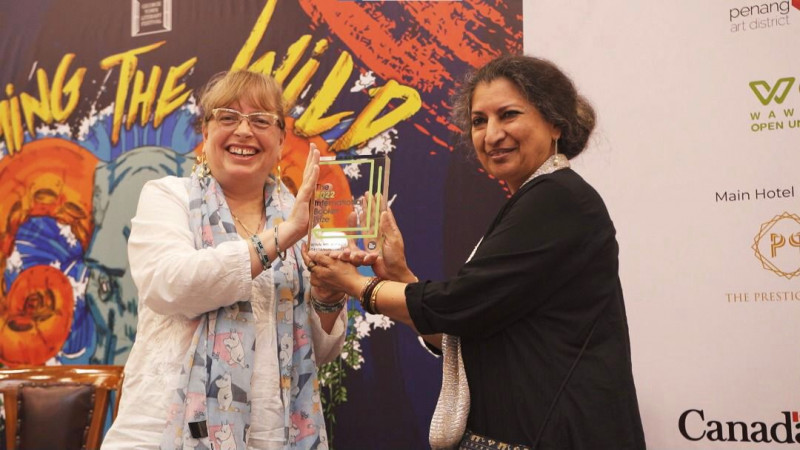
OVER the weekend at the George Town Literary Festival 2022, Indian author Geetanjali Shree received the International Booker Prize 2022 trophy – with her name engraved – from her translator Daisy Rockwell. Geetanjali was a speaker and panelist at the event.
Her novel Tomb of Sand, was announced as the winner of this year’s Booker Prize – perhaps the most prestigious literary prize awarded every year to the best novel written in English – back on May 26.
Tomb of Sand is also the recipient of a lot of firsts, being the first book originally written in any Indian language to win the prize, and the first novel translated from Hindi to be recognised. Pretty good for Geetanjali’s first novel to be published in the UK.
In addition to the trophy, both Shree and Rockwell received the £50,000 (RM270,000) prize money, giving them equal recognition.
Originally published in Hindi in 2018, Tomb of Sand was awarded one of English PEN’s coveted translation awards, which Rockwell received in 2019.

The author of three novels and several story collections, Geetanjali Shree has been translated into English, French, German, Serbian, and Korean. She was born in Mainpuri, India, in 1957. She has received and been shortlisted for a number of awards and fellowships, and lives in New Delhi.
Daisy Rockwell is a painter, writer and translator living in Vermont, US. She was born in 1969 in Massachusetts. She has translated a number of classic works of Hindi and Urdu literature, including Upendranath Ashk's Falling Walls, Bhisham Sahni's Tamas, and Khadija Mastur's The Women's Courtyard.
Tomb of Sand is set in northern India, and follows an 80-year-old woman who slips into a deep depression at the death of her husband, then resurfaces to gain a new lease on life.
To her family’s consternation, Ma insists on travelling to Pakistan, simultaneously confronting the unresolved trauma of her teenage experiences of Partition, and reevaluating what it means to be a mother, a daughter, a woman, a feminist.
According to the International Booker Prize, “Geetanjali Shree's playful tone and exuberant wordplay results in a book that is engaging, funny, and utterly original, at the same time as being an urgent and timely protest against the destructive impact of borders and boundaries, whether between religions, countries, or genders.” – The Vibes, November 29, 2022