By Fariz F. Tyebjee
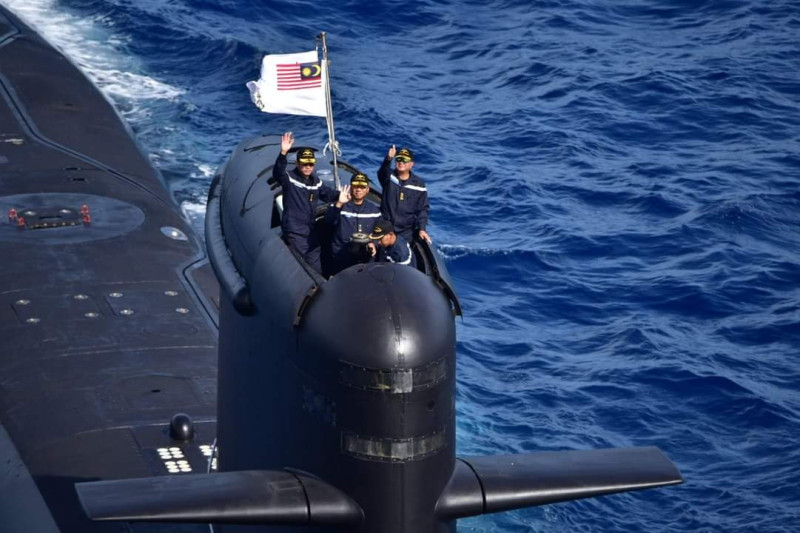
SHORTLY after entering service the Royal Malaysian Navy's [RMN] first diesel electric submarines, KD Tunku Abdul Rahman and KD Tun Razak, became the subject of great controversy following reports of alleged kickbacks.
Not helping matters was a 2010 February article which reported that sea trials involving KD Tunku Abdul Rahman had been postponed following the discovery of a technical problem.
The article also mentioned that DCNS had fixed the problem and that the warranty period which was due to end on 2010 March 25th had been extended till 25th May to enable the boat to attain Initial Operational Capability [IOC].
Responding to the article the Chief of the RMN said that the problem was due to a defect found in the High Pressure Air Blowing System.
News of the technical problem was to have unexpected consequences for the RMN.
Years after the article was published the first that comes to the mind for many when the Scorpenes are mentioned are of boats which are unable to dive.
It also led to politicising of the issue by groups out to gain political mileage and triggered intense debate - in a country where the average person on the street has little knowledge on defence matters - on whether the RMN needed submarines and whether the Scorpene was the right choice.
Pro-opposition NGOs and members of the public were quick to suggest that the government had wasted funds on a "defective" submarine and that a "better" and "proven" design should instead have been selected - no suggestions were given as to which design was supposedly "better" and "proven”.
Others questioned the RMN's professionalism ignoring the fact that the crews of KD Tunku Abdul Rahman and KD Tun Abdul Razak had put great effort and pride in qualifying as submariners and getting their boats operational.
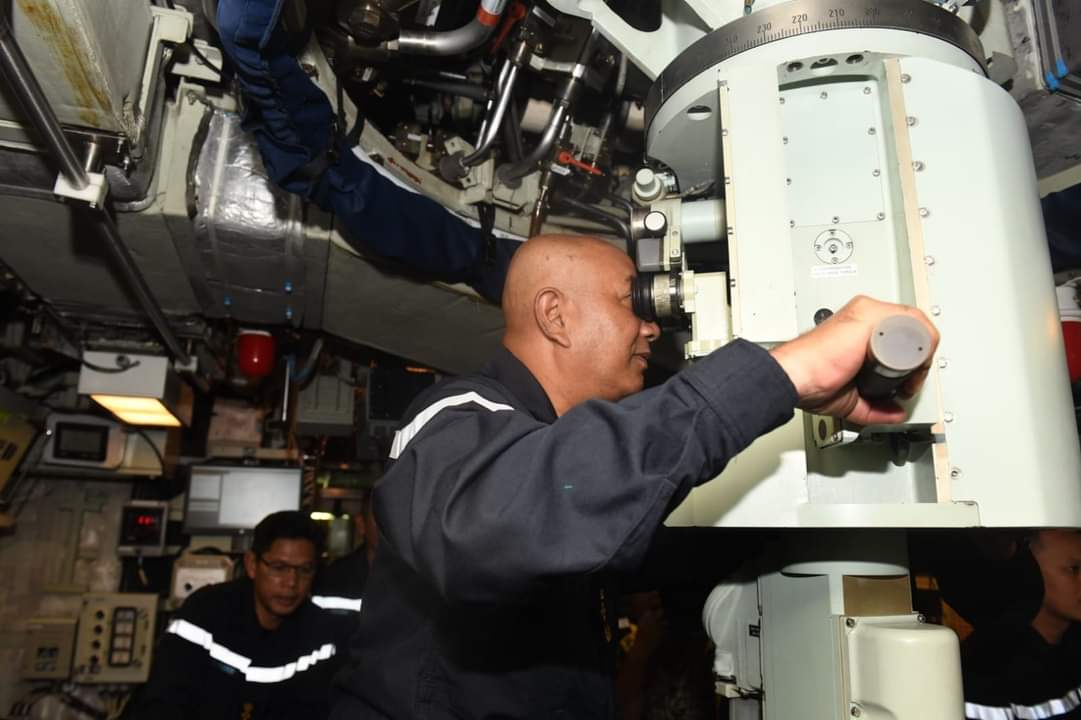
Malaysia’s former Chief of Defence Forces General Tan Sri Mohammad Ab Rahman having a look through KD Tunku Abdul Rahman's periscope [RMN]
Self-proclaimed experts questioned the competence of the RMN and technical aspects of the Scorpene's design, unaware and ignoring the fact that other navies, established SSK operators - have also experienced teething and technical problems with newly commissioned boats and even with boats which have been in service for years.
- Germany experienced various technical issues with newly delivered Type 212 boats which made "strange grinding sounds due to being off centre, marring acoustic stealth" during sea trials . Other issues included a radar which broke down and a malfunctioning communications buoy.
- HMAS Dechaineux cancelled her participation in Bersama Shield 2011 due to technical problems encountered whilst at Singapore.
- In 2008 South Korea announced that noise related problems had been encountered in a newly built Type-214.
- In 2006 Greece refused to accept delivery of a Type-214 due to certain technical issues.
Politicians invited to ‘dive’
The highly pertinent fact that it was not a case of a submarine being unable to dive but the RMN deciding to postpone trials for safety reasons due to a technical issue was overlooked by critics.
To refute allegations made by members of the opposition the Ministry of Defence issued an invitation for certain opposition members to experience a dive onboard a submarine.
Although Lim Guan Eng, Nurul Izzah Anwar, Khalid Samad and Tony Pua received invitations the only one to accept was Guan Eng
Following his visit to KD Tun Abdul Razak in December 2011 which included a 30 metre dive which he described as "exciting", Guan Eng said that the submarine "could dive" and was quoted: "on the submarine purchase I feel that it is needed' .
He also said: "diving with the Scorpene submarine KD Tun Abdul Razak 21 months after a challenge was issued by the Defence Minister does not dispute the fact that the submarine could not dive upon delivery nor whether it was value for money for the purchase price tag of RM3.68 billion for two submarines".
Unfortunately, he did not provide any examples as to what would have been "value for money'".
Despite the former Chief Minister of Penang participating in a dive it was still common to hear self-proclaimed "experts* insisting - without any facts to back up their claim - that the Scorpenes still could not dive.
The question that arises is whether these "experts" who were unaware of his visit to KD Tun Abdul Razak, were doubting his statement that the Scorpene "can dive", were genuinely ignorant or were just out for political mileage.
.jpeg)
A RMN Scorpene at the Boustead shipyard [Boustead].
In the run up to the 13th General Election, the RMN Chief threatened legal action against opposition figures making false remarks.
The Scorpenes again became a convenient platform for those seeking political mileage following the landing of Sulu gunmen in the Lahad Dato area in early 2013.
The Sabah DAP chapter posted an article: "How Did Ragtag Suluk Militants Get Pass Malaysian, Marines, Navy, Army and Police? What For 2 Multi Billion Scorpene Submarines In Sepanggar?"
The reality is that nobody procures submarines to detect groups of men in small boats, and submarines are not ideal platforms for such a task.
As late as 2016 "informed" citizens were still claiming that the Scorpenese were unable of diving, the Chief of RMN seeing fit to mention that: "I know many people doubt whether our submarines can actually submerge but I assure you they can submerge. Even now, KD Tun Razak is currently on an operation, and it is actually underwater".
Feasibility studies done in 1970s
Feasibility studies conducted in the late 1970s led to the RMN registering a requirement for submarines in the 1980s.
A lack of funding however resulted in the service having to wait for more than 2 decades for its submarines.
In mid-1986 the RMN said that if submarines were funded under the 4th Malaysian Plan the RMN could have an operational submarine force by the turn of the century.
The following year the RMN announced that it had submitted its requirements and was waiting for approval.
In preperation personnel were sent to Australia, Britain, France, Holland, Turkey and Sweden for training.
In the early 1990's a number of officers, including a future Chief of RMN, completed a course at HMAS Platypus and received their Dolphins.
In 1993 an RMN delegation visited the Swedish base at Karkskona and went to sea onboard a Nacken class boat.
A pair of RMN officers were awarded the French Navy’s Submarine Upper Certificate after being trained on board the La Praya an Agosta class boat in 1997 and in 1998 five officers were sent to Turkey for a course at the Turkish Golcuk naval base.
Training provided included damage control, escape training, time on a simulator and participation on a routine patrol onboard a Type 209 in the Black Sea.
The RMN came close to acquiring a submarine capability in 1991, 2 T-96s and a used Draken training boat from Kockums but a change of plans led to 2 Lekiu class frigates being ordered from GEC-Yarrow.
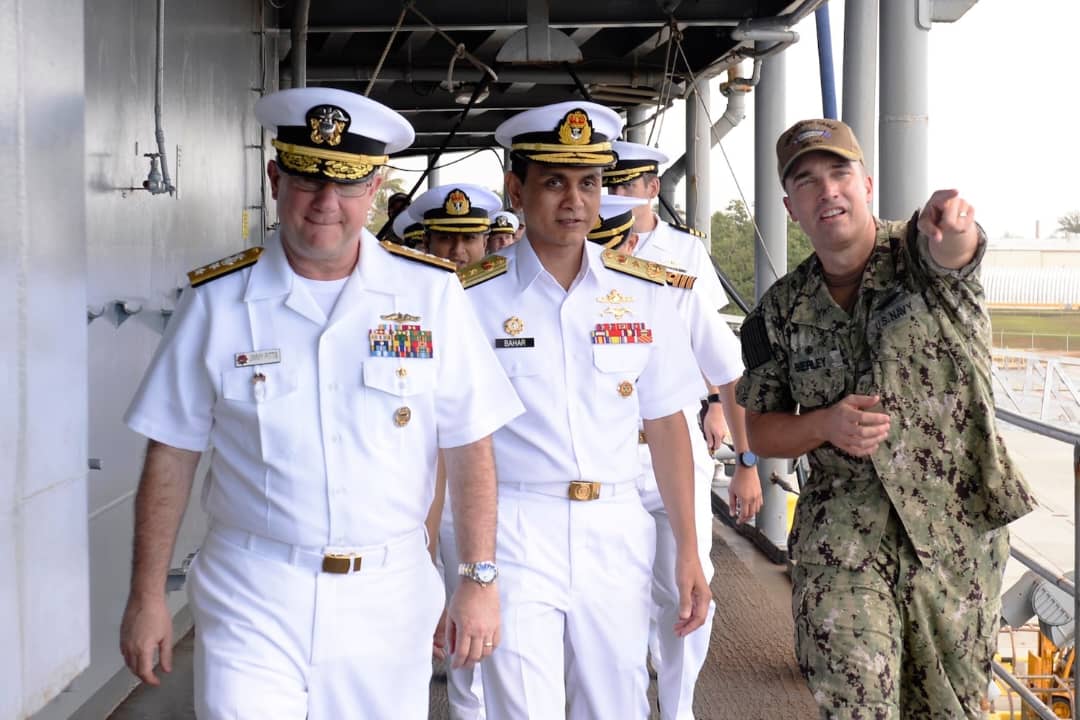
RMN Submarine Force commander First Admiral Baharudin Bin Wan Md Nor and the USN's Commander of Submarine Group 7 Rear Admiral Jimmy Pitts, during the Submarine Talks at Guam in 2019 [U.S. Navy/MC3 Randall W. Ramaswamy].
Prior to that it was offered a pair of former Royal Navy Oberon class boats, the former HMS Oberon and HMS Walrus, part of an arms MOU signed with Britain in 1988.
As part of France's efforts to secure a deal a Daphne class boat the Physche was in Malaysia for almost a month in 1989. Prior to Singapore procuring the Sjoormen class boats they were offered to the RMN.
Events took a surprising turn in December 2000 when the Zwaardis and Tigerhaai, 2 former Dutch navy Zwaardis class boats arrived at Lumut.
In partnership with PSC-NDSB Dutch shipyard RDM was hoping to deliver these boats after an upgrade, there were also plans to secure a contract for a pair of newly built Moray class boats later.
Other submarines offered included licensed built Turkish Type 209s, surplus South Korean Type 209s and Kilos from Russia.
At the LIMA 1997 exhibition a Russian Navy Kilo Type 877 EKM, a Turkish Navy Type 209, a French Navy Agosta 70B and a Pakistan Navy Agosta 70B were on display.
After prolonged and intense negotiations in June 2002, a Euro 969.1 million contract was signed with Amaris [comprising DCN and Izar] for a pair of Scorpenes, - the RMN the 2nd customer after Chile to order the design.
Included in the contract was an Integrated Logistics Support deal, training package and provision for a former French Navy Agosta class SSK the Ouessant to serve as a training platform.
Originally launched in 1978 she was retired from French service in 2001.
150 submariners trained
Under the terms of the contract 150 RMN submariners were trained by NAVCO - the training arm of DCN - under standards set by ALFOS the Marine Nationale's submarine command.
Selected from 2,000 applicants who volunteered for submarine service; each trainee was required to have served a minimum of 3 years onboard surface ships before volunteering for submarine training.
Upon being selected each underwent evaluations prior to being sent to KD Pelandok for a 3-month refresher course under standards set by the Defence Conseil International and NAVFCO.
Conducted at Brest and Cherbourg, training included classroom and simulator instruction, as well as time at sea on board the Ouessant.
An advantage in using the Ouessant as a training platform was, she was able to carry twice the number of trainees than would have been possible with a Scorpene.
On completion of their training the first intake of trainees who qualified were awarded Advanced Certificates - based on the French Navy’s Elementary Submariner Certificate - at a ceremony held in Brest in June 2007.
Another group underwent training in Spain by Spanish Navy instructors belonging to ISDEFE - a company linked the Spanish Ministry of Defence.
Built around an Albacore shaped hull with a cross-configuration tailplane and fin mounted hydroplane, the Scorpene has a 7 blade skewed propeller and 4 stern rudders.
The sonar suite includes a passive flank array [believed to be the Thales Underwater Systems TSM 2253], an active/passive hull mounted sonar [believed to be the Thales Underwater Systems TSM 2233 MK2] and a high resolution mine avoidance sonar.
Unlike Chilean Scorpenes which operate in deeper waters the RMN's Scorpenes operate mostly within the continental shelf and are fitted with a cofferdam section comprising 2 water/pressure tight bulkheads.
Both are equipped with a SUBTICS [Submarine Tactical Integrated Combat System, a Thales CKO-48 search/attack periscope, a CMO-10 non-hull penetrating optronic mast containing a thermal imager/TV sensor and a SAGEM navigation radar, a Shipmaster integrated platform management system, a Northrop Grumman PL41 Mk4 Mod1 RLG inertial navigation system and DR3000-ESM.
The subs are armed with 6 533mm [21 inch] bow torpedo tubes which can fire Black Shark heavyweight torpedoes and SM-39 Exocet anti-ship missiles.
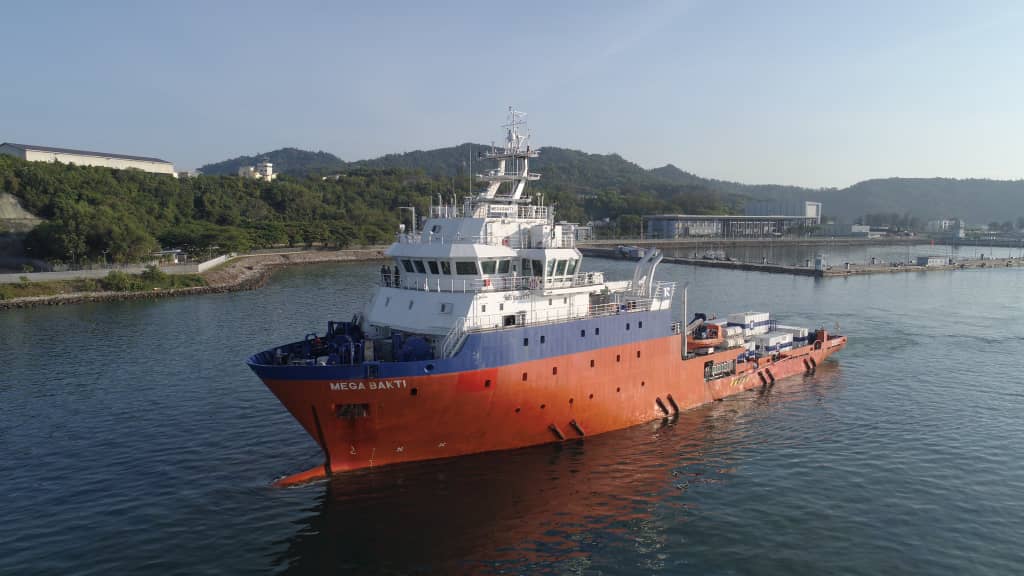
The Mega Bakti submarine rescue ship [RMN].
Participated in numerous exercises
Since entering service both boats have participated in numerous exercises and have conducted live torpedo and missile firings.
In 2016 KD Tun Razak participated in a joint exercise with the Provence, a Marine Nationale FREMM class frigate and its embarked NH90 in the waters off Sabah.
The previous year KD Tunku Abdul Rahman participated in a joint exercise with HMAS Sheean.
To support its submarines the RMN established a training and shore support infrastructure at Teluk Sepanggar.
In addition to hangar and workshop and a Power Supply/Battery Charging and Shore Supply electrical network, a pair of simulators are operated by the Submarine Training Centre.
Contracts were also placed for tugboat services, a transfer system and umbilical services.
In addition to hatches which are STANAG 1297 compliant the Scorpenes have a connection point for a diving bell or a Deep Submergence Rescue Vehicle [DSRV].
To enable a submarine rescue capability a local company was awarded a 30-year rescue and support contract.
As part of the contract the Mega Bakti a 80 metre Submarine Escape and Rescue Intervention ship is operated, equipped with a Triton ROV, an Emergency Ventilation & decompression System and other equipment able to be operated up to a depth of 650 metres.
She deployed to Australia for Pacific Reach 2019.
Prior to that she deployed to South Korea for Pacific Reach 2016 where she performed simulated rescues on HMAS Rankin and ROKS Changbogo.
During the same year the MV Mega Bakti was certified by the USN as "an approved commercial vessel of opportunity" enabling her to perform rescues on US submarines.
In 2021 the Mega Bakti deployed to the waters off Bali to assist in operations to locate KRI Nanggala.
The downside however is that with only 2 boats, ensuring at least one is always prepared to put to sea will be a challenge.
A force of three or preferably four boats would make it easier to carry out planned deployments, as well as meeting training requirements.
.jpeg)
An RMN Scorpene at sea [RMN].
Plans to procure two more subs
During a visit to Sabah in early 2023 the Defence Minister spoke of a plan to procure a single submarine under the 14th Malaysia Plan [2031-2035] followed by another under the 15th Malaysia Plan [2036-2040]
Submarines are inherently expensive to operate and maintain, requiring an extensive shore support infrastructure.
This is a challenge for resource constrained navies. Another challenge is that adequate numbers of crews are required, not only to crew existing boats but also as replacements as people are always leaving the service, may be away for courses or will be posted to other postings.
The wash out rate for submariners is also high, even after qualifying and serving time at sea, some submariners might not be found suitable.
Contrary to the impression some may have submarines are not invincible, nor a panacea.
They don't operate in a vacuum and at times in order to be effective they will have to be paired with other assets.
Like fighters, ships and other assets, submarines also have to be placed in tactical situations which are as advantageous as possible.
Potential opponents who may have a numerical edge will all also have submarines and will understand their strengths and limitations.
They will also be expecting submarines to be deployed and may counter them with submarines of their own or air and surface assets, as well as mines. A lesson learnt a long time ago that at times, preventing a submarine from doing its job is just as or more important than physically destroying it.
Held at Port Klang in 2006 the first submarine talks involving the USN, RAN and RMN were hosted aboard the USN submarine tender USS Frank Cable, berthed alongside the USS Frank Cable was the USS Houston.
Over the years submarine talks have also been held in Guam and Teluk Sepanggar.
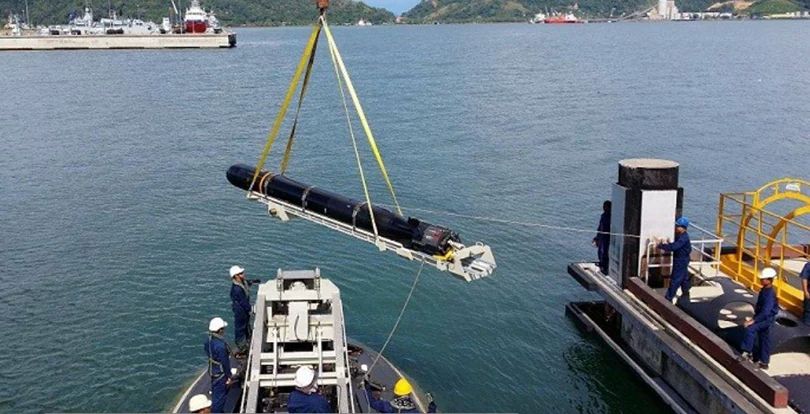
An RMN Blackshark heavy weight torpedo [RMN].
Operating submarines in Malaysian waters presents its own set of challenges given that with the exception of the South China Sea the northern approaches to the Melaka Straits and the waters off Sabah, waters are mainly shallow and confined - in certain areas shallow enough for a submerged submarine to be spotted visually from the air.
Operations in the littorals can also hamper submarine operations but will also in certain areas offer advantages, especially in waters that are familiar to RMN crews.
ASW is often likened to a game of chess, the submarine always playing from an advantage compared to aircraft or surface ships.
Skillful and aggressive employment of submarines by one side and a lack of an ASW capability or a lack of training on the other side can have a major impact on operations.
The question was always a matter of not whether the country could afford submarines but whether it could afford to be without submarines.
The capital expenditure involved in the purchase of submarines was a small price to pay for what is offered in return as a long term tangible investment essential for the country's ability to defend its maritime domain.
In addition to the deterrent value and roles such as sea denial, intelligence gathering and supporting special forces operations, submarines also have improved the RMN's ability to conduct Anti-Submarine Warfare [ASW] training.
Prior to this the only practice sonar operators on surface ships received was during exercises held with other countries and during instances when foreign submarines were detected close to Malaysian waters.
There will be instances of foreign submarines being along the periphery or even well inside Malaysia waters, especially in areas where there are overlapping claims or during periods when exercises are held - one of the best means of detecting these submarines are other submarines.
Despite speculation that the purchase of submarines were driven by concerns over the rapidly growing number of submarines operated by China's People's Liberation Army's Navy [PLAN] others maintain that it was largely due for the need to maintain parity with neighbouring countries.
Displaying a basic lack of understanding as to the utility of submarines many amongst the public still maintain that Malaysia does not need submarines. The most common claims are "Malaysia is not a "superpower" and "submarines are only used for offensive purposes" and the "Malaysian military is a defensive force".
If that was indeed the case it would not explain why Argentina, Peru, Vietnam and various other countries which do not have a primary offensive doctrine, nor are "superpowers" operate submarines.
Raison dêtre
Although the decision to order submarines remains a point of contention what is for certain is that the Scorpenes have significantly improved the RMN's ability to defend the country's maritime domain.
Not only do the sea lanes between West and East Malaysia need to be kept open but the country has extensive offshore resources which require safeguarding and requires unrestricted access to shipping lanes which connect it to the rest of the world.
It also has overlapping claims in the Spratlys, often labelled as a potential "flash point".
As proven during both World Wars, the Pakistan/India 1971 war, the Falklands and other post WW2 wars/conflicts, submarines can produce an impact far out of proportion to their numbers.
- During WW1/2 the Germans failed to totally blockade the British Isles but the thought that they might succeed was a major cause of concern. Ultimately effective tactics, intelligence, technology and large numbers of anti-submarine ships and aircraft defeated the U-Boats.
- Sunk during the 1971 Indian/Pakistan War by the PNS Hangor, a Daphne class boat, the INS Khukri, a Blackwood class frigate, had the misfortune of being the first ship to be sunk by a submarine since WW2.
- The ARA Belgran, a Brooklyn class cruiser, was sunk in 1982 by torpedoes fired from HMS Conqueror a Churchill class nuclear attack submarine.
- In 2010 a South Korean ship the ROKS Cheonan, Pohang class corvette, was sunk by torpedoes fired from a North Korean submarine.
- The presence of a single Argentine SSK the ARA San Luis, a Type 209 boat, was a cause of major concern for the British during the Falklands war.
Despite attempts to detect the ARA San Luis she managed to conduct 2 attacks on British surface units which were unsuccessful mainly due to problems with her fire control system. Problems faced by the Royal Navy, a skilled ASW practitioner, in locating a single submarine highlighted the challenges faced in conducting ASW operations.
- In the run up to the landing of International Force for East Timor [INTERFET] troops in East Timor there were great concerns that the Indonesians would oppose the landings. An unidentified contact; either KRI Chakra or KRI Nanggala, was detected by HMNZS Canterbury, a Leander class frigate.
Current and prospective regional submarine operators
Indonesia
During the 1960's Indonesia acquired a force of 12 Project 613 Whiskey [NATO reporting name] class boats from the Soviets.
These were a source of great concern for Malaysia and its Commonwealth partners during the Confrontation due to fears that they would be used to interdict sea lanes.
Next to be operated were a pair of West German constructed Type 209/1300 boats ordered in the late 1970's.
Until Singapore acquired a submarine capability in the 1990s, KRI Chakra and KRI Nanggala were the only submarines operated by a regional navy.
Sadly KRI Nanggala was lost with all 53 of her crew in 2021 in the Bali Sea.
The acquisition of the pair of Type 209/1300 was followed decades later by an order for 3 South Korean constructed boats.
Named the Nagapasa class these boats are a licensed built variant of the Type 209/1300.
Even before the loss of KRI Nanggala the Indonesian Navy or Tentera Nasional Indonesia-Angkatan Laut had made it a priority to acquire additional submarines.
At one period Kilos from Russia were seriously considered.
The leading contender at present is the Scorpene from France's Naval Group.
As a large archepelegic nation stretching westwards from the Melaka Straits all the way eastwards to the fringes of the Pacific which has extensive off shore resources and sea lanes which require safe guarding, it is obvious why submarines long been seen as essential for Indonesia's defence.
Singapore
Considered the most advanced submarine operator in the region the Republic of Singapore Navy acquired a submarine capability when it ordered 4 former Swedish Sjoornen class boats in the 1990's.
Re-named the Challenger class these boats were refurbish and modified for RSN requirements. Having proved its worth in providing Singapore with the needed experience the class was augmented and eventually replaced by a pair of former Swedish Västergotland class boats.
Like the Challenger class these boats, re-named the Archer class, were modified for Singaporean requirements.
Next to enter service were a pair of German Type 218SG boats a, variant of the Type 214.
Named the Invincible class these boats are currently the most advanced operated by a regional navy. Together with an advanced air force and other naval assets, Singapore's submarine force poses a great theat to any would be aggressor.
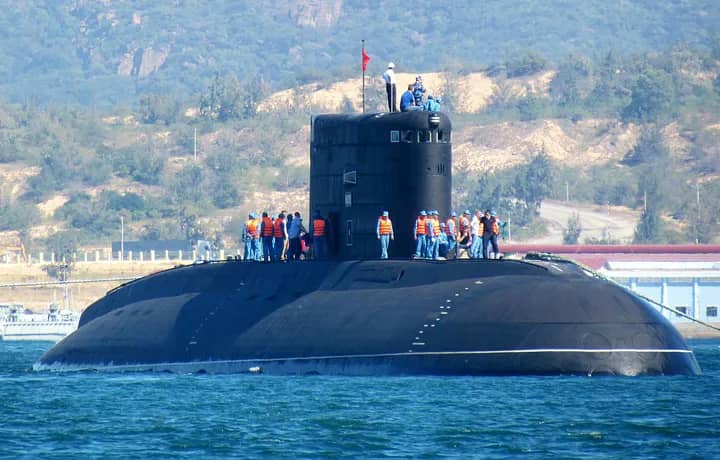
A Vietnamese Kilo submarine [medium. com].
Vietnam
In 2009 Vietnam signed a contract for 6 Russian constructed Project 636.1 Kilo [NATO reporting name] class boats, the Vietnam People's Navy or Hải quân nhân dân Việt Nam's 1st submarines.
Having been involved in a short but highly intense border war with China, having lost the Paracels in a military action to China and being a claimant in the Spratlys dispute, Vietnam's threat perceptions are centred on China and the threat posed by the People's Liberation Army's Navy [PLAN].
Equipped with long range missiles and heavy weight torpedos the Kilos provide Vietnam with a level of deterrence and in the event of hostilities provide it with the means to counter the PLAN in a way which would be hard to do with surface ships and aircraft.
Thailand
The Royal Thai Navy or kong thap ruea Thai became the 1st regional submarine operator when it acquired a class of 4 Mitsubishi constructed Matchanu class boats in the 1930s.
Although deployed during the Franco-Siam war these boats did not see any action.
Retired in the early 1950's these boats were not replaced, leading to a capability gap.
Thailand was later offered Chinese Romeo [NATO reporting name] class boats and later expressed a keen interest in former German Tyoe 206 boats but a deal remained elusive.
Approval was later granted to acquire a Chinese constructed S26T boat which is a variant of the Chinese operated Type 039A or Yuan [NATO reporting name] class but refusal by Germany to grant export approval for the MTU 396 engine prevented the deal from being awarded.
Quite unusually the Royal Thai Navy has a Submarine Day celebrated annually every September 4th, marking the day in 1937 when the first submarine was delivered.
Philippines
Like Indonesia the Philippines is an archipelagic nation which has a need legitimate need for submarines. Unlike Indonesia however the Philippines is a claimant in the Spratlys dispute and has borne the brunt of agressive Chinese actions in what the Philippines calls the West Philippine Sea.
Like many others the Philippines Navy or Hukbong Dagat ng Pilipinas sees submarines as providing asymmetrical value, as a deterrent against a Chinese military which enjoys a qualitative and numerical edge.
With a limited budget and the need to address other requirements, sufficient funding to acquire and later maintain even a small submarine force, plus the setting up of a required shore support infrastructure, remains a major challenge.
The leading contender to fulfil the requirement is the Scorpene." - March 10, 2025
The writer has long had an interest in military and geo-strategic affairs and has been a contributor to a number of publications.


_twitter_pic_01022021.PNG)