
THE wife of Penang Chief Minister, Tan Lean Kee, has called on hawkers and food vendors to support environmental efforts by offering small discounts to customers who bring their own biodegradable food containers.
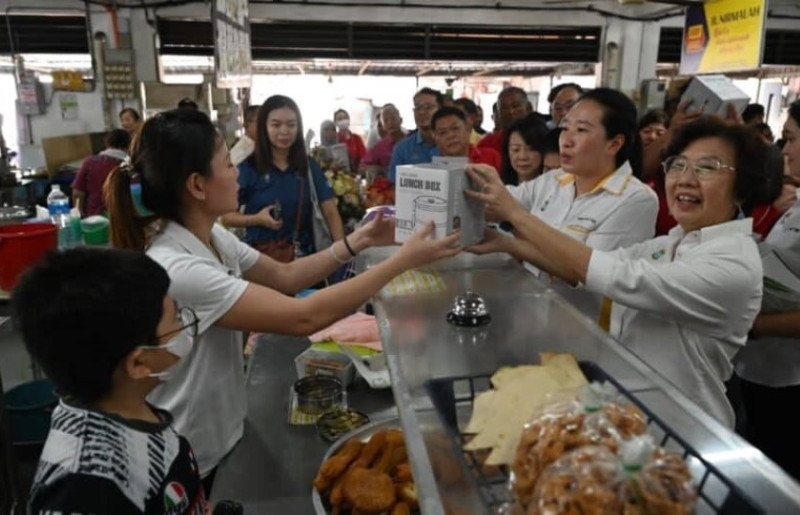
Speaking at the launch of an anti-plastic campaign at the Bagan Ajam wet market recycling centre, Tan said such incentives could significantly shift public habits in favour of sustainability, particularly at food stalls and hawker centres which continue to rely heavily on plastic packaging.
“This initiative will stimulate more people in Penang to discard the reliance on plastic packaging by bringing their own biodegradable containers to pack food and drinks, especially at their favourite food and hawker joints,” she said.
Tan, who leads the Mutiara Women Association – a group representing spouses of elected representatives – also emphasised the role of tiffin carriers, noting their practicality and environmental benefits.
“Since 2019, the state government has adopted a proactive stand to reduce the use of plastic to prevent pollution. One of the key areas is at food and hawker places,” she said.
She acknowledged, however, that the Covid-19 pandemic had caused a resurgence in plastic use, and called for renewed efforts to reduce reliance on single-use materials.
“One way is to encourage food vendors and hawkers to offer discounts to those bringing in their own packaging,” she suggested, noting that even a 50 sen to RM1 reduction could be a worthwhile incentive.
Tan was joined at the campaign by Sungai Puyu assemblyperson Phee Syn Tze. Her father, veteran DAP leader Datuk Seri Phee Boon Poh, was among the early advocates for reducing plastic use in Penang.
She also cited New World Park as a positive example, where vendors are reportedly offering larger portions to customers who bring reusable containers.
Meanwhile, ongoing coastal clean-up studies at a 500-metre stretch in Bayan Lepas highlight the persistent challenge of plastic pollution.
In 2020, researchers recorded 37.3 plastic bags and 13.3 plastic straws per person per kilometre. While those figures declined slightly in 2021, they surged in 2022, with 16.5 bags and a sharp rise to 80.8 straws per person per kilometre. By 2023, the numbers dropped again to 6.1 and 17.2 respectively — a sign of improvement, though far from conclusive.
Tan stressed that grassroots initiatives and small behavioural changes are essential if Penang is to stay on track with its long-term environmental goals. - August 14, 2025