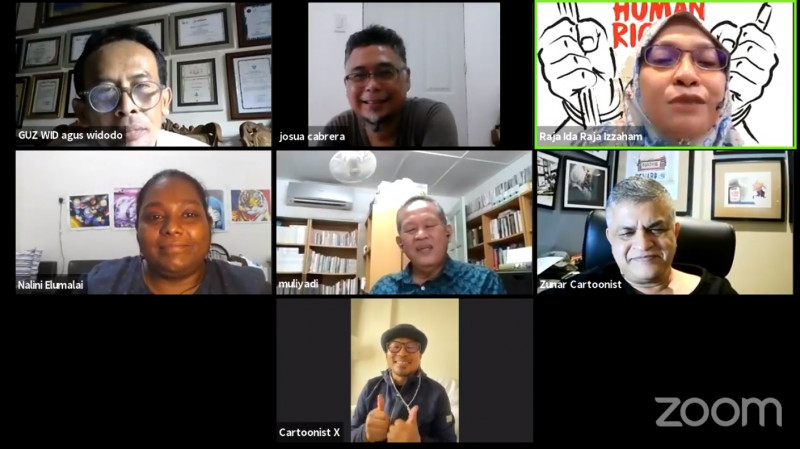

CARTOONISTS, critics, and political observers alike joined in on the first online forum held in conjunction with the Asean Human Rights Cartoon Exhibition to discuss the experience of political repression against art.
Themed ‘Cartoonist: Enemy of the State’, the two-hour long event also got cartoonists detailing their experiences and how it impacts a democratic society’s right towards freedom of expression.
Among those present as speakers were Filipino and Indonesian political cartoonists Josua Cabrera and Guzwid, Persatuan Kartunis Malaysia (Pekartun) founder Professor Dr Muliyadi Mahmood and non-profit Article 19 representative Nalini Elumalai, alongside organiser Zunar.
Roles to play
.jpg)
“The cultural system that we live in has certain players in it, and with each has roles to play,” shares cartoon critic Muliyadi Mahmood.
“The first – decision makers who formulate the policies and laws of a nation. Second, creators or in this case would be the artists who illuminate certain issues relevant to their society when matters such as corruption and abuse of power are at play.
“The audience and mediators, who are the people that appreciates the cartoons (ranging from professionals to the general public) and the critics/media respectively, would make up the last two,” he added.
He further says that these roles dictate the interpretations and degree of acceptance on what the artwork in question talks about.
“Cartoonists being labelled as the enemy of the state is not an isolated situation focused just within our region. One of which, is Rob Rogers who was fired from his editorial post after 25 years of being a political cartoonist for criticising the Trump administration.
“Why such a label (an enemy) associates closely when we talk about cartoonists is because cartoons are simple yet powerful – being able to condense very complex issues but also visually universal that garners quick and immediate response,” said Muliyadi.
“Authorities that clamp down on cartoonists are possibly not happy with the issues being raised where to some extent highlights their lack of openness towards criticism,” he added.
Layers of expression
“Freedom of expression is the fundamental right of a democracy,” said Nalini.
“Whether or not cartoonists are in fact the ‘enemy of the state’ requires us to understand the background of what constitute as the right to express.
“Artistic freedom cuts across all social, cultural, civic and political life – this is where we need to understand the layers of it.
“When you censor art, you are in effect censoring people’s awareness. While we push for enabling an enviroment that promotes dialogues that ensures our society (especially minorities) are not discriminated or taken for granted, we must also be mindful to note that freedom of expression is not absolute.
“Art or the political cartoons (in the context of human rights) should not create a hostile environment, and if it has, we must be able to look into it deeper.
Enlightening the masses
Hosted live on Craftora’s Facebook page, the forum is one of the two scheduled specially for audiences during the month-long exhibition.
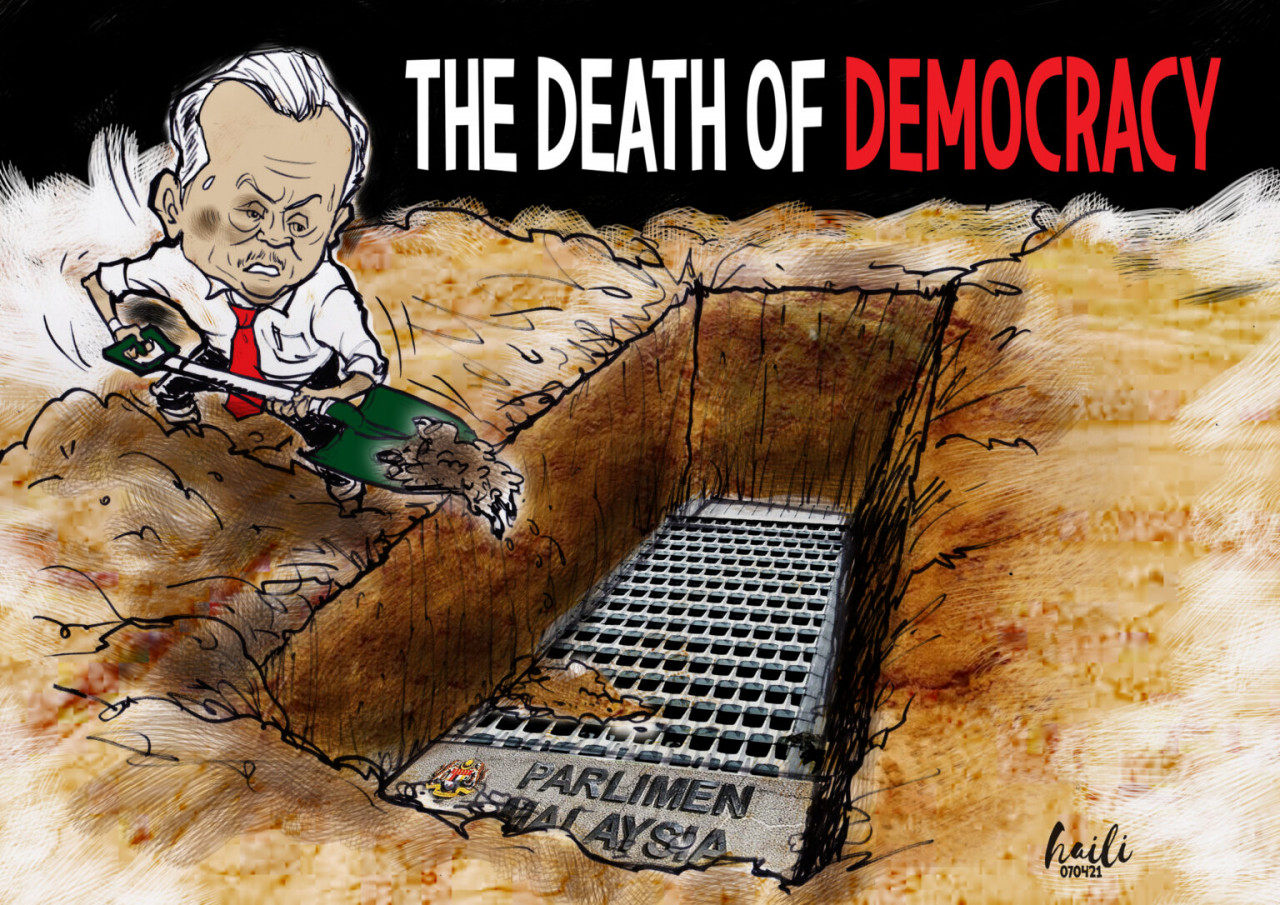
Silently joining the speakers was an unnamed cartoonist who was later revealed to be Haili, one of the 37 participating cartoonists whose work is displayed in the exhibition.
Explaining about his artwork, he notes, “[Parliament] is seen being burried (by our PM) because the state of affairs is as such – where the voice of the people is ignored”.
Cabrera joined him, sharing details behind his own artwork, an illustration of Philippine president Rodrigo Duterte with a “... pinnochio like nose, injecting the head of the ‘Juan dela Cruz’ (the national personification of the Philippine people).
“It is a response of how our government is (poorly) dealing with the pandemic and the vaccination rollout.
“We (the people) are being misled with lies that has left the nation divided – ones that are with (the government) and against.
“Corruption is very prevalent during the pandemic and I simply want the people in the Philippines to think very well and verify the information first before accepting everything the government says,” stressed Cabrera.
“Cartoonists are not the enemies of the state, but in fact a partner in building a nation through the artistry to achieve a shared vision.
“We are also able to contribute to helping enlighten everyone, including leaders, to mirror themselves and see what is actually going on.
“The state of human rights depends on the political condition of the country,” expressed Indonesian cartoonist Guzwid.
“In Indonesia, we do not face challenges when it comes to expression by political powers, but more on how we are able to fare against a rapidly progressing medium – from hard copy to virtual.
“For a political cartoonist, their work will see a dynamic progression, which relies on the ups and downs of the issue being questioned,” he shared.
“Political cartoons are able to cleverly highlight what has not been done by the state to ensure livelihood of its nation is cared for."
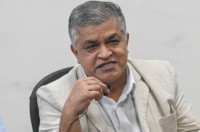
Programme director Zunar, who was recently called in by the police for an investigation against his cartoon released earlier in the year – depicting the ruling for the Thaipussam celebrations in Kedah – spoke publicly for the first time after being interrogated.
“More than 20 questions were asked by authorities where I am investigated under the Penal Code Section 505 and the Communications and Multimedia Act Section 233.
“I am not new to this as it would be my 10th investigation by far being intimidated by the government.
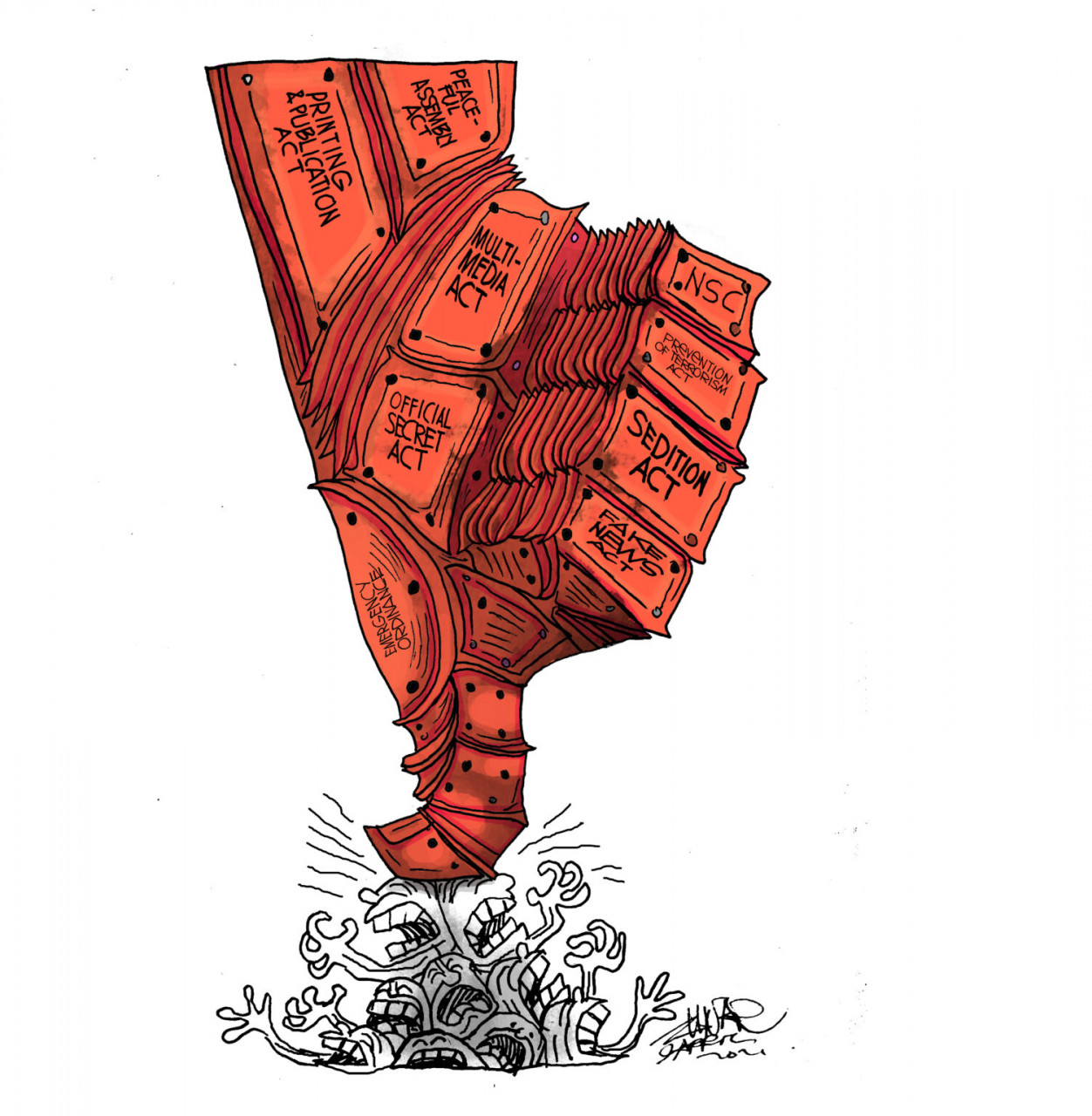
“The problem with all these laws is that it gives political leaders the ease of deciding what is right and wrong. You can be having breakfast, and suddenly be told that what you are doing is seditious.
“The cartoon I submitted for this exhibition highlights that, how our oppresive rulers is using the laws (through an iron fist approach) to silence whoever dares to question.
Additionally, he notes, “... we discovered more than a hundred attempts to hack the website and it came from more than 50 different IPs. But so far, no damage."
There were more than 100 attempts to hacked craftora.com, the server hosting the exhibition.
Themed ‘Human Rights in My Country’ the exhibition showcases 100 hard-hitting cartoons by 37 cartoonists from the Asean region. There are 13 from Malaysia (including Zunar), 13 from Indonesia, 4 from Thailand, 6 from the Philippines and one cartoonist representing Myanmar. The exhibition is going on until May 29th and can be accessed at Craftora.com.
Revisit the discussion of the main forum, Cartoonist: Enemy of the State at https://fb.watch/5m41aLUoMy/ – The Vibes, May 8, 2021
.jpeg)
_stars_as_Mahathir_Mohamad._–_Pic_courtesy_of_Bianglala_Entertainment.jpeg-1.jpeg)