.jpg)
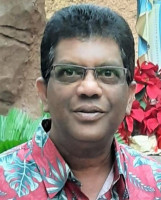
DEATH, tears, and grief are what make the day for funeral directors. But rarely do thoughts of their own death and funeral come to their mind, though some people would think it is a shame for funeral directors not to be able to witness their own funeral.
Last year Christopher Jude Anthony came close to staring at his death in all its frosty un-welcomeness. For the first time, death’s warning lights blinked on Anthony, the director of Trinity Funeral Services in Kuala Lumpur.
The 54-year-old suddenly found himself in an ambulance with its beacon lights flashing and siren in full blast rushing him to the Universiti Malaya Medical Centre (UMMC) from his house in Kota Kemuning, Shah Alam.
It was May 28 when Anthony was nothing more than a mere statistic, being among the 8,290 Covid-19 cases announced by the daily television bulletin that evening.
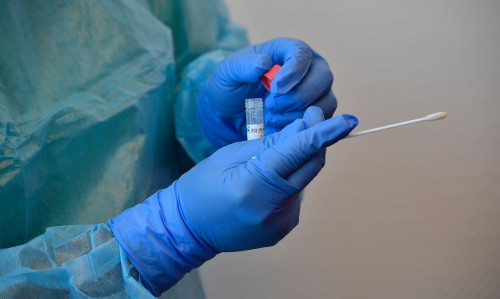
Just days earlier Anthony felt feverish and a little out of sorts. He went to a clinic and the doctor tested him and found him to be Covid-19 positive. Anthony went home, took a bath, took two Panadol, and took a nap. At 4pm, an officer from the Health Ministry called to say that an ambulance was on its way to pick him up.
“I do not know at what stage of the infection I was in at that time. I was standing on my feet, not distressed in any way, and needed no help to board the ambulance. There was another patient, too, who had been picked up from her house due to the same infection. She, too, seemed to be fine.”
At the hospital’s emergency room, Anthony was placed on a couch and told to rest. That was the last thing he remembers on arriving at the medical facility. “Things escalated from here onwards,” Anthony tells The Vibes.
52 days in limbo
Anthony became conscious only after 52 days. He felt strange and realised that he was in the intensive care unit (ICU). All around him patient-monitoring machines beeped and blinked. It was such a dismal rhythm in the cheerless and all-too-sterile hospital ambience.
Anthony’s throat felt sore and he was thirsty. The medical staff was all wearing protective suits. He simply felt that he did not belong to that icy-cold and adverse intensive care ward.
He said: “I felt like I was in a ‘sci-fi world’ and just wanted to go home.”
Nurses told Anthony it had been 52 days since his admission. He was also informed that he was put under an induced coma and had been intubated with a ventilator to support his breathing and increase his depleted oxygen saturation level.
.jpg)
He was informed that the infection had critically affected his upper respiratory tract and his lungs.
“I was shocked to know that I had been in that immobilised state for 52 days. No wonder the searing pain in my back. I had developed bed sores due to the long period of being immobilised. More than this, cold fear overwhelmed me when I came to the realisation that I had come so close to death’s door.”
Seven days after he came to, Anthony’s family was able to organise a simple “phone-connection mode” to communicate with him with the help of medical staff, as all Covid-19 wards and ICUs are out of bounds to family members of patients. Anthony communicated with his family via Zoom.
“I could not talk much as I felt tired most of the time. I had brief chats and cried most of the time. A funeral director in tears is unheard of. And there I was, down and out, physically and emotionally. They say it takes a great man to cry. Yes and indeed so, I was there. I felt it was OK for now to be that great man, to let go of all inhibitions and be humble before God.
“I told my siblings how much I loved them and missed them. This is something I had taken for granted before and had rarely expressed my softer side openly.
“I promised my family, I will be a different person once I got back home alive. I promised to love more, to care more, and to be more patient as I have naturally been a very temperamental person. I prayed earnestly in my silent thoughts as well. Even trying to bargain with God, telling Him why he should spare my life.”
Pre-occupied with death
The days after Anthony was eased out from the induced coma were difficult. While lying in bed, he was conscious and aware of the things happening around him. He was aware that the virus can turn nasty even while patients are recovering.
He was also aware that infected patients may show no symptoms. They could be walking and talking just like any other person, but only to become too ill the next minute and be listed as brought-in-dead (BID) at the hospital.
“That is what happened to me. I felt fine, I just showed some mild symptoms. I was plain lucky that my infection took a turn for the worst only at the emergency room. I dread to think what would have happened to me if that ambulance did not pick me up that day. Maybe I would be another BID case.”
Anthony was still not out of the woods while recovering in the ward. He did not feel safe in the hospital. He knew that the Covid-19 ward was itself a thriving seedbed for the virus and infection can spread like wildfire in such a setting.
Thoughts of his death were a major pre-occupation. Having been a funeral director who has seen to the burial and cremation of many, he wondered what would it be like to be at the opposite end of a funeral wake and requiem.
Each time the steel gurney from the morgue entered the ward announcing its arrival with an ominous clanking sound – a cold shiver ran up his spine. Anthony hated that clangouring rattle of metal against metal. It felt like an intimidating and uncanny death knell for him.
“Whenever that sound is heard in the ward, it means an infected victim has lost the battle against the virus and the mortuary attendants have arrived to retrieve the body. I was told the dead are put into body bags, disinfected, and disposed of with just some silently whispered prayers, minus the rituals and ceremonies.
“During sleepless nights in my silent vigil, the sound of the gurney’s arrival and departure was most forbidding. It was not something nice to hear at such an unearthly hour but it did make me reflect on my fragility and wonder what would my funeral be like?
“But saved by Grace, my funeral did not happen as yet. God has blessed me with another chance at life, thanks to all the prayers raised by my family and friends.”
Back from the brink and on his feet, Anthony, a former student of Montfort Boys’ Town who was trained in graphic science and printing, is now ready to continue his vocation which he perceives as an apostolate in the bereavement ministry.
Firm in his belief that the end of life deserves as much beauty, care, and respect as the beginning, Trinity Funeral Services embraces its mission with a charitable narrative reading “Simplifying life’s most vulnerable decisions” as its signature catchword. – The Vibes, March 22, 2022