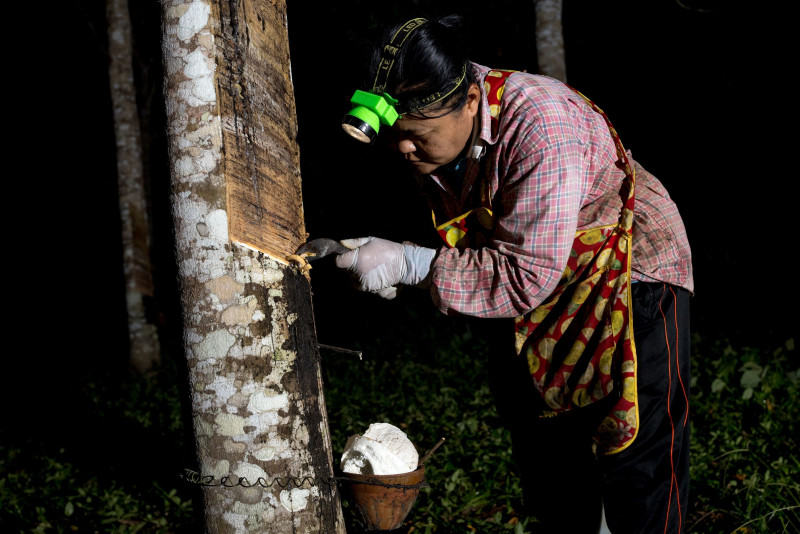
BANGKOK – By the light of a head torch, Wanida Hityim deftly strips bark from a rubber tree, collecting the milky latex as she explains why she's among a small number of Thai farmers trying to work more sustainably.
As the world's largest producer of natural rubber – supplying more than a third of global stocks in 2021 – Thailand's policies have stimulated massive deforestation, plummeting biodiversity and soaring soil erosion.
The vast majority of the kingdom's plantations are still worked conventionally, but a few farmers like Wanida are abandoning pesticides to try and lessen their impact on the environment.
And while money is her bottom line, Wanida also sees the small-scale benefits of turning to greener methods.
"This place even has worms in the soil," she said of her 1.5-hectare plot in the southern province of Surat Thani, home to about 500 trees.
"Plantations that use pesticides wouldn't have nature like this because the chemicals they use would just ruin the soil," the 41-year-old told AFP.
Wanida is one of a few Thai farmers to have received the international non-profit Forest Stewardship Council (FSC) certificate, which encourages the sustainable use of forests.
FSC is not without its critics. Grant Rosoman, a senior advisor to Greenpeace International, warned it is vulnerable to industry pressure and manipulation.
"All certification schemes have problems with auditors which are paid by clients, the companies," Rosoman told AFP.
"There is a financial conflict of interest between who is paying and the auditor."
'Right time, right message'
Adopting more sustainable methods has enabled Wanida to sell her rubber at a higher price, earning her around US$650 (RM2,880) a month instead of US$550.
Thailand exported nearly US$6 billion of rubber in 2021, the vast majority of it produced by small-scale farmers who sell to middlemen – so financial incentives are key to changing methods.
"When I talk about sustainable development for the first time, people look at me with a smile and a big question mark on their face," said Maiprae Loyen, co-founder of Agriac, a rubber intermediary set up in 2019 to promote good practices among farmers in southern Thailand.
The firm works with roughly 1,000 small farmers – 60% of them women – many of whom previously thought environmentally friendly methods were a "burden", said Maiprae.
But they were convinced by both the financial returns – Agriac offers a three baht bonus per FSC-approved kilogram sold – and also the ecological benefits, she said.
Later she pointed to the cracked soil of another rubber plantation in Surat Thani, the result of unsustainable "chemical products".
"It's time that people start to understand that the value of things is not defined by price tag," she said.
"It's the right time, the right message."
China drag
But Agriac farmers are just a few leaves in the forest of Thailand's rubber industry: only two percent of the nation's roughly 3.2 million hectares of plantations are worked under FSC guidelines.
In December the European Union agreed to ban the import of rubber deemed to contribute to deforestation, a move hailed as a milestone by green groups.
But the impact of this change on Thailand will be limited, said Krungsri Bank analyst Chaiwat Sowcharoensuk, because China – which accounts for almost half of the kingdom's market – does not prioritise sustainability.
While medium and large firms do cater to Western consumers, he said, the shift was yet to trickle down to smallholders.
"But if one day China announces a plan about sustainable rubber, then local farmers would pay attention," he said.
"If they can't sell their rubber, then they would take action."
Rosoman of Greenpeace said that with question marks hanging over certification schemes such as FSC, tougher regulation like that imposed by the EU will be key to sustainability.
The future of natural rubber should be "very bright" he said, as the alternative – synthetic rubber produced from oil – is highly polluting.
For Wanida, out tapping her trees at 3am with her faithful dogs yapping at her heels, rubber is in her blood.
Passed down from her grandfather to her father, the plantation might be taking a new direction under her care.
But, she says, "I'm still a rubber farmer through and through". – AFP, February 27, 2023




.jpeg)