By Murray Hunter
MOST will remember the dramatic assassination of North Korean leader Kim Jong-Um’s half-brother Kim Jong-Nam at the Kuala Lumpur International Airport back in 2017.
The assassination was just like something out of a James Bond or Mission Impossible script.
It’s very rare that Malaysians are made aware of clandestine intelligence operations going on in Malaysia.
Malaysia, just like the rest of ASEAN, is a target for foreign soft power and intelligence operations.
These activities are undertaken by agents of various countries, focused on collecting intelligence, seeking political influence, assisting their nationals’ commercial activities, and disseminating information and propaganda.
These activities centre around the nation’s corridors of power, the defence establishment, the commercial arena, academic circles, and the public at large.
The objectives of undertaking intelligence and utilising various forms of soft power include;
· Influencing Malaysia’s defence and foreign policies
· Undertaking political, economic, and commercial information gathering,
· Gaining commercial advantages and furthering commercial interests,
· Influencing Malaysian citizens both culturally and religiously, and
· Observing their own diaspora.
Clandestine operations, as was seen with the assassination of Kim Jong-Nam, do occur, but the public rarely becomes aware.
Just as the Malaysian External Intelligence Organisation (MEIO) reportedly has more than 1,000 operatives overseas, foreign agencies have their own operatives; many are housed at foreign embassy complexes. In addition, there are sponsored or paid operatives who operate freelance within Malaysia, usually on an ad hoc basis.
Some of these foreign agents are clearly identifiable and here on an official basis, while others can be fairly easily spotted and identified.
External attempts to influence Malaysians in politics and business began in the 1950s with both the Colombo Plan and the Fulbright Student Program, which were sophisticated attempts to guide and influence Malaysian post-independence students into thinking favourably towards Britain and the United States.
Since those early days, many nations have carried out and sought to influence Malaysia.
The United States
The International Republican Institute (IRI) President Daniel Twining claimed the US played a role in the victory over UMNO in 2018, a political party that held power for 61 years.
The United States has long been involved in attempting to influence politics and society within Malaysia.
The US has a large intelligence capability housed within its embassy in Jalan Ampang. There are also a number of unofficial satellite offices around the country.
The allegations made by the PAS leader Tan Sri Abdul Hadi Awang are not new or confined to Malaysia.
Back in 2023, the US embassy in Bangkok was also accused of meddling in the affairs of Thai politics through its support for Move Forward, which won the popular vote in the 2023 and 2026 general elections.
From Twining’s omission, it can be assumed similar operations have occurred in Malaysia.
Most US funding into Malaysia came through the now-defunct USAID and the National Endowment for Democracy (NED), and its affiliates.
The US long considered Malaysia a strategic partner in the fight against communist expansion during the Cold War.
However, over the last decade Malaysia has sought to improve bilateral relations with Beijing, abandoning its Cold War stance. This has concerned the US State Department in its pivot to Asia.During the lead-up to the 2018 general election, the NED reportedly directly and indirectly funded many pro-democracy, human rights, anti-corruption NGOs, and liberal leaning news portals.
In 2022, the NED, through INVOKE Taiwan, is alleged to have funded the expansion of Datuk Seri Rafizi Ramli’s election analytics firm INVOKE.
This was the primary reason the MACC raided the INVOKE offices in 2022.
In a 2022 NED country report, the organisation reported that it had directly spent USD 1.6 million on operations in Malaysia.
The NED had financed local academics and journalists.
Through affiliates like the Centre for International Private Enterprise (CIPE), a number of local think tanks have been financed.
There are numerous relationships between the NED, its affiliates, and local organisations and political parties in Malaysia.
One has to delve a little bit into the sources of funding of these organisations, much of which is on public record.
China
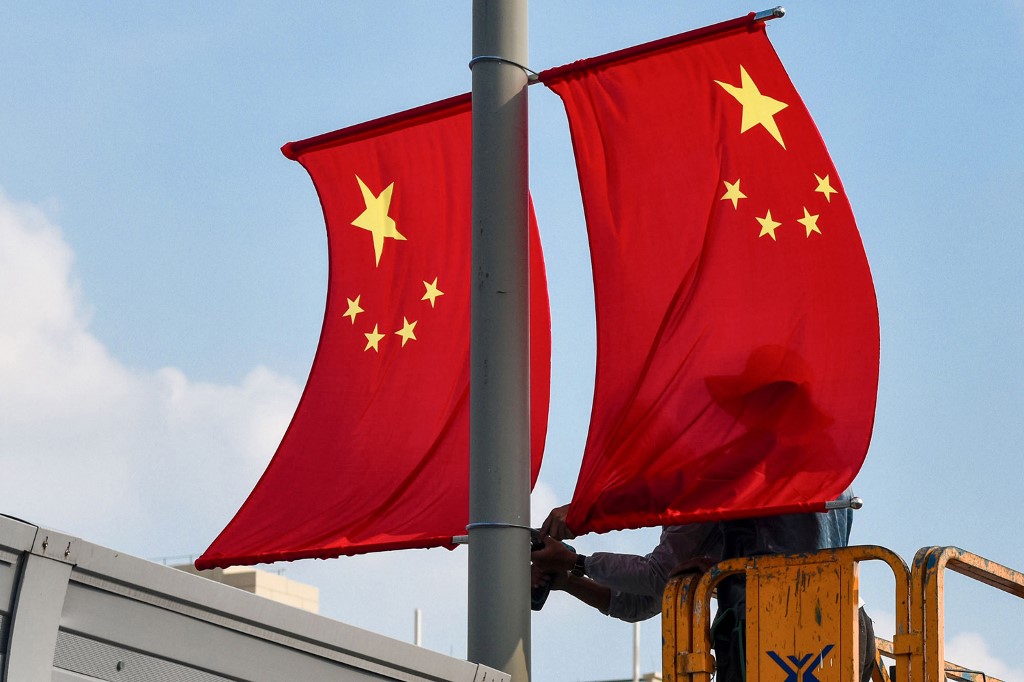
The major objective of China is to influence Malaysian foreign policy towards Chinese interests.
China had a very close relationship with Malaysia during the Datuk Seri Najib Razak era, which stepped back slightly under Tun Dr Mahathir Mohamed.
It's yet to be seen how close Malaysia will be to China under Datuk Seri Anwar Ibrahim.
Nevertheless, China has a massive intelligence presence in Malaysia, probably only second to the United States.
China’s equivalent to the NED is the CCP United Front Work Department (UFWD). However, the UFWD is much more hands-on than the NED.
The UFWD is much more involved in grassroots activities, particularly through the Malaysian Chinese communities.
China influences local Chinese media through networking with the owners and journalists, and providing content.
Chinese diplomats in Malaysia also write frequent Op-eds.
Confucius Institutes in several Malaysian universities teach Chinese language, culture and history.
They have been criticised in a number of Western countries for providing a slanted view of China.
This is disputed by Chinese scholars.
The UFWD is alleged to have close ties with the MCA, and assists in the funding of several cultural and business programs across the country.
The UFWD has cultivated politicians, journalists, and academics over the years, facilitating visits to China.
China’s influence in Malaysian politics and society is a very scantily studied area, which needs much more attention.
Saudi Arabia
Saudi Arabia has extensively focused on and propagated the spread of its Islamic doctrines in Malaysia over the last 30 years. This is partly dakwah and partly an attempt to stem the spread of the Muslim Brotherhood’s influence in Malaysia.
There is a proxy war between two Islamic doctrines in Malaysia today.
Saudi Arabia funds Islamic schools, sends teachers, assists in the building of mosques, and provides scholarships to Saudi Arabia for students to study Islam.
More controversially, an organisation dubbed the Alumni, made up of Islamic graduates, primarily from the MENA region, is provided with a monthly allowance to spread the word of Islam within their workplaces in an apolitical manner. Members of the Alumni exist within the civil service, military, schools, universities, and top echelons of government.
Thailand
There is a lot of uncorroborated evidence of Thai security forces running clandestine operations in Malaysia against political opponents and criminal elements.
There was a dead body of a Malaysian national, Zahri Bin Abdullah, floating in the Kolok River, which runs along the Thai-Malaysian border back in 2023.
The Royal Thai Army claims Zahri was a member of the BRN youth insurgency wing. Zahri had been a resident of Rantau Panjang, a town on the Malaysian side of the border, for many years.
News reports indicate Thai security personnel in three cars came across the border, abducting Zahri in the open.
His tortured body was found in the Kolok River. This incident was reported in the Thai media, but largely unreported in Malaysia.
World Economic Forum (WEF)
The WEF has an agenda to centralise governments and introduce policies that favour a centralised approach to solving world problems. A number of local politicians are members of the WEF.
These include Tengku Zafrul Tengku Abul Aziz, Hannah Yeoh, Syed Saddiq Syed Abdul Rahman, Datuk Seri Mustapa Mohamed, Khairy Jamaluddin, and entrepreneur Vijay Eswaran.
AirAsia, Khazanah, Astro, Axiah, and CIMB are corporate members.
Khairy Jamaluddin was elected vice president of the WHO World Health Assembly and was instrumental in pushing for WHO recommendations on public health emergencies to be mandatory for governments to follow.
Malaysia has hosted at least four major WEF events in the region, and WEF economic policies such as Industry 4.0 have been incorporated into Malaysia’s national policy.
There is much foreign influence on Malaysia’s government and society from many quarters.
The examples above come from publicly available information. Under the surface, there could be much more.
Anwar Ibrahim and strategic independence
There is, however, an important distinction between foreign powers attempting to influence Malaysia and actually controlling Malaysian policy.
Whatever one’s domestic political view of Anwar Ibrahim, his foreign policy since taking office provides little evidence that Malaysia under his leadership is simply following the agenda of any particular power bloc.
If anything, his positions have sometimes irritated almost everybody.
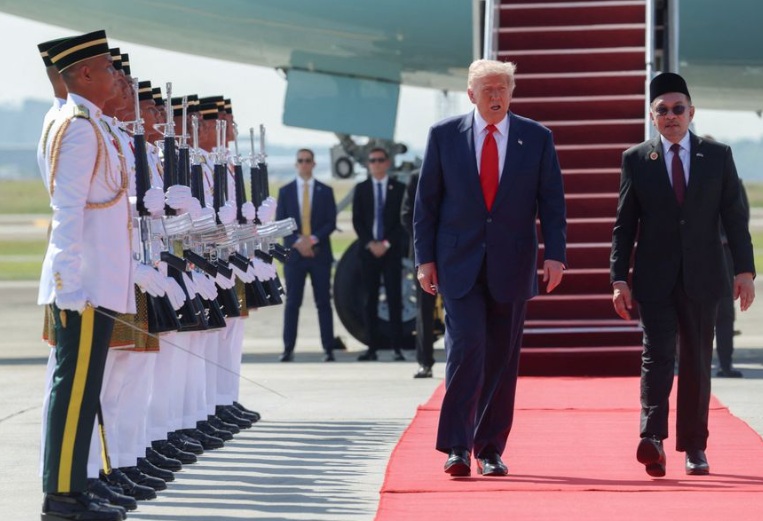
Anwar has maintained good relations with Washington and Europe while being one of the Muslim world’s most outspoken political leaders on Gaza and sharply criticising Western support for Israel. At the same time, Malaysia continues to engage economically and diplomatically with the United States.
He has strengthened relations with China and recently reaffirmed Malaysia’s longstanding One China policy — including a position on Taiwan strong enough to provoke a public rebuke from Taipei — yet Malaysia continues to describe peaceful resolution and Malaysian national interests as central to its policy.
Nor has closer engagement with China prevented Anwar from expanding Malaysia’s relationship with India. Narendra Modi’s February 2026 visit produced an extensive strengthening of the Malaysia–India Comprehensive Strategic Partnership, covering defence, security, semiconductors, trade, technology and other areas.
At the same time, Anwar has been willing to engage Russia when much of the Western world has sought to isolate Moscow.
Malaysia has characterised this engagement not as choosing Russia over the West, but as exercising the country’s longstanding strategic autonomy.
Malaysia is simultaneously developing relations across South Asia. Anwar has strengthened ties with India while maintaining Malaysia’s relationships elsewhere in the region, including Bangladesh, whose new Prime Minister Tarique Rahman chose Malaysia for his first official bilateral visit abroad in June 2026.
There is a pattern here.
Washington cannot reasonably claim Anwar as its man. Neither can Beijing. Neither can Moscow, New Delhi, nor Brussels.
Indeed, Anwar himself has described Malaysia’s approach very simply: friendship with the major powers does not mean surrendering Malaysia’s principles or national interests.
That does not mean foreign governments will stop attempting to influence Malaysia. They will not. Every serious power pursues its interests.
But influence attempted is not necessarily influence achieved.
Malaysia’s present foreign policy increasingly resembles the traditional ASEAN instinct of strategic autonomy: talk to America, trade with China, engage Russia, deepen relations with India and the rest of Asia, disagree with the West when necessary, agree with it when Malaysian interests coincide, and refuse to be permanently placed inside anybody else’s geopolitical camp.
For a relatively small trading nation sitting at one of the world’s most strategically important crossroads, that may not merely be independence.
It may be a necessity. – September 10, 2026