WHETHER it's being used to compile articles for the media or to write a history report or even compose a love letter, individuals are finding a wide range of 'uses' for ChatGPT or are at least experimenting with the AI in a range of domains, with varying success.
Whether we like it or not, artificial intelligence is the buzzword of the moment and could even be leading to a new digital revolution. However innovative it may be, the use of AI in the culinary world actually isn't so new. We explain.
Six pounds (2.7kg) pale malt, 8 oz (227g) of oats, 1 lb (454 g) of flaked wheat and as much flaked oats as well as a teaspoon of Irish moss...
This is an excerpt from the recipe for a beer recently made by a Canadian brewery based in Vancouver, presented by CBC, Canada's national public broadcaster.
This sequence of instructions for making a beer is, on the face of it, quite ordinary, except that it was actually generated by ChatGPT, the famous conversational agent developed by OpenAI that is being tested out in a host of areas.
When it comes to beer, the AI appears to know what it's doing, since Whistle Buoy Brewing took the project from experimenting to production, introducing the beer on the market a few weeks ago. It was, rather appropriately, given the name Robo Beer.
While it may seem to be an amusing or offbeat one-off project, in fact, when it comes to food preparation, AI has been put to use for many years.
Of course, the latest innovations, such as AI Food Generator, which creates photos of dishes with just a few keywords, brings a new dimension to such uses.
But, training algorithms to simulate human thought processes is already a part of the operations of various companies working in the food industry.
Finnish company Valio recently used it to develop what it considers to be the most perfect chocolate.
More than 1.5 million comments and reviews posted on social networks about milk chocolate were fed into a software programme to develop a recipe based on the most shared taste preferences.
The result is a bar composed of five layers, each with a different flavour and texture, based on AI's recommendations.
These are just a few examples of how AI can be useful when it comes to cooking, particularly in the creation of recipes. An area with a history of innovation highlighted by specialised blog The Spoon.
In 2015, an app called Chef Watson generated recipes suggested by an IBM "supercomputer" that compiled three types of data: real recipes, data about the aromatic compounds of thousands of ingredients and data about how humans perceive flavours.
More recently, Estonian start-up Yummy unveiled an AI that kills two birds with one stone, not only suggesting recipes based on dietary restrictions but also generating a photo of the dish in question.
From theory to practice
Artificial intelligence is not only able to propose recipes, it can also help make them.
At a time when the food industry is looking to various innovations to reduce its carbon footprint in the context of climate change, it can be used as a tool for the research and development of plant-based alternatives.
It's an axe touted in a report published by ProVeg International, a German non-profit organization that promotes transforming the food system to a model with more plant-based options.
The document states that by compiling data on consumer preferences, flavour pairing and mimicking and cost constraints, it's possible to hone in on developing the 'right product," ie, one that is tasty, healthy and inexpensive.
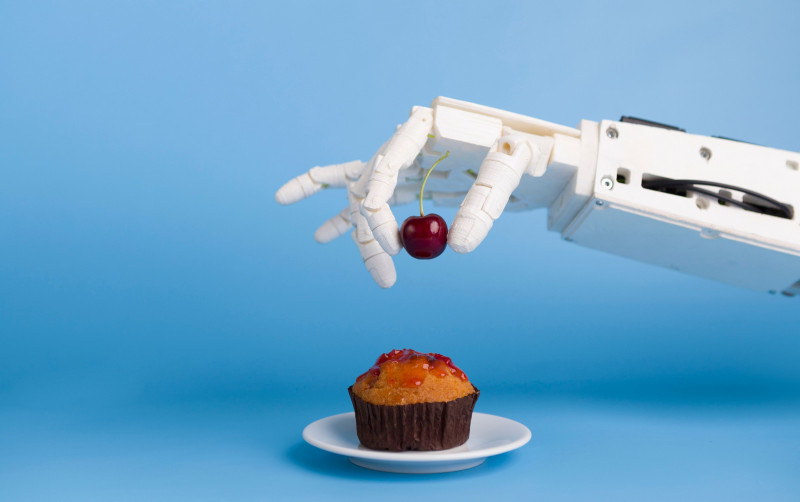
AI also plays a role behind the stove in the form of robots, which enable tedious tasks to be automated.
A year ago, the famous American fast-food chain White Castle announced it was expanding its use of robotic arms to dip potatoes into the fryer when the software says the time is right.
The chain signed a partnership with the start-up Miso Robotics, which has developed innovations that also determine the right moment to flip a burger patty.
Among the many uses of artificial intelligence in the kitchen, Californian start-up CloudChef envisions it as a way to capture the secrets of great chefs, for instance to know when to add this or that ingredient to a sauce, how many times to stir a stew or when to flip a piece of meat.
The company's technology consists in taking a whole series of measurements in order to transcribe a recipe and the gestures used to create it in an ultra-detailed form. – ETX Daily Up, March 7, 2023