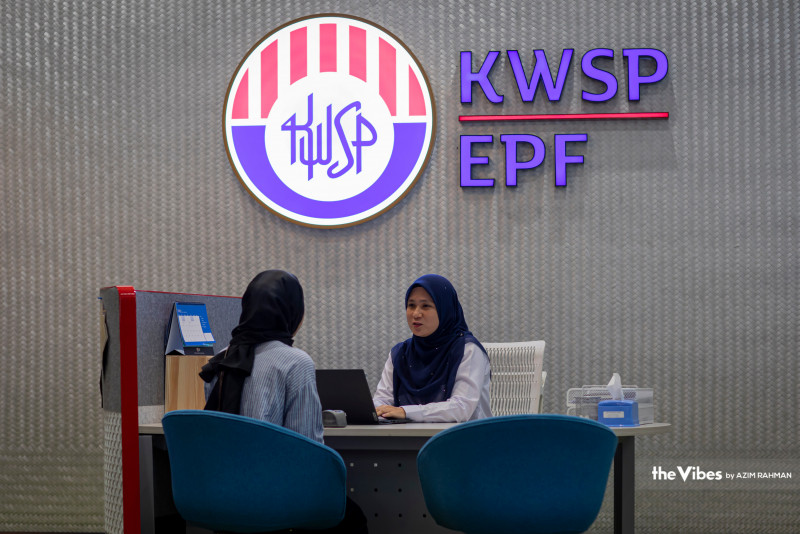
ECONOMISTS predict a positive boost to the national economy with the Employees Provident Fund (EPF) projecting RM5 billion in withdrawals from Akaun Fleksibel (Account 3),
They argue that the higher dividend payout and Akaun Fleksibel withdrawals will make EPF accounts more attractive than traditional savings accounts in banks, The Star reported today.
However, they caution that relying solely on these withdrawals for economic growth may not be sustainable.
Bank Muamalat Malaysia Bhd Chief Economist Mohd Afzanizam Abdul Rashid highlighted that private consumption already accounts for 61% of Malaysia’s GDP, with the country’s marginal propensity to consume (MPC) around 0.60.
“If EPF members spend their Account 3 withdrawals, it will contribute to GDP growth. But we should not rely solely on such withdrawals to drive the economy,” he said.
Afzanizam noted that based on past data, higher dividends and expanded Account 3 balances did not lead to irresponsible withdrawals.
“The EPF has revealed that 70% of its members prefer to keep their savings in the Akaun Fleksibel, with only 30% making withdrawals for various purposes,” he said.
He added, “It’s a matter of weighing the opportunity cost of spending the Account 3 withdrawal versus letting the money grow within the EPF.”
The EPF has consistently delivered high dividends, remaining above the long-term inflation rate of 2.5%.
In light of this, Afzanizam said that EPF contributors need to carefully consider whether to withdraw funds or allow their savings to grow until retirement.
“The compounding effect will accelerate the pace of accumulation, and ongoing contributions will increase the total returns for contributors,” he said.
To improve financial literacy, Afzanizam suggested a proactive approach by EPF to raise awareness about the importance of retirement savings, which could positively influence members' saving habits.
He also pointed to EPF’s latest Belanjawanku report, which includes the Retirement Income Adequacy (RIA) framework. This framework helps members assess their savings adequacy and align their savings with retirement goals.
Economist Geoffrey Williams echoed the sentiment, noting that with the total dividend payout amounting to RM73.24 billion, 10% of this, or RM7.324 billion, would be available in contributors’ Akaun Fleksibel.
“That could result in RM7.3 billion in potential extra consumer spending if it was all transferred and spent,” Williams said.
The founder and director of William Business Consultancy Sdn Bhd added that this could stimulate consumer spending and support economic growth. “With a multiplier effect, this could add between 1% and 1.2% to the GDP,” he explained.
However, Williams pointed out that this increase in GDP would be driven by a shift from savings to consumer spending, rather than an increase in actual productivity.
“It’s a demand-side boost to GDP, not supply-side growth,” he said, also noting that the EPF’s high dividends were risk-free and far more attractive compared to typical bank deposits.
“The Akaun Fleksibel allows withdrawals, making EPF accounts more appealing than traditional savings accounts. This has led to an increase in voluntary contributions,” Williams added.
On Saturday, the EPF announced that it had exceeded expectations by declaring a 6.3% dividend for both conventional and syariah accounts in 2024, its highest since 2017.
The total payout for conventional savings amounted to RM63.05 billion, while RM10.19 billion went to syariah accounts, bringing the overall dividend payout to RM73.24 billion.
EPF Chief Executive Officer Ahmad Zulqarnain Onn revealed that an average of RM400 million is withdrawn from Account 3 each month.
For this year, the retirement fund expects a total of RM11 billion to RM12 billion to be deposited into Akaun Fleksibel, with withdrawals projected to reach RM5 billion. – March 3, 2025