PRIME MINISTER Datuk Seri Anwar Ibrahim has expressed openness to Sabah pursuing the same oil and gas arrangements granted to Sarawak, including greater control over its petroleum resources.
However, he emphasised that such matters should be addressed through negotiation, not provocation.
Anwar said, “Why give it to Sarawak and not yet to Sabah? I have no problem at all. We negotiated. I have no issue giving Sabah the same priority — including on oil and gas.”
He clarified that the federal government's settlement with Sarawak was achieved through formal negotiations between Petronas and Sarawak’s state-owned oil and gas company, Petroleum Sarawak Berhad (Petros). Anwar personally intervened to ensure the matter was resolved amicably.
“At the end of the day, I asked the ministers to sit down, and I myself negotiated directly with Sarawak Premier Abang Johari Openg,” he said. “We settled it in a way that respected the national interest, the federal framework under the Petroleum Development Act 1974, and Sarawak’s rights.”
The agreement allowed Petros to take a lead role in regulating and commercially managing Sarawak’s oil and gas resources, while maintaining Petronas’ role as the national oil company.
Anwar stated that similar negotiations could take place with Sabah but warned against raising the issue through political grandstanding. “That’s the harmony we created. It doesn’t mean others cannot ask. But don’t act like one state wants to break away. Let’s find solutions — not shout on the streets or play to emotions,” he said.
He stressed that any resource agreement must ultimately serve the people. “Let’s sit down and talk — and make sure the benefits reach the people on the ground.”
Calls for a larger share of oil and gas revenue have long featured in Sabah’s political discourse. The recent deal with Sarawak has renewed public pressure for Sabah to receive similar recognition under the Malaysia Agreement 1963 (MA63).
Anwar reiterated his commitment to unity and institutional reform, stating, “Don’t win by shouting and insulting. Win through negotiations that uplift the state and its people.”
Corruption Must Be Tackled with Law, Not Accusations and Outrage
Meanwhile, Anwar stressed that corruption in Malaysia must be addressed firmly through legal principles and due process, not by fuelling public perception, spreading slander or resorting to abusive rhetoric.
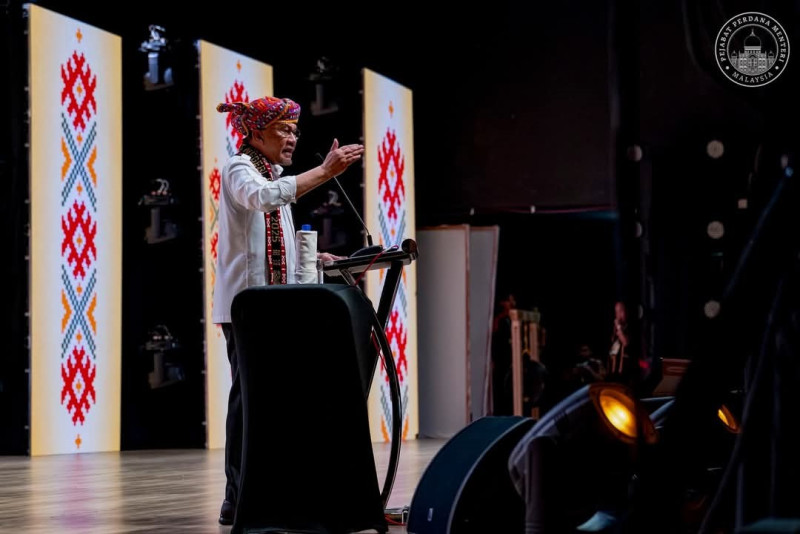
Speaking at the state-level Kaamatan Festival celebration in Penampang, Sabah, Anwar underscored the government's commitment to upholding justice and the rule of law under the MADANI administration.
“This country must be governed by law, not by perception, not by accusation or slander,” he said. “We will not allow leaders to plunder the wealth of the state and nation to enrich themselves while the people continue to suffer.”
Addressing a recent viral video allegedly implicating a Sabah state assemblyman in a corruption scandal, Anwar confirmed that the Malaysian Anti-Corruption Commission (MACC) was conducting an investigation based on legal procedures.
He expressed disappointment at certain quarters attempting to create the perception that the government was covering up the matter.
“The accusation that we are covering up corruption cases is merely perception. It’s a narrative, especially in urban areas, suggesting efforts to conceal wrongdoing — they want the people to believe this country is unsafe,” he said.
Anwar emphasised that the investigation remains ongoing and urged all parties to give the MACC the space it needs to complete its work. He also reiterated that he has not, and will not, interfere in such cases despite holding the office of Prime Minister.
“I am not a dictator. I follow the law. There is a process — investigations are the job of the MACC or the police, prosecution is the Attorney General’s role, and judgement lies with the judiciary,” he said. “As Prime Minister, my duty is to ensure this system runs smoothly and effectively.”
He warned against returning to the practices of previous administrations, where due process was often circumvented. “The Prime Minister cannot investigate, prosecute and judge — that would be a dictatorship. We have experienced that before, and I know what it looks like. Do not ask me to repeat such a system,” Anwar said.
The event at Dewan Hongkod Koisaan was attended by Sabah Chief Minister Datuk Seri Hajiji Noor, Deputy Chief Minister II Datuk Seri Dr Joachim Gunsalam, and Kadazandusun Cultural Association (KDCA) President Tan Sri Joseph Pairin Kitingan. - May 30, 2025




.jpeg)