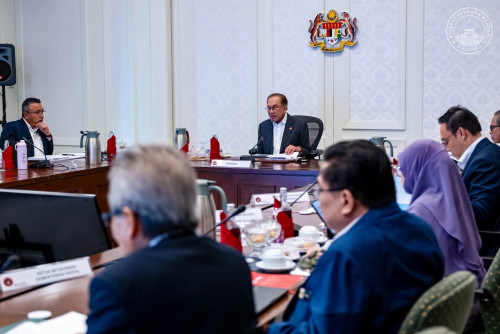
MALAYSIA must not passively await global stability but instead learn to steer through adversity, said Prime Minister Datuk Seri Anwar Ibrahim today.
Addressing a hall of senior policymakers, business leaders and academics at the opening of the Sasana Symposium 2025, hosted at Bank Negara Malaysia on Tuesday, the Prime Minister commended Bank Negara Malaysia for cultivating thoughtful public dialogue.
He emphasised that forums such as the Sasana Symposium should not remain theoretical but must inform and shape real-world policy.
Anwar said: “Reform is not a luxury. It is a national necessity,” warning against populist or superficial gestures. Instead, he stressed that structural reform must unlock long-term growth, advance broad-based prosperity and create buffers against future crises.
Recognising the headwinds of global uncertainty and geopolitical tensions, the Prime Minister stressed that Malaysia, as a small and open economy, must stay agile.
He explained that the MADANI Economic Framework provides a national compass, rooted in institutional strength and policy clarity.
He outlined two overarching commitments: modernising Malaysia’s industrial policies through digitalisation, green innovation and value chain enhancement, and ensuring that economic gains are equitably distributed, particularly to the underserved.
He detailed five reform priorities as part of this national vision at the symposium held at the Sasana Kijang in Kuala Lumpur.
First, fiscal sustainability will be supported by the Public Finance and Fiscal Responsibility Act and a medium-term consolidation strategy.
Second, subsidy rationalisation will be implemented to ensure that assistance is targeted at those most in need.
Third, tax reform will broaden the national revenue base without increasing the burden on low-income groups.
Fourth, human capital will be strengthened through technical and vocational education, digital skills development and labour market reforms. And, fifth, institutional integrity will be upheld through enhanced transparency and accountability across ministries and government-linked investment companies.
On the regional front, the Prime Minister reaffirmed Malaysia’s commitment to advancing ASEAN economic integration as Chair in 2025. He described ASEAN centrality as a “steady compass and a strategic counterbalance” amid global volatility.
The Prime Minister also underscored digital transformation as a key pillar of Malaysia’s future readiness.
Citing national strategies such as the Digital Economy Blueprint, the Financial Sector Blueprint and the Capital Market Masterplan, he noted Malaysia’s early foray into digital assets, having explored central bank digital currencies as early as 2017.
He officially launched the Digital Asset Innovation Hub, which he described as “a testament to Malaysia’s commitment to ensure policy evolves alongside innovation.”
The hub will provide a platform for testing initiatives such as programmable payments, ringgit-backed stablecoins and supply chain financing tools.
“Our ambition is clear: to align infrastructure, policy and talent, across both the public and private sectors, in pursuit of a digitally capable, future-ready Malaysia,” he said.
He stressed that technology should not be adopted for novelty’s sake but must be rooted in trust, shaped by transparency and designed to serve national and regional interests.
On domestic priorities, the Prime Minister addressed growing concern over the rising cost of private healthcare. “This is not simply an economic concern; it is a matter of national well-being,” he said.
To this end, he announced the formation of a joint ministerial committee between the Ministry of Finance and the Ministry of Health to lead reform efforts. He described the new direction as “a fundamental shift towards a value-based private healthcare system that prioritises outcomes, transparency and fairness.”
Reform measures will include clearer medical pricing, stronger integration of digital healthcare services and the introduction of a universal base medical insurance product.
A dedicated session led by the Ministry of Health, Ministry of Finance and Bank Negara Malaysia is scheduled to explore these efforts in greater detail.
Anwar reiterated the Government’s resolve to deliver sustained and meaningful reform under the MADANI framework. “Like seasoned navigators, we must and will stay the course, especially when the waters are uncharted and the conditions uncertain,” he said.
“Even small shifts in direction, when taken with consistency and purpose, can alter the course of a nation, shaping a future where the economy serves not the few, but uplifts the many.” - June 17, 2025