TARIFFS imposed by United States President Donald Trump on imports from ASEAN member states are likely to drive the region to deepen trade relations with alternative partners such as China and India, while damaging Washington’s standing as a reliable economically in Southeast Asia, according to a regional affairs expert.
In an interview with RIA Novosti, Associate Professor Khoo Ying Hooi, who lectures in International Relations and Human Rights at the University of Malaya, said Washington’s latest protectionist move would only hasten ASEAN’s existing efforts to diversify its trade relationships.
On Monday, President Trump issued a series of formal trade notifications to foreign governments outlining revised import tariff structures.
Among the hardest hit within ASEAN, Laos and Myanmar face the highest tariffs at 40 per cent. Cambodia and Thailand are subject to 36 per cent, Indonesia 32 per cent, while Malaysia faces a 25 per cent import duty.
“In many respects, ASEAN’s reorientation of its exports away from the United States is already underway,” said Khoo. “We are seeing ASEAN states strengthening trade ties through multilateral agreements such as the RCEP (Regional Comprehensive Economic Partnership) and CPTPP (Comprehensive and Progressive Agreement for Trans-Pacific Partnership).”
Khoo noted that China is the most likely beneficiary of the shift, although deeper engagement with Beijing would carry its own geopolitical consequences. India, she said, could also emerge as a key alternative partner due to its sizeable market and growing regional ambitions.
She added that ASEAN’s long-standing trade strategy has been one of diversification and balance, and the new tariffs would only accelerate that trajectory.
“In the long run, these tariffs may weaken US influence in the region by nudging ASEAN closer to other economic poles,” Khoo observed. “They will strain US-ASEAN economic relations and could draw Southeast Asia nearer to China and other alternatives.”
Khoo warned that the United States risks losing its credibility as a stable and predictable economic partner in the region, particularly if the tariffs are perceived as politically motivated and lacking in consistency.
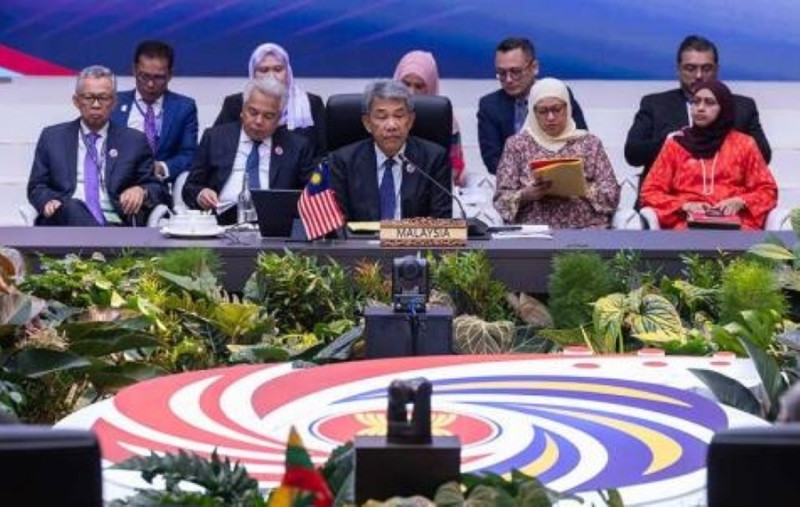
While the upcoming ASEAN Summit in Malaysia could provide space for closed-door discussions, Khoo was sceptical of any major policy reversals.
“Trump’s tariff policy is often driven by domestic political motives. He has little incentive to alter course unless pressured by lawmakers or domestic business interests,” she said.
Countries like Malaysia, Vietnam and Thailand, which maintain strategic dialogues with the US, might use bilateral sidelines to raise concerns, but Khoo emphasised that “ASEAN as a bloc holds limited sway over US trade policy, especially under an administration more inclined toward unilateral action than multilateral negotiation.”
Since returning to the White House, President Trump has adopted an increasingly protectionist posture—raising tariffs on China, reintroducing levies on imports from Canada and Mexico, and targeting goods such as steel, aluminium, and automobiles.
This latest policy culminated on 2 April when Trump announced a 10 per cent baseline import tariff, with significantly higher rates for specific countries. However, one week later, the tariff hikes were temporarily suspended and trade talks with selected partners commenced.
On Tuesday, the White House confirmed an extension of the tariff postponement until 1 August. - July 9, 2025