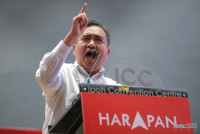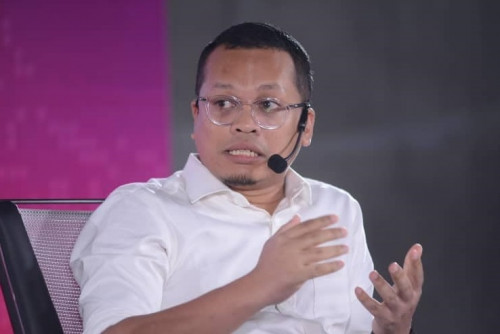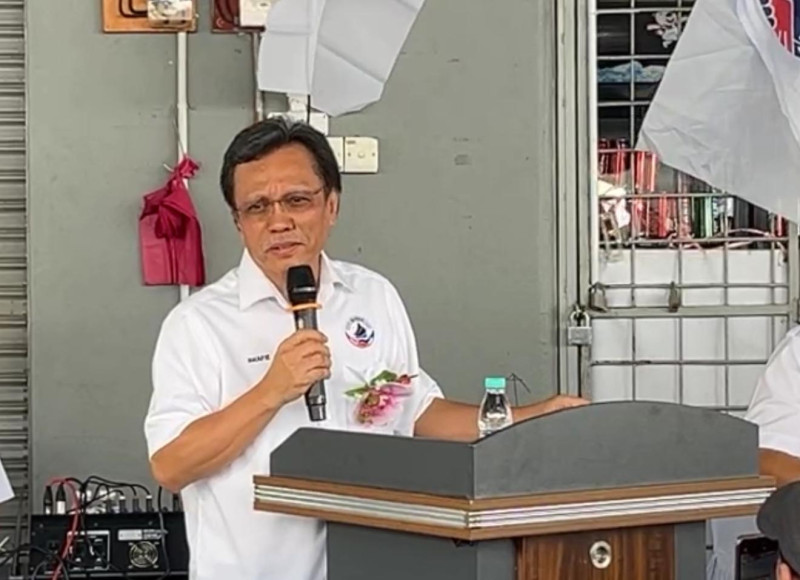
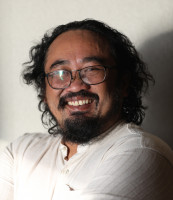
WARISAN leader Datuk Seri Mohd Shafie Apdal did not mince words when he branded the ruling Gabungan Rakyat Sabah (GRS) coalition as “Gabungan Rasuah Sabah” during a speech in Keningau, accusing the state government of failing to address corruption and basic infrastructure issues.
He said the water crisis in Sabah has persisted under the current administration, yet no one has held Deputy Prime Minister Datuk Seri Ahmad Zahid Hamidi accountable, despite Zahid now holding the same rural development portfolio that Shafie once did.
“Last time I was Minister of Rural Development. When there was no water, no electricity—I was the one blamed.
But now, the DPM holds the same position. Nobody blames him. Gabungan Rakyat Sabah? No. Gabungan Rasuah Sabah,” he said during his speech in Keningau on Saturday.
Shafie served as Rural and Regional Development Minister from 2008 to 2015. He was removed from the Cabinet after questioning then-Prime Minister Datuk Seri Najib Razak over the 1MDB scandal.
“This is not a legacy issue. This is a GRS problem. I am prepared if I am summoned because I said that,” he said.
The phrase “Gabungan Rasuah Sabah” had circulated widely as a social media meme and, according to critics online, reflects the perception of widespread corruption and dysfunction under the current state administration.
Gabungan Rakyat Sabah, or GRS, is the ruling alliance in Sabah, led by Chief Minister Datuk Seri Hajiji Noor. It currently governs the state in partnership with Pakatan Harapan.
GRS was recently hit by a mining corruption scandal and has already seen two of its elected representatives charged in court.
Shafie also criticised the Malaysian Anti-Corruption Commission (MACC) and the broader justice system.
He recounted how he was detained in 2017, forced to wear the MACC’s orange lock-up shirt, and made to sleep on the floor, despite no evidence being found against him.
“They came into my house, found nothing. They searched my bank, found nothing. I was made to sleep on the floor, no mattress, no pillow.
They asked me to wear the orange shirt. But there was no charge. No case,” he said.
The arrest was part of an investigation into the alleged misappropriation of rural development funds during his tenure as a federal minister. At the time, the probe was reported to involve as much as RM1.5 billion.
Shafie said his accounts and transactions, totalling up to RM1 billion, were scrutinised, but investigators eventually cleared him of any wrongdoing. The case was closed in mid-2018 without charges.
He then compared his case to that of former Prime Minister Datuk Seri Ismail Sabri Yaakob.
“Ismail Sabri, over one hundred million ringgit was found. He wore his own clothes. No orange shirt. What kind of system is this?” he said.
Shafie said enforcement in Malaysia is politically selective and often avoids those with ties to the ruling coalition.
He also addressed accusations that Warisan is a “PTI party,” a derogatory term used in Sabah to imply links with undocumented immigrants.
Shafie pointed to Warisan deputy president Darell Leiking, a KadazanDusun leader, as evidence that the party represents Sabah’s indigenous communities.
“Is Darell a pilak?” he said, adding that most of Warisan’s supreme council members are from the KadazanDusun and Murut (KDM) ethnic groups, with only himself, Information Chief Datuk Azis Jamman, and Vice President Datuk Jaujan Sambakong coming from other ethnic backgrounds.
He also dismissed claims that he himself is a PTI (Pendatang Tanpa Izin), saying such accusations would have disqualified him from ever serving as a federal minister before.
Shafie clarified that letters of support he signed during his tenure as Chief Minister, commonly referred to as “mohon disokong” letters, do not determine citizenship status.
“I do not know who was applying for the IC. As Chief Minister I was asked to support, but the final decision lies with the federal National Registration Department to determine whether that person is a Sabahan or a Malaysian,” he said.
In another part of his speech, Shafie reframed the upcoming state election as more than just a political contest, describing it as a rare opportunity for Sabahans to reclaim their voice and reshape the future of the state.
“This is not UMNO’s vote. This is not GRS’s vote. This is not PAS’s vote. This vote belongs to the people of Sabah.
This time, the political landscape of Sabah can be changed by Sabahans. This is your hand—the hand of Sabahans. Vote for Sabah’s future,” he said.
Shafie also pointed out that many of the children or relatives of Malaysia’s founding leaders, such as Tun Mustapha Datu Harun and Tun Fuad Stephens, are now aligned with Warisan as an endorsement of Warisan’s goal to return to single-party rule in Sabah.
He emphasised that Warisan will not work with any other political parties, stating that the only pact it seeks is with the people of Sabah. He said he had faced enough challenges and disappointments from previous alliances.
Warisan, under Shafie’s leadership, initially maintained a friendly relationship with Pakatan Harapan from before the 2018 general election until the 2020 state election.
However, Pakatan Harapan later switched its support to GRS in 2022, following Umno’s withdrawal from the coalition, in order to keep the state government intact. - July 19, 2025