By Datuk Ismail Yusop
MORE than sixty years since gaining independence, Malaysia has witnessed waves of economic transformation and an array of political slogans. Yet, a profound question remains unanswered: have we truly matured as a nation?
Despite modern infrastructure and national milestones, Malaysia still finds itself mired in recurring debates over race, religion and symbols of patriotism—suggesting that the nation has yet to fully graduate from the historical lessons of its past.
Nearly a century ago, the revered Malay intellectual Za’ba warned that national progress would remain elusive without a transformation in character and mindset. He argued that underdevelopment stemmed not merely from material poverty but from a deeper poverty of manners, knowledge and intellect.
“A nation that refuses to think, shuns effort and is too easily content will remain trapped in old cycles,” he wrote. For Za’ba, education was the only path forward—a process that not only trained the intellect but shaped moral character grounded in high values and personal discipline.
Today, his words resonate more than ever. While Malaysia has built highways, skyscrapers and economic zones, civilisation cannot be measured in concrete and steel alone—it must be filled with soul.
Without ethics and wisdom, development becomes hollow. When knowledge is undervalued, a nation cannot hope to compete. Even the spirit of independence risks being reduced to surface-level rituals.
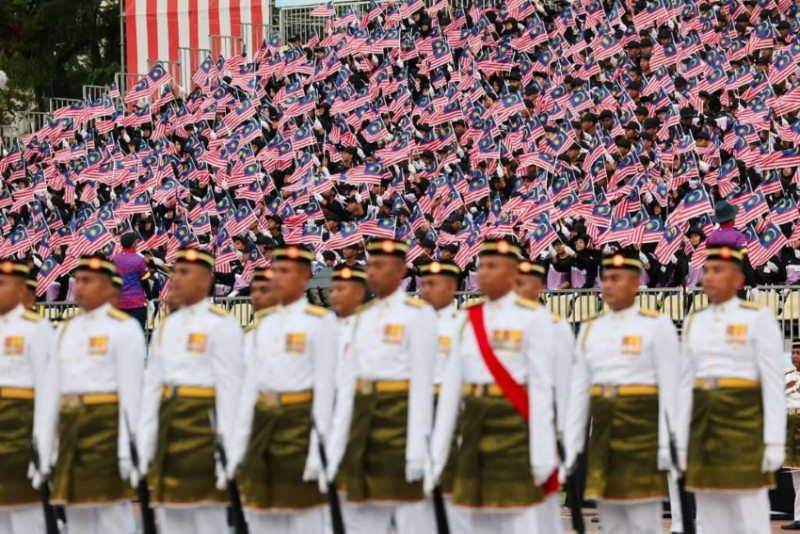
Flags are waved only when handed out for free. Slogans are shouted without truly understanding their meaning. Patriotism becomes performance, rather than consciousness.
In this context, the government’s introduction of the 13th Malaysia Plan (2026–2030), founded on the Madani philosophy, must be viewed as a crucial effort to break this cycle.
Centred on six pillars—sustainability, prosperity, innovation, respect, trust and compassion—Madani is more than rhetoric; it is a strategic framework to build a forward-looking and value-driven society.
Key to RMK13 are initiatives to “raise the floor”, ensuring no citizen is left behind in education or development, while also “raising the ceiling” to boost national capacity in high-value sectors such as artificial intelligence, STEM and digital innovation.
This approach seeks to balance both material progress and spiritual growth, in alignment with the ‘maqasid syariah’ principle of holistic human development.
Still, we must be honest: even the most ambitious policy will fail if entrenched cultural attitudes remain unchanged.
Za’ba warned that a nation seeking renewal must first practise self-critique. We can no longer blame colonial legacies, the government or others. We must look in the mirror and confront our own shortcomings. Criticism born of love for one’s country is not betrayal—it is the condition for progress.
So, when will we move forward?
How long must we circle the same old arguments? How long will we remain trapped in nostalgia without forging ahead?
True independence is not merely the absence of colonisers. It is the ability to stand on our own, to compete with dignity, and to live with values.
If our education system produces only certificate-chasers rather than thinking citizens, we will never achieve a civilised soul.
If our patriotism is measured by free flags and social media hashtags, we are not yet truly free.
The time has come to break free from tired narratives. We cannot continue as a nation content with symbols devoid of meaning.
Za’ba gave us the roadmap nearly a century ago: build a nation with knowledge, ethics and discipline.
If we remain poor in manners and intellect, all development will be no more than empty monuments. But if we dare to live out the true meaning of independence through wisdom and moral strength, we will finally mature—not only in the eyes of the world, but in the judgement of history. - August 29, 2025
*Datuk Ismail Yusop is the Director-General of the Department of Community Communications (J-KOM)












.jpeg)