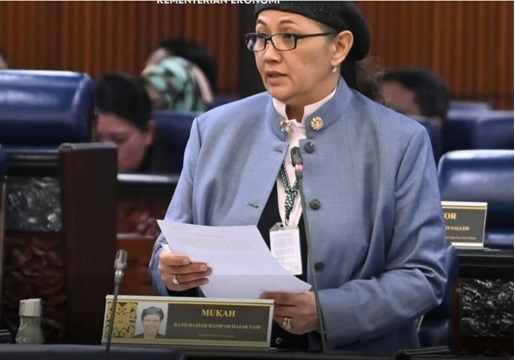
THE Federal Government is examining the adoption of a more precise method for identifying target groups for social assistance, including the possible use of disposable income rather than gross household income, Deputy Economy Minister Datuk Hanifah Hajar Taib told Parliament today.
She said the proposal, which would alter how eligibility for government aid and subsidies is classified, demands time and comprehensive evaluation to ensure it delivers the intended outcomes.
“At present, the provision of assistance is generally based on the Poverty Line Income, which takes into account basic household needs, covering both food and non-food items including housing, healthcare and education,” she said during Question Time in the Dewan Rakyat on Wednesday.
She explained that current income classification is intended to guide policy and social planning aimed at delivering support to the correct groups.
“This method refers to a statistical approach that ranks households from the lowest to highest income into equal-sized groups or according to their relative position in the income distribution,” she said.
Assistance remains largely focused on the B40 group and is determined using gross household income, she added.
Hanifah was responding to Datuk Che Mohamad Zulkifly Jusoh (PN–Besut), who asked for updates on the plan to use disposable income as a fairer basis for allocating government aid and subsidies across all segments of society.
During a supplementary question, Datuk Dr Richard Rapu (GPS–Betong) queried the current income thresholds used to categorise the B40, M40 and T20 socioeconomic groups.
Citing the 2024 Household Income and Expenditure Survey (HIES), Hanifah said median incomes for all three groups have risen due to higher earnings from wages, self-employment, assets, investments and informal transfers.
She noted that the B40 median income increased from RM3,440 in 2022 to RM3,815 in 2024, representing an average annual growth of 5.2 per cent.
For the M40, median income rose from RM7,694 to RM8,599 over the same period, with average annual growth of 5.6 per cent.
Meanwhile, median income for the T20 climbed from RM15,867 in 2022 to RM16,517 in 2024, reflecting an annual growth rate of two per cent.
The Government’s ongoing study is expected to determine whether disposable income would provide a more equitable basis for channeling targeted assistance in future. - December 3, 2025




.jpeg)