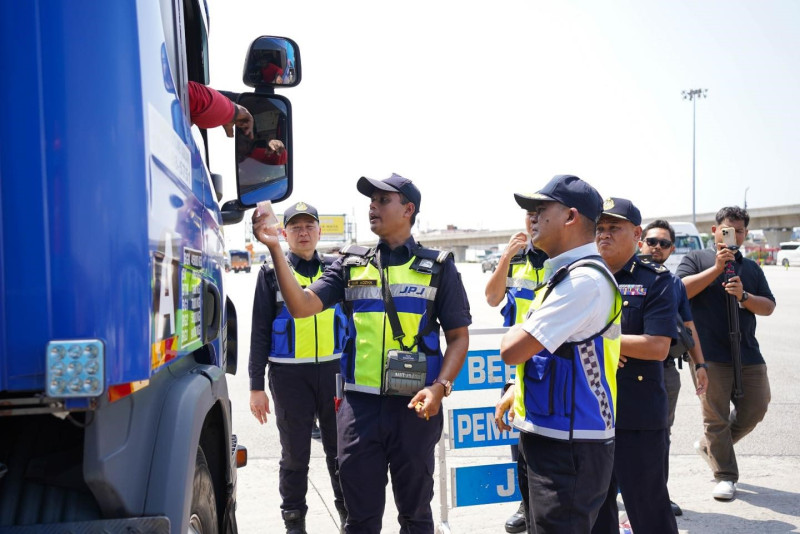
THE Road Transport Department will roll out special enforcement operations targeting heavy vehicles and long-distance express buses ahead of the Chinese New Year festive period, as authorities move to curb fatigue-related risks and improve passenger safety during peak travel days.
Kuala Lumpur JPJ director Hamidi Adam said enforcement efforts will pay particular attention to express buses travelling more than 300km to ensure the mandatory requirement for a second driver is met.
“The enforcement will also focus on drivers’ licences, compliance with driving hour limits and the condition of vehicles, along with adherence to the requirement for a second driver (where applicable) to manage fatigue,” he said when contacted yesterday.
“It will cover passenger safety requirements to ensure the well-being of road users travelling during the holiday period,” The Star cited him adding.
Hamidi said the special operation is aimed at improving road safety and ensuring smoother traffic flow throughout the festive season.
“It will include restrictions on the movement of heavy vehicles during specified periods and technical inspections, as well as firm action against drivers and vehicles found to be in breach of road traffic regulations,” he said.
He added that enforcement will be carried out together with relevant agencies as part of a coordinated effort to reduce accidents and congestion during the holiday period.
“We are committed to conducting continuous operations throughout the year. However, efforts will be stepped up during the festive seasons, especially during the coming Lunar New Year celebration,” he said.
Hamidi noted that Kuala Lumpur JPJ issued 137,192 summonses and seized 955 vehicles last year. “It is a slight reduction compared to the 145,542 summonses issued in 2024,” he said.
Among the most common offences recorded were expired driving licences, expired road tax and the absence of vehicle insurance. “We also identified instances of vehicles with tinted windows that did not comply with specifications, as well as cases of heavy vehicles being overloaded,” he added.
During an operation on Jan 27, KL JPJ issued 382 summonses for various offences, including against two tour buses that were found to be operating without tour guides.
“It is a serious offence, as it could endanger the passengers and tarnish the reputation of the country’s tourism industry,” Hamidi had said.
He also reminded road users to ensure their documents were in order. “We also urge all road users to channel information about traffic offences through the MyJPJ app or [[email protected]](mailto:[email protected]),” he said.
Meanwhile, Transport Minister Anthony Loke confirmed that enforcement checks will be intensified nationwide during the festive period.
“It will not only be through traditional roadblocks but also plainclothes officers boarding buses,” he said.
Loke revealed that 1,305 compounds were issued last year for failure to wear seat belts on buses, involving 1,147 express buses and 158 tour buses.
Between 2022 and 2025, a total of 507 inspections were conducted at bus terminals and inspection centres during special Chinese New Year operations, which uncovered 32 cases of buses travelling more than 300km without a second driver.
“Enforcement is not meant to be punitive but to safeguard the industry’s future. If we want to grow and gain public confidence, operators must cooperate and ensure safety standards are upheld.
“Raising safety standards will further encourage greater public transport use,” he said.
Loke, who conducted a walkabout at the Terminal Bersepadu Selatan yesterday, said he observed that all passengers on a bus heading to Melaka were wearing seat belts.
“We want this to be a norm, not just through enforcement but public awareness,” he said, adding that those found not buckling up will be fined RM300.
He also said authorities are exploring the use of new technologies to strengthen enforcement.
“Authorities are looking to revamp enforcement through new technologies, including the use of telematics, to enable drivers and operators to be continuously monitored,” he said. - February 4, 2026