THE MADANI Government has resumed negotiations with the United States to determine a new tariff structure after a previously signed reciprocal trade agreement was effectively rendered inapplicable following the introduction of a 10 per cent global tariff by the administration of United States President Donald Trump.
Investment, Trade and Industry (MITI) Minister Datuk Seri Johari Abdul Ghani said the Reciprocal Trade Agreement (ART) signed between Malaysia and the United States in October last year had set a tariff rate of 19 per cent on Malaysian goods.
However, he said the arrangement no longer applied after Washington implemented a blanket 10 per cent tariff on imports from all countries under Section 122 of the US Trade Act of 1974.
"Now he (Trump) is using Section 122 (of the US Trade Act 1974), he has placed Malaysia at 10 per cent. So, within these five months, he will review it under Section 301. What is Section 301? There are four things he will examine.
"Whether there is dumping of our products in the US through the access capability that we have. Second, whether when we produce goods that we export to the US, we are involved in forced labour. Are we using illegal workers or underage workers, so there are many things (being evaluated)," Johari said.
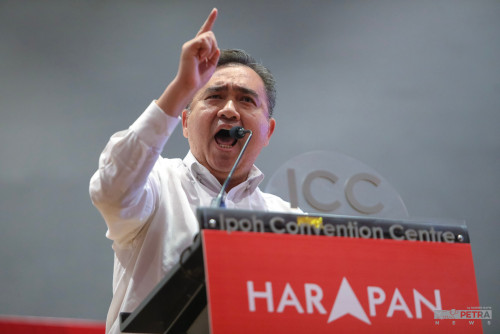
He was speaking to reporters after attending the Aidilfitri Contribution Programme 2026 at Desa Pandan in Kuala Lumpur.
The minister explained that environmental practices would also be scrutinised as part of the review process, reflecting a growing emphasis by Western economies on sustainability standards.
"Like the environmental assessment done by Europe, the US also considers environmental issues, anything that damages the environment. Fourth, they want to see whether when a country exports its goods, the government provides subsidies to exporters.
"If the government gives subsidies to exporters, it means that country has lowered the price of the product simply to ensure that the industries there, if they compete with us, they will lose because we sell cheaper. That is the objective," he said.
Johari added the same evaluation framework would be applied not only to Malaysia but to companies from 60 countries trading with the United States.
Malaysia has not ratified the earlier agreement despite signing it in October last year and is currently studying the implications of Washington’s tariff policy shift.
Meanwhile, the government has also warned that escalating geopolitical tensions in the Middle East could exert fresh pressure on Malaysia’s inflation outlook.
Economy Minister Akmal Nasrullah Mohd Nasir said the ongoing conflict involving Israel, the United States and Iran could disrupt global energy supply chains, potentially driving up production and logistics costs.
He noted that Malaysia had maintained relatively low inflation of around 1.4 per cent throughout last year but cautioned that recent developments could change the outlook in the months ahead.
"The impact of this conflict depends on several factors such as the intensity of the damage and how long the conflict continues.
"For now, we expect there will be an impact on inflation even though last year we managed to maintain inflation at around 1.4 per cent for the whole of 2025.
“But we expect in the coming months there will be inflationary effects due to supply chain disruptions caused by rising oil input and output costs," he said.
He spoke after attending the Rahmah Sales Programme in Johor Bahru.
Akmal added that the situation could worsen significantly if the conflict disrupts critical global shipping routes such as the Strait of Hormuz, one of the world’s most important energy transit corridors.
"Disruption to oil and gas supplies will have direct implications for petroleum-based products such as petrol and diesel.
"Oil is also an important component in the production process of many goods, whether from the input or output perspective. So, when supply disruptions occur, it will increase production costs as well as logistics and supply chain costs," he said.
The government is closely monitoring developments as both trade policy shifts and geopolitical tensions threaten to reshape the global economic landscape and affect Malaysia’s trade and price stability. - March 15, 2026