
KOTA KINABALU – The Sabah Law Society (SLS) has urged the federal government to urgently enact the anti-hopping legislation to prevent elected lawmakers from switching parties.
Its president Roger Chin said this would resolve the political malaise besetting Malaysia once and for all.
“The number of defections hit unprecedented levels in 2020 and as recent events have proven, many elected representatives of the people are unable to control their impulses to jump ship.
“Hence, there is an urgent need to adopt anti-defection laws in the country to prevent this type of behaviour,” he said.
Chin said the anti-defection legislation is not a novel concept as it has already been made into law by the Penang government under Article 14(A)(1) of the Constitution of the State of Penang (Amendment) Enactment 2012.
However, it is said to infringe Article 10 of the federal constitution which guarantees freedom of association. Because of this, an earlier anti-hopping law in Sabah was declared unconstitutional by the Supreme Court in 1992.
However, Chin said Article 10(2) provides that legal restrictions on the rights conferred by Article 10(1) may be imposed by Parliament “as it deems necessary or expedient in the interest of the security of the Federation or any part thereof, public order or morality”.
“It is thus apparent that those rights are not absolute in nature and may be limited by federal law, and an anti-hopping law is justified based on public order and morality,” he said.
“Public confidence in the democratic process will diminish greatly if this (defections) continues to take place. Implementing such laws is imperative and may not be ultra vires to the federal constitution,” he said.
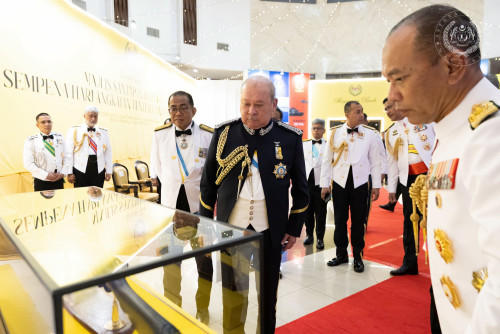
Chin said this during the opening of the Legal Year 2021 event here today.
He also pointed out that the roles of the attorney-general and the public prosecutor need to be separated to avoid a serious conflict of interest, especially for cases involving influential political figures in government.
“In recent years and especially in 2020, many criminal charges against high-profile individuals were dropped by the public prosecutor.
He said their roles are fundamentally different in nature.
The attorney-general is a civil servant appointed by the Yang di-Pertuan Agong on the advice of the prime minister and is not answerable to anybody, including the prime minister.
Therefore, the attorney-general has the power to prosecute anyone who is criminally liable, including the prime minister.
“However, on the other hand, the attorney-general only holds office at the pleasure of the Agong, which means that the prime minister determines his position. This therefore deprives the attorney-general of independence in the exercise of his duty,” he said.
Chin said that the United States senate ensures its attorney-general is appointed based on merit, which takes away the power of the president to choose the attorney-general. – The Vibes, January 3, 2020