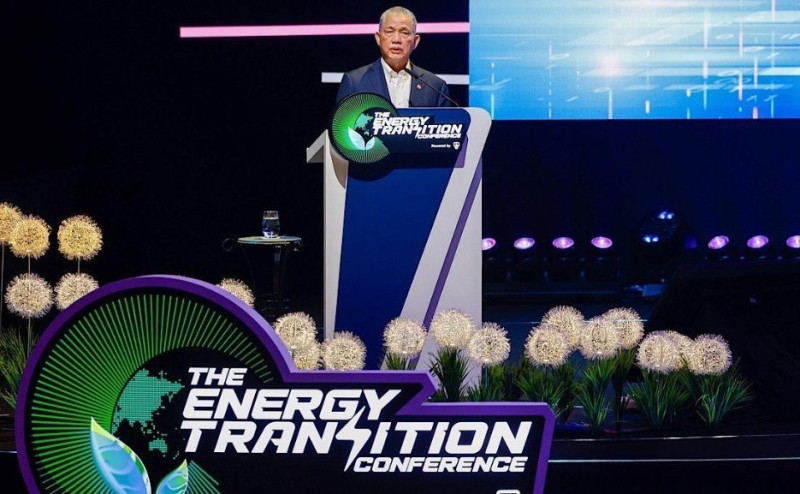
THE Government has called for urgent and coordinated action to accelerate the global energy transition, with Deputy Prime Minister II Datuk Seri Fadillah Yusof warning that the world’s energy system is under growing strain from rising demand, constrained supply growth and increasing geopolitical volatility.
Speaking at the Energy Transition Conference 2026 at the Kuala Lumpur Convention Centre on Wednesday, Fadillah said the global energy landscape is undergoing a profound transformation that requires governments, industry and society to respond with urgency and shared responsibility.
He said the principle reinforces humanity’s duty as custodians of the Earth rather than its owners.
“The choices we make today, particularly in how we produce, consume and manage energy — will determine the legacy we leave to future generations,” he said.
Fadillah said global energy systems are currently caught between rapidly rising electricity demand and increasing constraints on supply expansion due to cost pressures and climate commitments.
He also warned that fossil fuel resources remain finite, citing widely referenced estimates that proven oil and gas reserves may last around 50 years each, while coal could last approximately 130 years at current production rates.
“These figures do present a stark reminder. That even as energy demand continues to rise, fossil fuel resources remain finite,” he said.
“The question is not just ‘how long will our fuels last?’, but ‘how do we effectively and fairly manage our transition toward a more sustainable energy system’.”
He added that instability in West Asia and volatility in global energy markets further underline the urgency of reducing dependence on conventional fuels and accelerating the shift towards more secure and resilient energy systems.
Against this backdrop, he said the Energy Transition Conference 2026 provides a timely platform for regional and international coordination on the transition agenda.
Malaysia’s Long-Term Energy Strategy
Fadillah said Malaysia’s energy transition is anchored in long-standing national policy direction aimed at diversifying the country’s energy mix.
He noted that renewable energy was first introduced as the “fifth fuel” in the early 1990s under the National Energy Policy, alongside oil, gas, coal and hydropower.
Today, Malaysia’s renewable energy mix includes solar, small hydro, biomass and biogas, with solar emerging as the fastest-growing source of clean power.
Guided by the National Energy Transition Roadmap (NETR), Malaysia has steadily expanded renewable capacity, reaching more than 13.3 gigawatts of installed renewable energy by 2025.
He credited Tenaga Nasional Berhad and industry partners for playing a central role in enabling this expansion.
Fadillah also highlighted the Ministry of Energy Transition and Water Transformation’s 2026–2030 Strategic Plan, which sets out 119 programmes and 133 measurable targets focused on grid modernisation, digitalisation and demand-side management.
He said the government’s overarching objective is to build a resilient, future-ready energy system that supports economic growth while meeting climate obligations.
“This transition requires an ecosystem where both public and private sectors can collaborate with confidence to accelerate the transition at scale,” he said.
Energy Transition As Nation-Building
Fadillah stressed that the energy transition goes beyond technology and infrastructure, describing it as a central pillar of nation-building and societal progress.
Quoting Malaysia’s second Prime Minister Tun Abdul Razak, he said: "I regard our present national and human endeavour as vital, not only to bring about change for the sake of change, but to bring about change for the well-being and prosperity of our people."
He said Malaysia’s development journey — from rural electrification to industrialisation and digital transformation — demonstrates the importance of investing in people, institutions and shared national purpose.
“The energy transition must be approached in the same spirit. It is not merely a technological shift. It is, at its core, about the well-being and prosperity of our people,” he said.
He added that for Malaysia and ASEAN, the transition represents not only an environmental responsibility but also an economic necessity and strategic priority.
Investment Pressures And Regional Demand Growth
Fadillah said Malaysia, through Tenaga Nasional Berhad, plans to invest RM43 billion (US$10.8 billion) between 2025 and 2027 to strengthen and modernise the national grid, including the integration of artificial intelligence technologies.
He noted that electricity demand across Southeast Asia is expected to grow by 4 to 5 per cent annually over the next decade, driven by industrialisation, urbanisation and new demand centres such as electric vehicles, cooling systems and data centres.
“Data centres, for example, are emerging as one of the fastest-growing sources of electricity demand globally, driven by the rapid expansion of AI and cloud infrastructure,” he said.
He warned that increasing electrification and digitalisation will place significant pressure on energy systems to deliver reliable, secure and sustainable power at scale.
Future Energy Systems And Asean Cooperation
Fadillah said the transition presents both challenges and opportunities, particularly for ASEAN, which must modernise grid infrastructure, strengthen interconnections and develop energy storage solutions to improve flexibility and resilience.
He highlighted the ASEAN Power Grid initiative as a key framework for enhancing regional energy security and enabling cross-border electricity trade.
He also noted that global investment in clean energy continues to accelerate as countries pursue decarbonisation alongside energy security objectives.
He said Southeast Asia must position itself to attract a larger share of this investment by maintaining policy clarity, regulatory stability and strong execution capacity.
Role Of Private Sector And Ai-Driven Energy Future
Fadillah said governments must set strategic direction, while the private sector provides capital, technology and operational expertise required to scale solutions effectively.
He called for deeper collaboration across the entire energy value chain, including utilities, developers, regulators and financial institutions.
Referring to the conference theme, “Energy & AI: The Synergy for Energy Transition,” he said artificial intelligence and digital technologies will fundamentally reshape future energy systems.
“We must remain adaptive and forward-looking to the developments of our time, so our capabilities evolve in step with this change,” he said.
He also commended Tenaga Nasional Berhad for hosting the conference and strengthening Malaysia’s role as a regional hub for energy transition dialogue.
Fadillah said Malaysia’s approach is grounded in the Malaysia MADANI framework, ensuring the transition is just, inclusive and equitable.
“The true measure of success will not be how many gigawatts we install, how many projects we launch, or how much capital we attract. It will be whether future generations inherit a nation that is more resilient, more prosperous and more secure than the one we inherited,” he said.
He concluded by declaring the Energy Transition Conference 2026 officially open.
“A nation is not transformed by the energy it consumes, but by the vision, courage and collective will of its people to shape a better tomorrow,” he said. - June 3, 2026