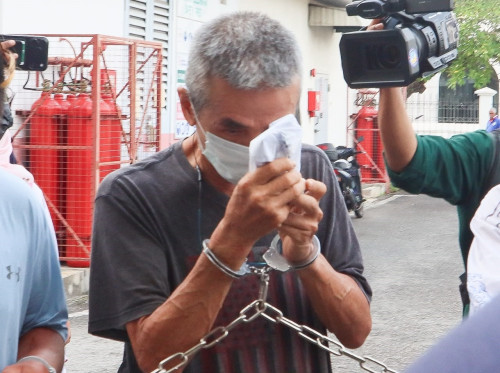
KINDERGARTEN teacher, M Indira Gandhi and 13 others failed in an originating summons (OS) at the High Court today to challenge the validity of Sharia law in six states and one Federal Territory regarding the unilateral conversion of children to Islam.
Judge, Datuk Aliza Sulaiman, ruled this after finding that all the plaintiffs' applications lacked locus standi or failed to prove that they had legal rights.
Reading out the decision in the proceedings held online, she said the plaintiffs failed to show that they were directly affected by the disputed provision.
"The plaintiffs have failed to show that they have an interest in obtaining a declaration that, among other things, the provisions of Islamic law in seven jurisdictions that allow the religious conversion of a child by one of the parents who is Muslim are unconstitutional," she said.
They are seeking to have the provisions in the Islamic enactments in Johor, Perlis, Kedah, Negeri Sembilan, Perak, Melaka and the Federal Territory annulled, on the grounds that they contravene Article 12(4) of the Federal Constitution and the Federal Court's 2018 judgment in the Indira Gandhi case.
They are also seeking a declaration that unilateral religious conversions carried out after the Federal Court's decision are invalid and contravene the Federal Constitution.
"Even if the conditions are lowered, and they are only considered as individuals and associations concerned about the public interest, I cannot see that they have any interest in this matter," he said.
In March 2023, Indira and 13 others as plaintiffs filed the suit to annul unilateral religious conversions in six states involving the State Governments of Johor, Perlis, Melaka, Kedah, Negeri Sembilan and Perak, as well as the Federal Territory.
The Federal Territory Islamic Religious Council (MAIWP) and the Johor State Islamic Religious Council (MAINJ) acted as interveners in the originating suit.
In the OS, the plaintiff claimed that the state enactment was contrary to Article 12(4) of the Federal Constitution, as interpreted in the 2018 Indira case on unilateral religious conversion.
Article 12(4) provides that the religion of a person aged 18 and below shall be determined by their 'parents or guardians'.
In that case, the High Court ruled that the word 'parents' in the provision should be interpreted as 'parents' if they are still alive, hence parental consent is required in religious conversion cases.
The plaintiffs said that according to Article 75 of the Federal Constitution, Federal law prevails over any state law that is inconsistent with it.
In this regard, they need to insist that the state enactment that allows unilateral religious conversion should be declared null and void. – June 12, 2026