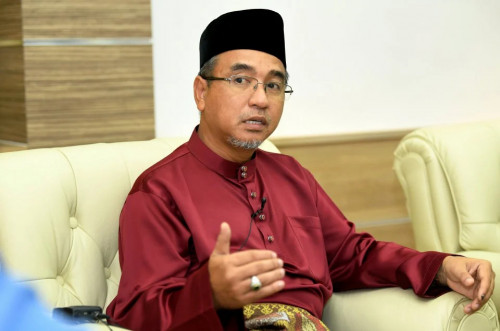
INDEPENDENT political commentator Sayuti Omar has launched a sharp critique of PAS, accusing the party of political opportunism and a lack of principled consistency in its dealings with allies, particularly Bersatu.
Sayuti, who has closely followed PAS for years, argued that the party frequently cloaks strategic political decisions in religious justification, specifically the concept of choosing the “lesser harm” over a greater one.
“PAS claims its political fiqh is based on taking the smaller mudarat compared to a bigger mudarat. That’s the same logic being applied in its relationship with Bersatu now,” he said.
However, he suggested that such reasoning is increasingly being used as a convenient cover for decisions driven by political expediency rather than genuine principle.
According to Sayuti, PAS now views Bersatu as more of a liability than an asset, pointing to the party’s waning public support, internal strife, and financial difficulties.
“To avoid a bigger harm, they choose what they see as a smaller one. Bersatu’s popularity is declining, there are internal conflicts that are not beneficial, and financial issues that are quite apparent. That is why PAS is taking the path of cutting ties,” he said.
But Sayuti was blunt in his assessment, arguing that the move exposes deeper issues within PAS’ political culture.
“In this issue, there is no loyalty and no honesty. But PAS justifies it under the banner of their ‘tahaluf siyasi’ (political cooperation),” he said, questioning whether the concept is being stretched beyond its original intent.
He added that such behaviour reflects a recurring pattern rather than an isolated episode, warning that PAS’ allies should take note.
“I have been observing PAS for a long time and have many friends within the party. To me, this is not surprising,” he said.
“It is possible that after this, they may leave another political partner in pursuit of greater gains and what they perceive as a smaller risk.”
Sayuti also took aim at PAS’ internal power structure, describing it as heavily centralised and dominated by its president, Tan Sri Abdul Hadi Awang.
“PAS has its own ‘mullah’-like figure, similar to Khomeini — a supreme leader in the form of Haji Hadi Awang. He can veto decisions even though the party has various councils and committees,” he claimed.
Such a structure, he argued, raises concerns about internal checks and balances, and whether key decisions are driven by collective deliberation or concentrated authority.
His remarks come amid growing speculation over fractures within opposition ranks, particularly between PAS and Bersatu under the Perikatan Nasional umbrella.
While PAS has yet to formally announce any split, Sayuti’s criticism underscores a broader narrative — that the party’s alliances may be guided less by enduring principles and more by shifting calculations of political survival. - June 12, 2026