MALAYSIA'S economic resurgence is being powered by stability rather than spectacle, with the country increasingly attracting international investors through sound institutions, policy consistency and political certainty instead of the high-profile infrastructure projects that once defined its development strategy.
Associate Professor Dr Bakti Hasan Basri said the assessment echoed a recent Bloomberg analysis by Daniel Moss, who argued that Malaysia's revival has shifted away from the era of mega projects and iconic skyscrapers towards a model founded on economic, political and institutional stability.
According to the Universiti Utara Malaysia, Deputy Vice-Chancellor (Student Affairs and Alumni), the observation is particularly significant because it comes from an international economic commentator who has monitored Asia's economic development for decades.
He said Malaysia's improved standing is not only the result of stronger domestic performance but also reflects mounting challenges confronting several of its regional competitors, particularly Indonesia.
Although Indonesia has long been regarded as Southeast Asia's emerging economic powerhouse because of its population of more than 280 million people, vast domestic market and abundant natural resources, Bakti argued that recent developments demonstrate that economic size alone is no guarantee of investor confidence.
He pointed to pressure on Indonesia's financial markets, including the weakening rupiah, foreign capital outflows, declining demand for government bonds and an unexpected interest rate increase by Bank Indonesia, as evidence that market confidence is being tested.
By contrast, Malaysia is in a considerably stronger position, he said, with the ringgit stabilising after years of criticism, inflation remaining comparatively low and Bank Negara Malaysia maintaining a monetary policy that is viewed as consistent and predictable.
Bakti argued that Malaysia's first-quarter economic growth of 5.4 per cent is only part of the story. More significant, he said, is the country's ability to sustain that growth without triggering severe inflationary pressures, unlike many economies that have been forced to raise interest rates aggressively.
He also highlighted the growing wave of foreign direct investment, noting that global technology companies including Microsoft, Google, Nvidia and major international data centre operators have committed investments worth billions of ringgit in Malaysia.
According to the analysis, these companies are choosing Malaysia because of its rare combination of political stability, predictable policymaking, quality infrastructure, a resilient financial system and a skilled workforce.
Bakti said political stability has been central to Malaysia's renewed attractiveness. After years of political uncertainty between 2018 and 2022, many observers questioned whether any government could remain in office long enough to implement meaningful reforms.
However, he argued that Prime Minister Datuk Seri Anwar Ibrahim's administration remaining in power for nearly four years has sent a strong signal to international investors that Malaysia has regained political continuity.
He said investors are not necessarily seeking a perfect government but rather one that is stable, implements predictable policies and is supported by functioning institutions.
The analysis also contrasted the political climates of Malaysia and Indonesia.
Bakti noted that Indonesia has experienced a series of large-scale protests since 2025 over rising living costs, governance concerns, corruption, legislative amendments and growing public unease about the military's influence in civilian affairs.
Most recently, on 12 June, thousands of university students demonstrated in Jakarta and several other major cities under the banner "Indonesia Heading Towards Bankruptcy", protesting against President Prabowo Subianto's economic policies, rising fuel prices, increasing living costs, subsidy reductions and what they described as imprudent government spending.
Malaysia, meanwhile, continues to face challenges including subsidy rationalisation, cost-of-living pressures and global economic uncertainty, but has managed to implement fiscal and economic reforms through established institutional processes without triggering major social unrest, he said.
This contrast, Bakti argued, has strengthened investor confidence that Malaysia remains a reliable destination for long-term investment.
While Indonesia may continue to enjoy advantages in terms of economic scale and population, he concluded that global investors are increasingly placing greater value on stability than sheer size.
Rather than pursuing economies with rapid but volatile growth, investors now favour markets that deliver moderate yet consistent expansion underpinned by political certainty, institutional resilience and fiscal discipline.
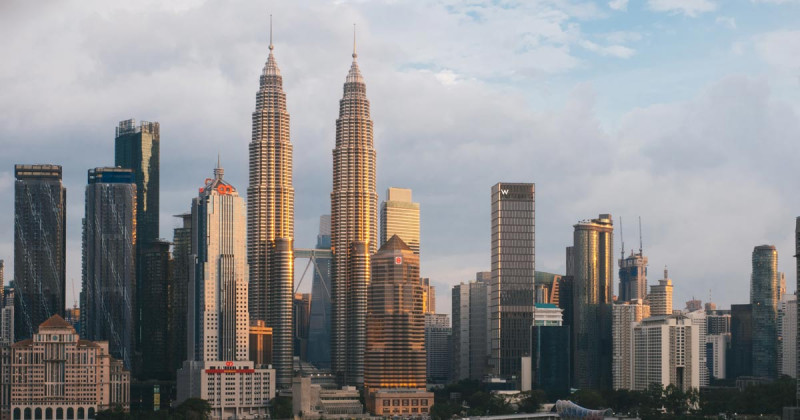
Malaysia may no longer dominate international headlines with the world's tallest buildings or ambitious mega projects, Bakti wrote, but it now possesses assets that are becoming increasingly valuable in today's global economy: institutional stability, policy consistency and social cohesion.
Bakti added that Malaysia's revival is not the product of development gimmicks but of stronger institutions, economic discipline and sustained political stability during a challenging period. - June 17, 2026