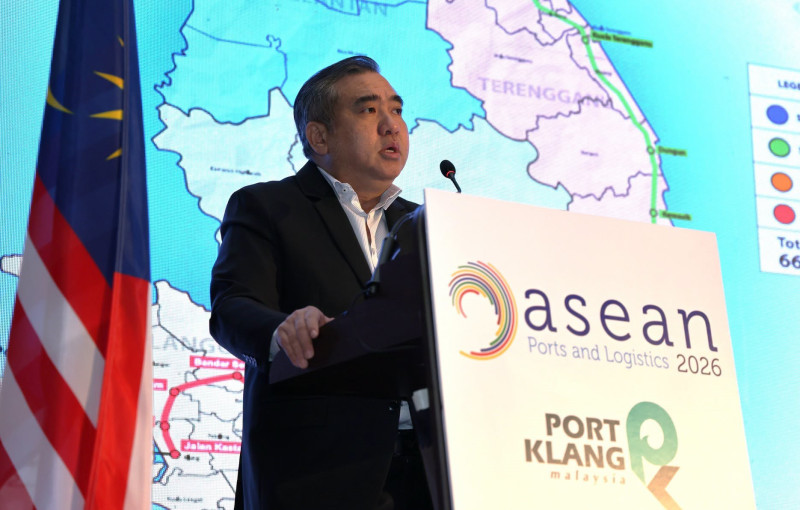
THE conflict in the Middle East has unexpectedly strengthened Malaysia's position in global maritime trade, with shipping lines increasingly diverting cargo through the country's ports as they seek stable and secure transhipment hubs, Transport Minister Anthony Loke said.
He said while geopolitical tensions had disrupted shipping operations and trade flows in several parts of the world, Malaysia's ports had remained largely unaffected, allowing both Port Klang and the Port of Tanjung Pelepas (PTP) to record robust shipping volumes during the first quarter of the year.
"Our port operations were not affected by the crisis in the Middle East. In fact, shipping volumes at both Port Klang and PTP were good.
"The geopolitical uncertainties posed a threat but they also created opportunities for ports in South-East Asia, particularly Malaysia because we are considered a safe haven and a lot of transhipment took place at our ports," he told reporters after launching the ASEAN Ports and Logistics 2026 Conference today.
Loke said the trend underscored the strategic importance of safeguarding the Straits of Melaka, one of the world's busiest maritime trade routes, through continued cooperation among ASEAN member states.
He said ensuring the waterway remains safe, secure and free from conflict is critical to preserving regional supply chains and sustaining international trade.
The minister said stronger cargo throughput had also highlighted the need for Malaysia to expand its port infrastructure to remain competitive as global shipping demand continues to grow.
He identified the proposed Pulau Carey Port as the centrepiece of the country's long-term maritime strategy, saying it would complement Port Klang and transform it into a mega port capable of meeting future cargo demand.
The project, he said, will be implemented through a public-private partnership in multiple phases over the next two decades.
Loke said feasibility studies for the proposed development were approved in 2018 following two to three years of detailed research, while the Transport Ministry is currently working with the Selangor government to resolve land-related issues before construction can commence.
Drawing comparisons with regional competitors, he noted that Singapore's Tuas Port has the capacity to handle approximately 60 million twenty-foot equivalent units (TEUs) annually, compared with Port Klang's existing capacity of around 20 million TEUs.
"If we want to compete, we must have the infrastructure to handle larger capacity. That is why we need to develop Pulau Carey Port," he said.
Highlighting Malaysia's recent performance, Loke said the country's ports handled approximately 33.07 million TEUs in 2025.
Port Klang recorded a historic 15.14 million TEUs, maintaining its position among the world's 10 busiest container ports for the second consecutive year, while the Port of Tanjung Pelepas achieved a record 14.03 million TEUs.
The growth has continued into 2026, with cargo volumes increasing by 5 per cent at Port Klang and 8 per cent at PTP as of May.
Loke said maritime transport remains the backbone of Malaysia's economy, with more than 90 per cent of the country's international trade carried by sea.
He stressed that continued investment in port infrastructure is essential to supporting future trade growth and strengthening Malaysia's ambition to become a leading regional maritime and logistics hub.
"If we do not make this effort to ensure this development is carried out, we will be left behind in 20 or 30 years in terms of handling greater capacity and infrastructure compared to our neighbouring country," he said. - July 8, 2026







.jpg)