SURGING electricity demand from data centres and artificial intelligence, coupled with global energy supply uncertainties, is increasing pressure on ASEAN countries to accelerate regional power integration to safeguard long-term energy security.
Deputy Prime Minister II Datuk Seri Fadillah Yusof said electricity was increasingly becoming a scarce resource, requiring Southeast Asian nations to strengthen cross-border connectivity, diversify energy sources and coordinate supply arrangements to meet growing demand.
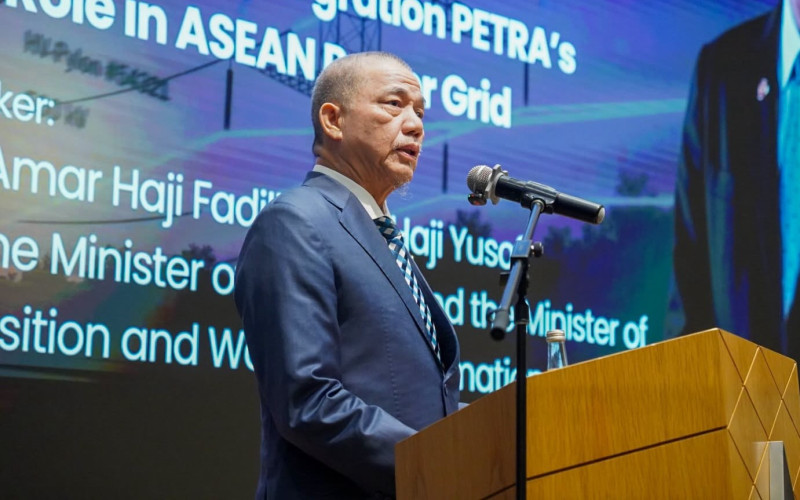
Fadillah, who is also Energy Transition and Water Transformation (PETRA) Minister, said Malaysia welcomed investments in data centres and other digital infrastructure, but electricity commitments must be balanced against the needs of households, industries and water resources.
"Every megawatt we promise to a data centre must be weighed against the needs of our households, our industries and our water resources," he said in his keynote address at the ASEAN Power Grid Forum organised by Universiti Malaya's Asia-Europe Institute and the Konrad-Adenauer-Stiftung in Kuala Lumpur.
Fadillah cited Johor's rapid emergence as a data centre investment destination, with electricity requirements associated with proposed developments now measured in gigawatts.
According to the Ninth ASEAN Energy Outlook, the region's final energy consumption could more than quadruple by 2060 under the baseline scenario, driven by economic growth, industrialisation and emerging sources of demand, including data centres.
He said PETRA, together with the Energy Commission and Tenaga Nasional Bhd, was strengthening the national grid, expanding energy storage and improving long-term planning to ensure electricity supply reliability.
Fadillah said regional electricity connectivity had also become more urgent amid geopolitical tensions and disruptions to international fuel supply routes, including the Strait of Hormuz, which could affect energy prices, industries and households far beyond the immediate region.
"That is why the ASEAN Power Grid is no longer only a technical or commercial project. It is a strategic one," he said.
He said the initiative, first envisioned by ASEAN leaders in 1997 under ASEAN Vision 2020, had evolved into a regional priority encompassing energy security, resilience and the transition towards cleaner energy.
During Malaysia's ASEAN chairmanship in 2025, member states worked to finalise the Enhanced Memorandum of Understanding on the ASEAN Power Grid, laying the foundation for stronger cross-border electricity cooperation.
The Lao PDR-Thailand-Malaysia-Singapore Power Integration Project had also demonstrated the feasibility of multilateral electricity trading in the region.
Fadillah said the ASEAN Power Grid Financing Initiative, launched in partnership with the Asian Development Bank and World Bank Group, would help mobilise financing and project preparation support to turn regional connectivity plans into viable investments.
However, he cautioned that infrastructure development alone would not ensure successful integration, with ASEAN needing common rules governing electricity access, pricing and emergency arrangements.
"The hard work lies in common rules for access, pricing and emergencies, and in the political will to agree on them," he said.
Citing developments in Borneo, Fadillah said Sarawak's hydropower resources and cross-border electricity links demonstrated the potential benefits of regional cooperation.
Hydropower accounts for about 60 per cent of Sarawak's installed generation capacity, while the Sarawak-West Kalimantan interconnection has helped reduce reliance on more costly electricity generation sources.
Sarawak is also pursuing greater electricity connectivity with Sabah, Brunei Darussalam and Singapore.
The proposed 1-gigawatt Sarawak-Singapore interconnection has received conditional approval from Singapore's Energy Market Authority, with commercial operations expected around 2035, subject to the necessary approvals.
He said Indonesia's cooperation would be essential for transmission projects involving cables passing through its waters.
Fadillah also cautioned against allowing regional electricity interdependence to become a geopolitical instrument, stressing the importance of transparent rules, reliable supply and diversified suppliers, routes and partners.
He outlined three possible futures for the ASEAN Power Grid over the next decade: cooperative integration through ASEAN-led arrangements, fragmented development through individual bilateral projects, or the emergence of separate electricity blocs shaped by great-power rivalries.
"Which path prevails will not be decided in Washington or Beijing. It will be decided by us, by the choices of ASEAN member states," he said.
He said Malaysia would pursue cooperative integration guided by ASEAN centrality, consensus and respect for national sovereignty while continuing its domestic energy transition under the National Energy Transition Roadmap.
"And we will keep the Grid ASEAN-driven, open to all partners, and captive to none," he added. - November 19, 2026