
GEORGE TOWN – The Federation of Malaysian Manufacturers’ (FMM) northern chapter has called on the Health Ministry to offer subsidies for employers to screen all their workers, not just foreign ones.
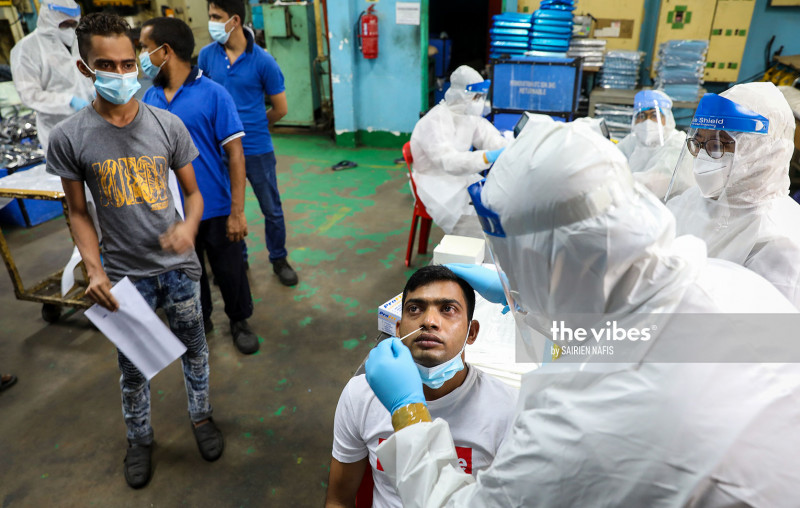
Its chairman, Datuk Jimmy Ong Chin Keng, said that mass screening is one of the best ways to ensuring the manufacturing sector contains the virus.
It is believed that the majority of the latest surge of infections in Penang comes from the manufacturing sector at the Bayan Lepas Free Industrial Zone and industrial estates on the mainland.
“Further, companies should carry out mass screening of all workers to detect and isolate positive cases fast, including those without symptoms, by using RT-PCR testing,” he said in an interview with The Vibes.
“Mass screening has been carried out in many countries, such as China, India and Singapore, as an immediate and faster response to detect and isolate cases, rather than waiting for asymptomatic cases to spread around slowly.”
Currently, FMM is working closely with the state government to roll out the Penang SAFE programme, in which a company can register for mass screening using pooled RT-PCR testing at a price of RM60 per pax.
The programme was launched by the state executive councillor Jagdeep Singh Deo on December 23, last year, he said, noting that Penang is the first state to launch such an affordable mass screening programme.
The Penang SAFE programme provides factories with a complete workflow for mass screening of workers in batches.
It will cost only RM60 per individual for registration, scheduling for swabbing, RT-PCR testing for pooled samples, with results in 24 hours. It also facilitates alerts if there are positive results in the pool and notification of subsequent actions.
It will only incur one-fifth of the normal cost per person for such a procedure.
Employers vulnerable
FMM president Tan Sri Soh Thian Lai told The Vibes that factories already operate under very controlled environments in terms of access into the premises by outsiders and movement of employees in and out, which would have been further enhanced in light of the pandemic.
These include strict implementation of the standard operating procedures (SOPs) issued by the government, and stringent health and safety measures.
However, even with all these measures in place, employers continue to be vulnerable as their employees could get infected outside of the workplace, risking spread of the virus to other employees.
“The screening requirement is supported as a proactive measure to be taken to get workers tested, especially in light of the high asymptomatic cases and to avoid the risk of spreading the virus to others despite taking all other precautionary measures, such as wearing of face masks, social distancing and hygiene,” he said.
“Conducting the tests would allow for such cases to be detected early and for the necessary measures and/or treatment to be administered as well as contact tracing and more extensive testing of workers to be done.”
That said, another issue looms on the horizon – will a second far-reaching movement control order (MCO) like that of March 18, last year, be implemented again?
Many small and medium enterprises (SMEs) are on the edge of their seats, hoping that there won’t be another MCO that could devastate the country’s economy and weaken some SMEs already struggling from the effects of the previous lockdown. – The Vibes, January 9, 2021