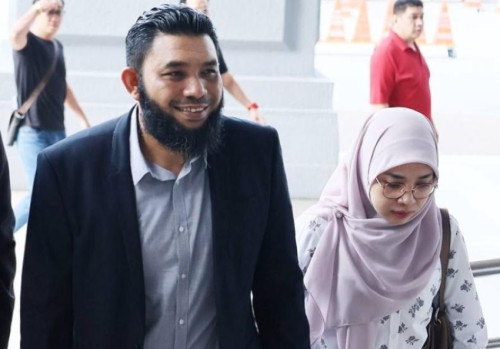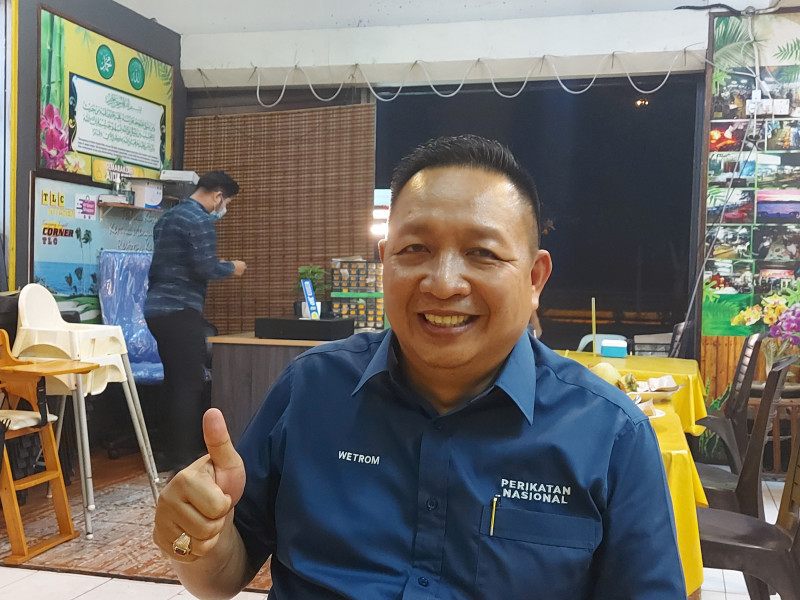

KOTA KINABALU – In light of the Covid-19 pandemic, which has made mass assemblies a big no-no, a Bersatu assemblyman hopeful has incorporated traditional face-to-face meets and small gatherings in his campaign strategy.
Datuk Wetrom Bahanda, who is contesting in Bandau, told The Vibes recently that his two-pronged approach to engage with voters relies on modern technology coupled with the human touch.
“We can no longer have large gatherings. So, one way (I can approach voters) is through social media. We will create groups to engage youth and spread our message. My team will conduct online activities for the youth.
“Second, we will target the heads of families. And, I will meet and explain my plans directly to them, and we expect that they will then disseminate my message to their family members. We have been doing this for the past two weeks, and it has been very effective.”
Traditionally, face-to-face meets and door-to-door campaigning are Umno’s forte.
Being a former Umno man, Wetrom is familiar with this personal-touch strategy, even though this is his first time campaigning as a candidate.
In the past two elections, he sacrificed his dream to contest for the good of Barisan Nasional (BN) and later, Pakatan Harapan (PH).
“We will probably see one or two family heads at any one time. They will bring my message to their family members – fathers, mothers, children, husbands, wives, siblings and relatives. A single voter can bring my message to around 50 other individuals.
“A large ceramah involving hundreds to 1,000 voters lacks the one-on-one personal touch. At small gatherings, I am able to personally listen to the problems, grouses and issues faced by my constituents and find ways to address them.”
According to the 50-year-old businessman, Bandau’s economy still relies heavily on agricultural activities.
The majority of its constituents are rubber tappers and fishermen, while some work on oil palm plantations. Many are in the B40 group, surviving on a household income of less than RM1,000 a month.
The problems facing locals are bread-and-butter issues, such as poor transport infrastructure and broadband connectivity.
Meanwhile, electricity and water have reached most villages.
“We still need a lot of development, such as better roads. If I’m voted in, my focus will be on developing their economic strength, and I believe that better roads will be a great help. It will make it easier for the rubber tappers, oil palm workers and farmers to move their crops,” said Wetrom.
“I also want to help the fishermen. Many are still using wooden paddles. They don’t even have outboard engines. So, I will be looking at how to get state funding to provide them with these engines.
“Even though I have been a politician for 20 years, I have not been an assemblyman. There’s only so much I can do as a party man. I also intend to increase commercial and business activities there,” said Wetrom, who hopes he can do more as an elected representative.
He wants to ensure better broadband connectivity for the community, saying Veveonah Mosibin’s plight is not an isolated incident, as there are hilltop huts in Bandau where students gather in the middle of the night to study.
The state constituency has 14,615 eligible voters. Muslim Bumiputeras make up 40%, while the majority are from the Rungus, Tobilung, Dusun and other ethnic tribes. There are also around 1,000 Chinese voters.
Wetrom is in a four-cornered fight against Parti Cinta Sabah candidate Webley Disim @ Rizal, Parti Warisan Sabah’s Majamis Timbong and Azahari Amit of the United Sabah National Organisation.
Asked about the challenges he expects to face, he said he believes that fake news will be his biggest headache.
“The problem with social media is that someone can come up with slander or fake news, and it goes viral very quickly. Even though we can mount a counterattack, the damage is already done.
“My team needs to monitor it diligently and explain to voters the real situation.
“Another challenge is the strict standard operating procedure we must follow because of Covid-19. I understand the reason for the SOP, but the challenge is that we now lack the freedom to simply move about to campaign.” – The Vibes, September 19, 2020