KUALA LUMPUR – The federal government has been admonished for making decisions that are so ambiguous and confusing that it seems as though the nation’s political leaders are acting out of fear of their own weaknesses.
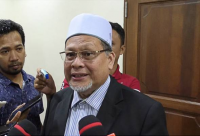
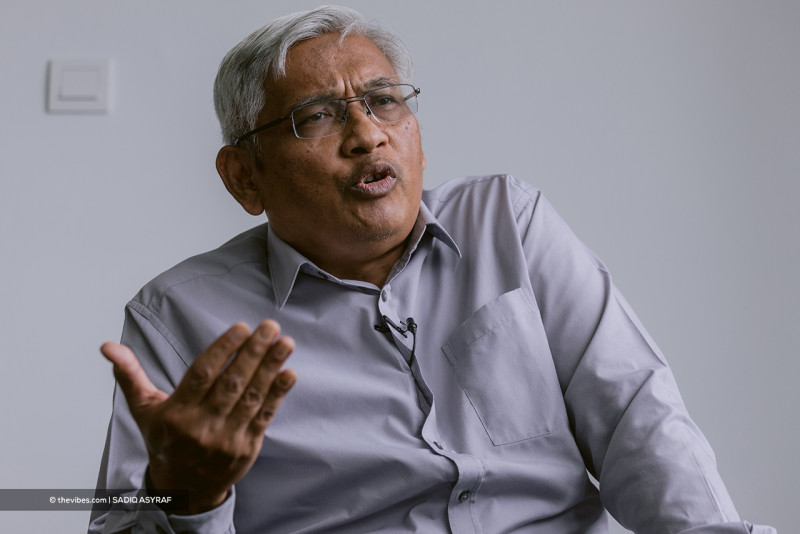
Perak opposition chief Abdul Aziz Bari said Putrajaya has taken too many actions that are not transparent, raising questions about its integrity.
Leaders’ fears have become more apparent with the suspension of Parliament, despite the fact that the king has said sittings can be conducted as usual, he said.
Added to this is the imposition of new laws to allow the government unfettered access to funds, and to restrict the media.
When Seri Paduka Baginda the Yang di-Pertuan Agong himself has decreed the need for Parliament to be held, only for it to go unheeded, it shows that the government is not prepared at all to face the people and perform its administrative process normally again.
“I reckon the Covid-19 situation has abated, with vaccinations taking place. Even though full recovery has not yet been achieved, there are already comprehensive guidelines and certain standard operating procedures implemented,” said Aziz.
With schools reopening and people not compelled to work from home anymore, he said, the situation is surely returning to normal.
He said the scenario shows that parliamentary sessions can indeed resume, without the need for an emergency ordinance to decide on the imposition of certain regulations.
Aziz, who is a political analyst and DAP’s Tebing Tinggi assemblyman, made these comments in an exclusive interview published by Getaran, The Vibes’ Bahasa Malaysia sister portal, today.
While new rules are expected, the real purpose of the emergency declaration is doubtful, he said.
“What is the real purpose of the emergency declaration? If we go back to the federal constitution itself, like how it was portrayed and reported by the Reid Commission, it has no meaning.
“If we reach a stage where we need to use the emergency ordinance for routine matters, then how far will it go before (the habit) ends?
“What if they announce later that elections will be suspended indefinitely, or until the government is satisfied? Wouldn’t that be strange?
“The situation has reached a stage where it is illogical.”
A new provision in the emergency ordinance that allows the government to use funds without parliamentary approval makes people worried about possible misconduct, he said.
Under two new sections – 10a and 10b – of the Emergency (Essential Powers) Ordinance 2021, the federal Treasury, menteris besar and chief ministers can increase their budgets from their respective consolidated funds without getting lawmakers’ approval.

The ordinance also grants the power to bypass paragraph 4(b) of the Government Funding Act 1983 and paragraph 2(2)(b) of the Treasury Bills (Local) Act 1946 on needing Dewan Rakyat approval for the spending of consolidated funds.
The law stipulates that “any such expenditure or withdrawal from the Federal Consolidated Fund or the Consolidated Fund of a State may be made with the approval of the Treasury, or Menteri Besar or Chief Minister of a State”.
The provisions are in force for as long as the emergency is in effect.
The state of emergency is scheduled to end on August 1. However, it can be extended on the advice of the prime minister to the Agong.
Aziz said the problem started when the country’s leaders appeared afraid to see Parliament reconvene, and then came up with the new law.
He recently questioned another piece of legislation to prevent the publication or dissemination of fake news relating to the Covid-19 pandemic and the emergency.
In light of this, he said, the meaning of “emergency” under the constitution needs to be refined.
“What is the definition of an ‘emergency’ as allowed by the constitution?
“And, why should one be declared? What is there to fear? What is there to hide?” he said, stressing that the media is an important platform and the rationale behind the law is confusing.
It was reasoned that the Emergency (Essential Powers) (No. 2) Ordinance 2021, which came into effect on March 12, is to combat fake news relating to Covid-19 and the emergency proclamation, essentially giving the government sweeping powers.
Under this law, those who spread fake news regarding the said matters face penalties, with the courts granted powers to order the removal of such publications.
“For me, the media is vital in the context of democracy. If the media is not free, and there is no legitimate media, then what can we hope for? Who should we depend on?” said Aziz.
“There was once a time when we had to face ‘TV tiga suku’ (brainless TV), but that is not the case anymore.”
The law expert expressed disappointment that Malaysia’s democracy now resembles the situation in Myanmar.
Why should we reach this stage? Why is the media made an enemy? For me, this is unreasonable. Perhaps, if there is a chance for media practitioners to show resistance, we can see what they (the government) will do next.
“I think we are unable and cannot afford to let our position with regard to freedom of speech or the media drop even further.”
It may even reach a stage where the government mulls the reimplementation of the Internal Security Act to allow any party to be detained without trial, he warned. – The Vibes, April 3, 2021