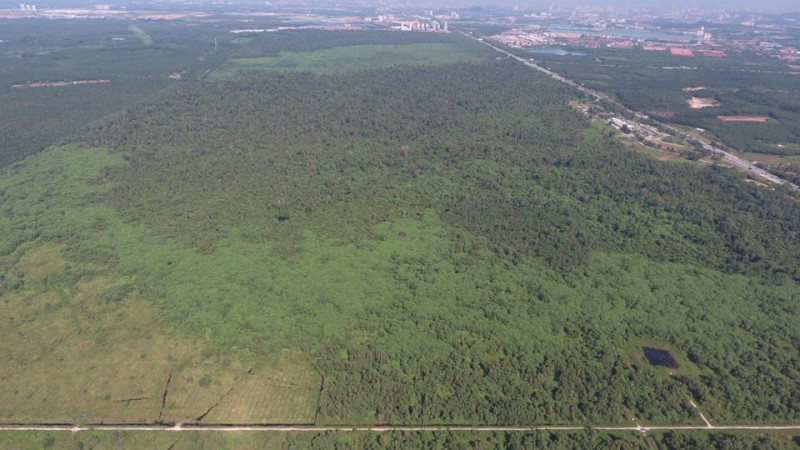

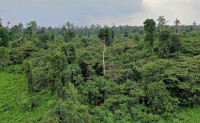
KUALA LUMPUR – One of the more effective ways to protect the Kuala Langat North Forest Reserve (KLNFR) from any attempts of development is to gazette it as a state park.
This is the opinion of environmentalist Sharifah Sabrina Syed Akil in objecting the Selangor government’s plan to degazette 931ha of the forest reserve for a mixed development project.
To further deter development bids, she mooted that the state park there should be named after Selangor’s Tengku Permaisuri Norashikin Abdul Rahman.
“Also, I think that it’s nice to name a state park after Selangor’s Tengku Permaisuri,” she said.
Sabrina is the president of a local green group called Pertubuhan Pelindung Khazanah Alam Malaysia (Peka).
This is the second time she has made the suggestion.
The first one was at a town hall in Pulau Carey last week, where she and other stakeholders voiced their objections over the proposed degazettement exercise.
“This is a tropical country. We need rainforests; without it we won’t get water. We, the people are not stupid anymore. Please, do not bully us,” she said.
Degazetting forest reserves requires a reimbursement of equal value. In this case, the state government plans to replace the earmarked lands with three separate plots.
But such a compensation was rejected by environmentalist and retired Universiti Malaya associate professor Rosli Omar – also a spokesman for green group Sahabat Alam Malaysia.
“You cannot move the wildlife living a single block of forest to three locations. The genetic diversity will diminish. In-breeding will occur, the wildlife will degenerate and die,” he said.
KLNFR is a rank 1 environmentally sensitive area – a rank that disallows developments to be done in said place. It is also one of the few peat swamp forests left in Selangor.
“The Kuala Langat South Forest Reserve is a peat swamp forest but very much degraded due to agricultural activities. There’s another one; the Raja Muda Forest Reserve bordering Perak.
“But basically, there are very little peat swamp forests in Selangor and Malaysia too.”
Peat swamp forests absorb excess rainwater, thus buffering floods in the process and can store carbon emission – up to 20 times more than other types of forests.
Carbon emission is the main contributor to climate change.
In a wildlife survey that he did in mid-February, Rosli found that KLNFR is home to 50 species of forest birds with four that were listed in the International Union for Conservation of Nature’s (IUCN) red list of threatened species.
The four birds are Black-bellied Malkoha, Blue-rumped Parrot, Lesser Green Leafbird and Green Iora.
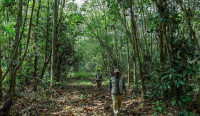
KLNFR also plays a vital role in the livelihood and culture of the nearby Orang Asli settlement, particularly those of the Temuan tribe – which has been living there since 1886.
“Of course, they will be given compensation… but that compensation is just money,” said a Temuan Orang Asli, Shahar Koyok in a video interview with The Vibes on September 30.
“It [the development] will erase our identity. Development should be for the people not forced unto them. Don’t put us under duress.”
He said KLNFR is also home to the Selangor pygmy flying squirrel and siamang (black-furred gibbons) – an endangered species in IUCN’s list. – The Vibes, October 9, 2020










.jpeg)