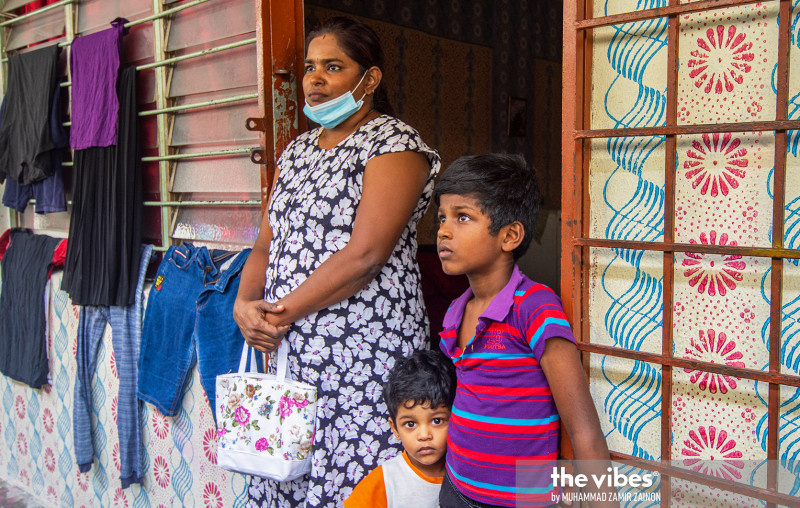

KUALA LUMPUR – Badly affected by the impact of Covid-19, poor families living in low-cost housing in the city centre have been forced to dip into their savings and cut down on food consumption to be able to survive financially.
According to a survey by the United Nations Children’s Fund (Unicef) and United Nations Population Fund (UNFPA), 39% of households surveyed claimed to have been using their savings to mitigate a reduction of income.
A quarter of the families also had to reduce their food intake to financially cope, while about a third said that they are forced to rely on government assistance.
These are among the disturbing findings in the fourth and final edition of the Family on the Edge research project commissioned by Unicef and UNFPA, on the impact of the pandemic on 500 low-income households in KL.
While the number of households unable to meet essential expenses has declined from last year, the survey found that the figure still remains high, with almost half the total respondents (46.7%) facing this problem.
And of these affected respondents, 60% said that they are unable to put food on the table – almost double the number in the pre-pandemic period in late 2019.
The poll showed 58% of households could not afford to pay their bills on time, while 28% are unable to clear their mortgages and rentals.
It should therefore come as no surprise that the vast majority of household heads still prefer cash assistance today, as opposed to any other form of aid.
A total of 42% claimed that the government’s Bantuan Sara Hidup would be most useful, with 18% saying withdrawing cash from the Employees Provident Fund would help the most.
Only 1% preferred rental exemption, compared with 20% a year ago, proving more Malaysians are finding difficulties making ends meet, after a year in various versions of lockdowns.
Meanwhile, 45% of respondents do not currently have social protection, particularly among the self-employed.
Education continues to be a major concern
The survey further found that there are persisting challenges in sending children back to school when schools reopen, particularly in terms of school-related expenses.
About a third of parents have reported facing at least some difficulties in providing enough money for their children to purchase meals after school, as well as with affording tuition fees.
More pressingly, since home-based learning was implemented on various occasions in the past year, 61% of parents claimed their children have lost interest in studying.
And, 78% of them said their children lacked focus in studying due to long periods of lockdown.
_during_online_class_at_Flat_Lembah_Subang_-_Sairien_02.jpg)
The only consolation when it comes to education is that 62% of the families believe the terrestrial educational television channel, DidikTV, has been of help to their children who are forced to stay at home due to various lockdowns.
Despite this, 82.5% of parents still prefer that children attend physical classes rather than online ones.
According to the survey, compared with men heading households, their female counterparts continue to lag behind when it comes to income parity, childcare, employment, and access to opportunity.
They have a much higher unemployment rate at 16%, over three times more that the national average of 4.8% as of February.
Jayamalar Samuel, the UNFPA assistant representative in Malaysia, said that ensuring a more gender-sensitive lens when it comes to policy planning and social protections mechanisms will ensure women do not continue to struggle in a quagmire of economic inequity.
“Instead, they will be able to rise and lead their families towards brighter possibilities,” she said.
What the government should do
The Unicef report claims that the economic effects of Covid-19 are likely to be felt well into 2022, requiring proactive measures to avoid permanent setbacks, especially for women and their children’s wellbeing, and for gender and child-sensitive policies and interventions to be introduced.
Among others, the report proposed the strengthening of Malaysia’s social protection and labour market intervention.
This includes timely and effective implementation of Budget 2021 commitments, expanding access to employment protection and expanding public financing and provision of quality childcare for poor families.
It said that there is also a need to introduce measures to increase income generating opportunities for low-income households.
It also recommended that existing systems be strengthened to ensure equity within education.
This, the report said, can be done by expanding the provision of quality school meals for poor children, furthering innovations in remote learning, and developing a targeted and funded strategy to protect and promote educational attainment.
Additionally, the report suggested the strengthening of mental health services and other services that prevent and respond to gender-based violence and violence against children. – The Vibes, May 11, 2021















.jpeg)