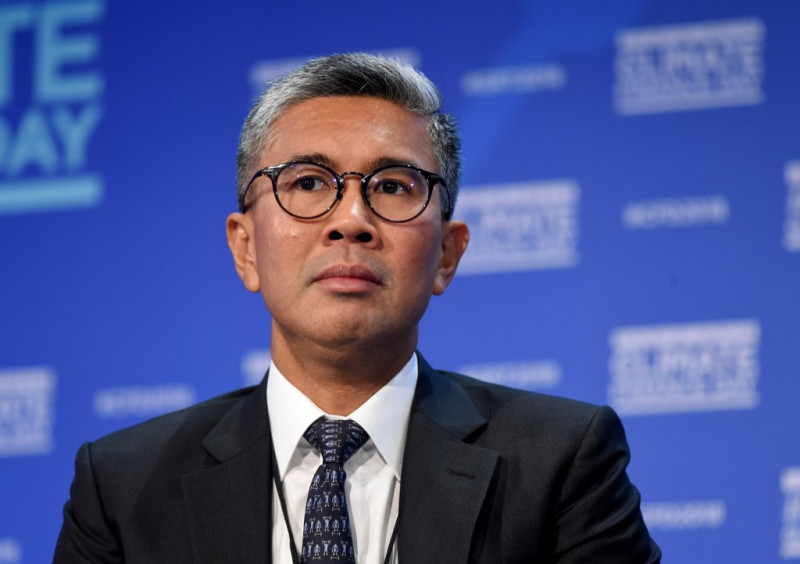
KUALA LUMPUR – Fighting the Covid-19 war is more of a marathon than a sprint, said Datuk Seri Tengku Zafrul Tengku Abdul Aziz, and given this, providing a blanket moratorium is akin to using a sledgehammer to crack a nut.
The finance minister questioned the need to deploy “more resources than necessary” when the journey may well be long and challenging.
“Knowing that those who need temporary relief have options, and those who can afford it have resumed repayments, is a blanket moratorium a smart thing to reinstate, particularly when we know we must optimise our resources?” he said in a commentary published in The Star today.
He said a blanket moratorium means that the government may need to significantly compensate banks for a measure that is not necessary in the first place.
Tengku Zafrul noted that while the Emergency (Essential Powers) Ordinance 2021 allows the government to acquire and mobilise the necessary resources for the public good, any such measure taken must see adequate compensation given to the party that yields its resources towards this end.
Granting a blanket moratorium does not make financial sense, particularly in a resource-tight situation amid a potentially lengthy war against an “enemy” that can mutate without warning, he said.
“I would rather direct those resources, in the form of aid or subsidies, to the rakyat and businesses that need them the most.”
On being quoted in the media as saying Putrajaya cannot compel banks to provide a blanket moratorium, he said his remarks have been taken out of context by “opportunistic quarters promoting their populist agenda”.
Under the Central Bank of Malaysia Act 2009 and Financial Services Act 2013, he said, the finance minister does not have the authority to instruct banks to grant an automatic moratorium.
He added that under the emergency ordinance, any new legislation must be approved by the cabinet and then presented to the Yang di-Pertuan Agong for his assent.
Even if the government decides to play the “populist card” and force the reimposition of measures such as a blanket moratorium, he said, there is a risk of investors’ confidence in Malaysia’s policies being affected for the long term.
As the rule of law is necessary for a stable market, the government’s indiscriminate use of emergency powers could result in parties being forced to break or amend contracts, in turn seriously impacting future business and investments, said Tengku Zafrul.
He said this may have far-reaching implications leading to a run on Malaysia’s capital markets and an outflow of funds, resulting in the ringgit’s value being impacted and the cost of doing business increasing – all grave repercussions for the nation’s economy.
We already have public health and economic crises to manage; why throw a potential financial and banking crisis into the mix?”
It is “neither fair nor responsible for the government to take all these risks just for the sake of enabling a blanket moratorium for everyone, particularly when we know that at least 80% of borrowers do not need it, and banks are already giving or offering targeted assistance to borrowers that really require this relief”.
Recalling the first movement control order (MCO 1.0) last year, he said back then, little was understood of the coronavirus, and vaccines were a “pipe dream”.
In that period, Putrajaya dished out various forms of assistance, including a six-month automatic moratorium that Bank Negara Malaysia and other lenders agreed to provide to all borrowers, he said.
“Everyone enjoyed it, from the B40, M40 and T20 to businesses, big and small. Whether they needed it or not, the rich, the elite, big corporates and even companies recording massive profits benefited.”

After the moratorium period ended in September, about 85% of borrowers resumed repayments, he said, calling it “a strong indication that most Malaysians were able to continue paying off their borrowings”.
Since then, he said, the banking sector has strategically focused on the 15% of borrowers who are struggling by offering the option of a three-month moratorium or a six-month 50% reduction in repayments under Budget 2021, measures that were extended through aid packages like Permai, Pemerkasa and Pemerkasa Plus.
He said a good number of borrowers have been granted other repayment options specific to their financial circumstances.
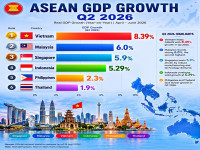
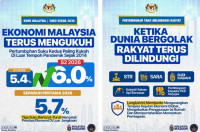
“Thus far, we have channelled over RM200 billion in assistance, benefiting 20 million Malaysians and 2.4 million businesses,” said Tengku Zafrul, adding that the country’s 6% gross domestic product growth in March signalled a good economic recovery.
“Further, in addition to the Budget 2021 initiatives worth RM322.5 billion and the recently announced RM40 billion Pemerkasa Plus aid package, measures worth more than RM100 billion are still available from previous packages to support the people, businesses and the economy.”
He said MCO 3.0 presents another major economic-public health quagmire, but the big difference is that much more is known about Covid-19 this time around, many firms have switched to teleworking, and numerous businesses with e-commerce capabilities have ramped up their online offerings.
Acknowledging that infections this year are higher than the figures recorded in 2020, he said the national vaccination plan has been accelerated with a target of 150,000 doses per day by end-June, setting the country firmly on the path to achieving herd immunity by year-end.
He argued that bringing back a blanket moratorium will end up hurting the people themselves, as the key investors or largest shareholders of banks in Malaysia are public institutions investing and managing funds on behalf of the country.
These shareholders include institutions like the Employees Provident Fund (EPF) and Retirement Fund Inc, which manage retirement funds for private sector employees and civil servants, respectively; Permodalan Nasional Bhd (PNB), which issues unit trust funds for Malaysians; Lembaga Tabung Haji, which manages Muslims’ savings; and, Social Security Organisation, which manages a social security fund for workers, he said.
This unnecessary, self-destructive, over-specified solution to the issue at hand is like cutting off our nose to spite our face.
“In short, it is the general rakyat who ‘own’ the banks. Ultimately, it is the rakyat who will get lower dividends from EPF, Amanah Saham Bumiputera (a fund under PNB), Tabung Haji, etc, if banks suffer losses because of a blanket moratorium.”
Granting such a moratorium means that banks will not get loan repayments to lend to others, and yet, must continue paying interest or profit to depositors, he said.
He said bank profits are also used to build capital buffers so that financial institutions can keep lending to support the economy despite loan losses.
“Without these buffers, lending will be severely constrained. This disrupts the virtuous cycle and halts the ensuing economic benefits that could be created from the efficient movement of capital.
“By ensuring that the banking sector helps all those in need, the government and Bank Negara are not only protecting depositors, shareholders and borrowers, but also ensuring that capital in the financial market ecosystem is efficiently utilised for economic growth. This is the best win-win situation.”
He added that part of his responsibility as finance minister is to avoid decision-making based on narrow, short-term interests meant to serve a populist agenda, and to do what is right for the people, and the country’s market stability and long-term benefits. – Bernama, June 5, 2021