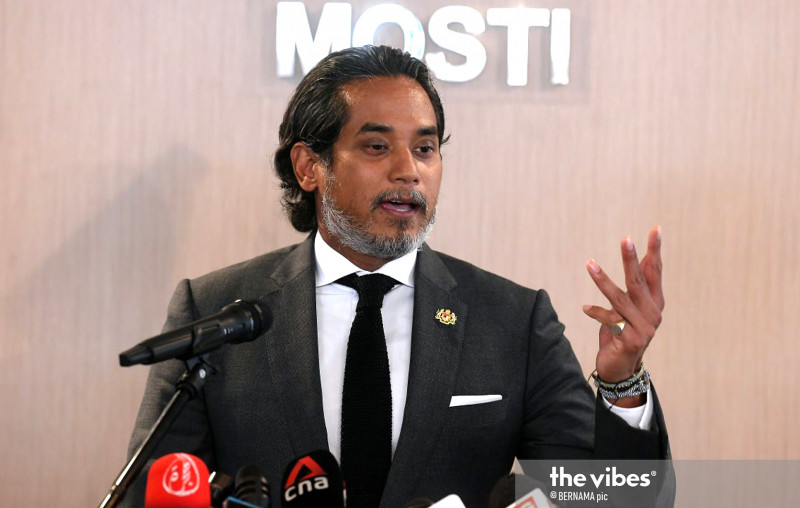
PUTRAJAYA – The third phase of the National Covid-19 Immunisation Programme in the Klang Valley will begin tomorrow at the National Stadium vaccination centre in Bukit Jalil here, said the programme’s coordinating minister Khairy Jamaluddin.
Khairy, who is also the minister of science, technology, and innovation, said this was because 99% of senior citizens in the Klang Valley and 88% in Selangor who had registered for vaccination had either received the first dose of the vaccine jab or received their appointment dates.
He said individuals who had registered to get vaccinated from February 23 would get their appointment dates tomorrow for vaccination at the National Stadium.
“Instead of waiting until we have completed 100% of those who registered for vaccination, I decided to start phase three (after the senior citizens have completely been vaccinated) so that this phase can be expedited.
“If any state has achieved 90% of the first dose of vaccines given or has those registered given received their appointment dates, we will begin the third phase of the immunisation programme,” he said at a joint press conference with Finance Minister Datuk Seri Tengku Zafrul Tengku Abdul Aziz on the National Recovery Plan.
Khairy explained that senior citizens who register after tomorrow’s launch of the third phase in the Klang Valley would still be given priority in the list of vaccine recipients.
In March, Health Minister Datuk Seri Dr Adham Baba was reported to have said that vaccination under phase three involving those aged 18 and above would be from May 2021 to February 2022.
In the meantime, Khairy said that Malaysia’s performance in administering vaccines was good and, in fact, more competitive compared with several of its neighbouring countries, not too far behind Japan.
“Vaccination capacity is actually not a problem, but (the problem) is the vaccine supply schedule due to vaccine inequality worldwide. The government is doing its best to get the vaccines as quickly as possible.
“We will get a supply of 12.8 million doses of vaccines in July and 14.4 million doses in August, subject to delivery. This is the agreement given by the suppliers and this will enable us to reach the target of having 80% of the country’s population vaccinated much earlier than December,” he said.
Khairy also said that as of June 18, Malaysia had received four million doses of the Pfizer vaccine out of the 44.8 million that was ordered, while 3.7 million doses of the Sinovac vaccine had been received from the 12 million ordered.
As for the AstraZeneca vaccine, he said Malaysia had received 828,000 doses from the 7.8 million ordered.
When asked why the government did not expand the use of the single-dose vaccines produced by CanSino Biologics Inc, China as well as Johnson & Johnson, Khairy said that the supply of Pfizer, AztraZeneca, and Sinovac was sufficient for the time being.
“The efficacy of Johnson & Johnson and Cansino is more than 65%. We will use these for those who are difficult to be contacted, such as in the interiors of Sabah, Sarawak, and the east coast, and refugees who are difficult to reach for second appointment dates.
“If both these vaccines are required, we will decide from time to time, subject to the country’s finances,” he said.
Khairy also explained that the reduced daily vaccination tally on weekends was due to some vaccination centres taking a day’s break in accordance with the total vaccine supply.
“But they have assured me that when supply increases in July, they are willing to operate seven days a week,” he said. – Bernama, June 20, 2021