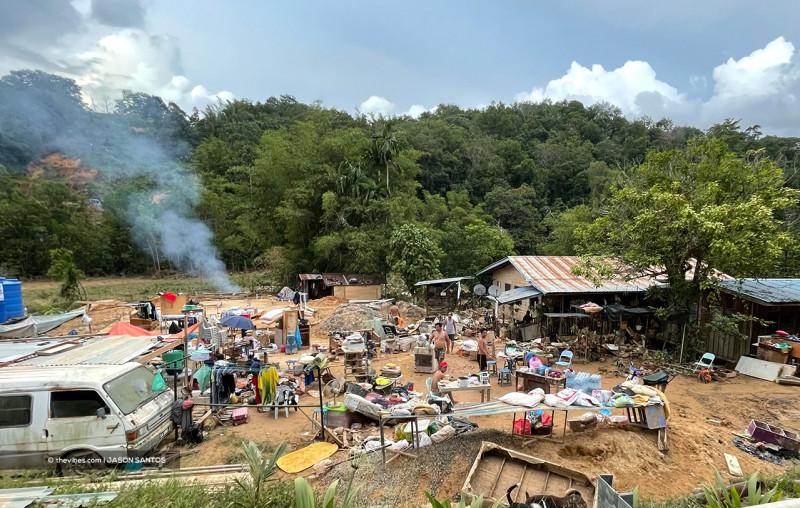

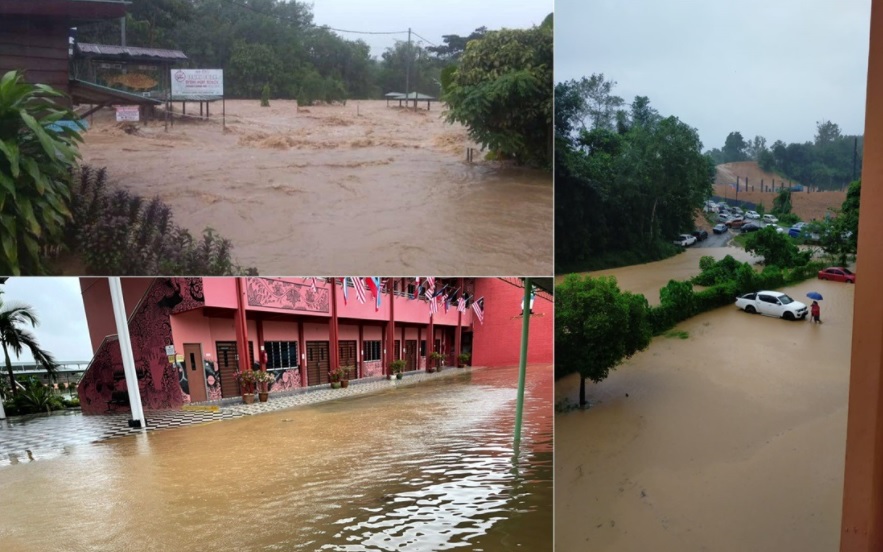
KOTA KINABALU – A leading geology expert has cautioned that unwarranted human activities led to the tragic floods when monsoon rains lashed Sabah recently, and that contrary to popular opinion, global warming plays only a minor part in such disasters.
Prof Rodeano Roslee, director of Universiti Malaysia Sabah’s (UMS) Natural Disaster Research Centre, said most of the landslides that occurred were due to the influence of human activities that contributed to the deterioration of the stability of slopes.
“We often blame technical factors when a landslide disaster occurs despite the fact that human beings build slopes, and when the slopes collapse, it is certainly human beings who should be questioned first,” he said in an interview with The Vibes.
“Therefore, it is important that the parties involved in the construction or repair of slopes in the future open their eyes and be more rational.
“They should not only look for natural causes, but be able to identify and distinguish the human factors and technical factors that cause landslides.”
Human activities are among the factors behind disasters such as road collapses, landslides and floods in Sabah’s west coast, he said, with other contributors being geological and geomorphological processes, as well as geomorphometric conditions, among others.
Elaborating on the said human activities, Rodeano pointed to four major influential factors:
- Negligence (lack of slope drainage system control and maintenance);
- Inefficiency (imperfect and non-standard drainage system design);
- Stubbornness/ignorance (neglect of geological inputs on weathering, discontinuities, geomorphological processes, material behaviour and defects); and,
- Ethical violations (lack of supervision).
“Examples of ethical violations are hiring unskilled workers, lack of supervision on the part of the authorities or consultants during construction, construction not according to proper specifications, and inaccurate data or reports,” said Rodeano.
“The factors listed above are interrelated with each other, and have a very large impact on the cause or causes of landslides or other geological disasters. However, stating the facts, I am not implying that any party should be blamed.”
Last week, Sabah Deputy Chief Minister Datuk Seri Jeffrey Kitingan said the state government needs RM481 million to end flooding issues in Penampang and Putatan districts.
He urged the federal government to provide the allocation in lump sum so that the related projects can be completed at once, highlighting that people have long suffered.
On this, Rodeano said he agrees with Jeffrey that public safety and welfare are at stake, and the problem must be taken seriously.
“In my opinion, the measures to solve the flood problem in Penampang, Putatan, Kota Belud, Beaufort and any area in Sabah need to be taken seriously and proactively. We must think about the safety, lives and welfare of society.
“There is no point in pointing the finger at each other. In addition to finding out the cause of a disaster, we must think of the steps to solve it.
“All this time, we have been busy looking for the cause, to the point of ignoring the solution, when finding a solution is more important. Otherwise, such problems will continue.”

Non-structural approaches part of solution
To avoid fatalities and the destruction of public utilities due to floods, the first step is to identify the areas prone or highly vulnerable to natural disasters.
“Then, we must continue to monitor and implement self-preparedness,” said Rodeano.
“Self-preparedness requires non-structural approaches, such as public awareness, the development of early warning systems, and increasing the level of community resilience.
“A level of preparedness needs to be instilled in the community. If we can accept the risk of disaster, then the community will know how to deal with a disaster. At the same time, the level of community resilience is enhanced.
We must learn to accept the risk of these natural disasters as part of the normal things in our lives. What is important is that we should have a high level of preparedness and awareness.
“In addition, hazard identification and monitoring need to be improved or activated, especially by local authorities.”
The UMS Natural Disaster Research Centre’s findings on natural disasters have been presented at national and international conferences, and published in books and journals.
Members of the research team are also involved as advisers, reference experts and consultants to several government agencies and contractors in Sabah.
Over the past few weeks, monsoon rains have wreaked havoc in the state’s west coast districts, causing flash floods, landslides and collapsed roads in many areas, and disrupting electricity supply to tens of thousands of families.
On Thursday, Special Functions Minister Datuk Abdul Latiff Ahmad said more than 8,000 personnel from various agencies have been placed on standby for deployment should major floods recur in the state.
He said a cabinet paper on alleviating and preventing such disasters was scheduled to be submitted to the cabinet yesterday, following a request from the Sabah government. – The Vibes, September 25, 2021