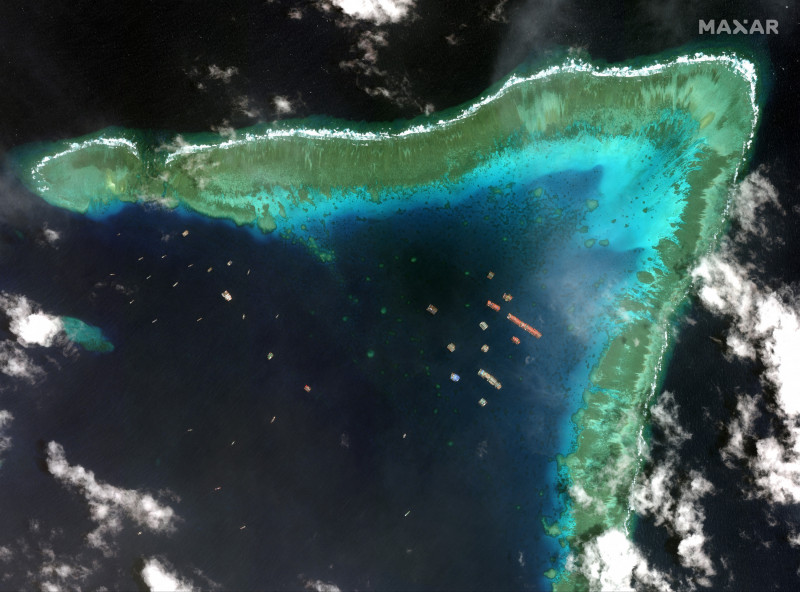

KUALA LUMPUR – A study by the Yusof Ishak Institute conducted last year reported Malaysia as having claims over 10 atolls in the South China Sea within 200 nautical miles of the exclusive economic zone (EEZ), which is also disputed by China, which claims all of it.
The ongoing territorial dispute in the South China Sea, which also involves other Asean countries, has resulted in conflicts on the high seas such as the one on October 4 when Wisma Putra issued a statement protesting the presence of Chinese vessels in Malaysia’s territory. This recent encroachment by China occurred off the coast of Sabah and Sarawak in the EEZ.
However, given Malaysia’s ongoing economic relationship with China, University Malaya’s Asia-Europe Institute senior lecturer Rahul Mishra suggested it would be impractical for Malaysia to drop its territorial claims.
He added that this is especially so given that other Asean countries are standing up against China.
Instead, he emphasised, Malaysia can continue its diplomacy and economic ties but with a firmer approach to its territorial claims.
“Trying a different approach where Malaysia warms up to countries hostile towards China would also prove detrimental,” said Rahul.
Malaysia bringing in China’s so-called enemies into the picture has its pros and cons, but because such an approach would make China jittery, leaving out the United States and other countries would be prudent.”
Instead, he said, the European Union (EU) may be the best partner for Malaysia with regard to its conflict with China.
This is because, according to Rahul, the EU is aware of the conflict but puts emphasis on broken rules instead of the wrongdoers, as opposed to other players in the region.
“The EU is a good partner as it has a balanced approach, which is focused on the rules. They are aware of the wrongs, but they are concerned with the laws as opposed to the actor.
“These types of stakeholders can be brought into the conflict as a stabilising mechanism,” Rahul added.
Meanwhile, University Malaya’s Department of International and Strategic Studies senior lecturer K. S. Balakrishnan also contended that Malaysia will maintain its claims in the South China Sea to safeguard sovereignty over the EEZ.
However, he suggested that the best method for Malaysia and other Asean countries to resolve the conflict is to return to the United Nations Convention on the Law of the Sea and make use of the International Court of Justice (ICJ).
While diplomacy may be the best method to avoid tension, Balakrishnan said it does not seem to be putting the brakes on China.
“Diplomacy is good for reducing tension, but it’s not stopping China’s territorial claims and maritime invasions.
“The best thing to do is for Malaysia to strengthen its military positions in the EEZ and refer the conflict to the ICJ,” Balakrishnan said when contacted. – The Vibes, October 18, 2021