
KUALA LUMPUR – Pakatan Harapan (PH) communications director Fahmi Fadzil has panned Minister Datuk Abdul Latiff Ahmad over the latter’s parliamentary reply that private telecommunication companies (telcos) may ignore areas where they lack clients, leaving the government little choice but to form Digital Nasional Bhd (DNB).
Speaking to The Vibes, the Lembah Pantai MP pointed out that PH’s National Fiberisation and Connectivity Plan – which was discontinued in favour of Perikatan Nasional’s DNB – had already taken into consideration that particular issue and found a solution.
“The answer given by Latiff in Parliament today – that private telcos may ignore low-density residential areas or areas where they lack customers in the 5G rollout – blatantly ignores the fact that the Malaysian Communications and Multimedia Commission itself has set up a specific fund to build telecommunications towers in under-served areas.
“In Malaysia, telcos contribute 6% of their weighted annual net revenue to the universal service provision (USP) fund.
“This means that billions of ringgit can be used to deploy towers in commercially less-viable areas, totally contrary to what the minister has said,” said Fahmi.
The USP that the opposition lawmaker referred to was established circa 2002, where contributions to the fund are calculated based on the submitted return of net revenue from designated services by all licensees – which are telcos.
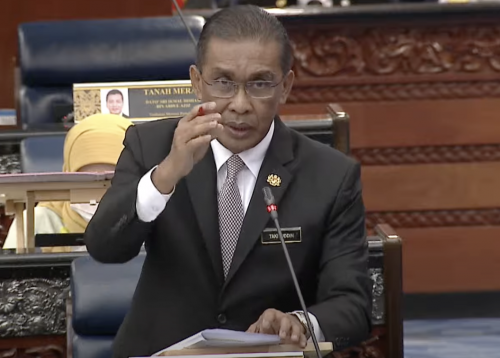
Earlier, Latiff – who is the minister in the Prime Minister’s Department (special functions) – came to the defence of DNB when questioned by Pejuang’s Jerlun lawmaker Datuk Seri Mukhriz Mahathir, who criticised the special purpose vehicle.
The Bersatu minister said telcos have their own private interests, seeing that – as listed companies – they are answerable to their shareholders.
In his argument, Latiff cited Maxis Bhd and Axiata Group Bhd as his examples.
Fahmi rebutted the statement, saying both telco giants have a strong percentage of public shareholdings, and that it is disingenuous to say the two corporations must kow-tow to what their shareholders want.
For example, 24.8% of Maxis is held by government-linked investment companies:
• Employees Provident Fund (EPF) (11.9%);
• Permodalan Nasional Bhd (PNB) (10.3%);
• Retirement Fund Inc (KWAP) (1.4%); and
• Urusharta Jamaah Sdn Bhd (1.2%).
On another note, Axiata is 58.9%-owned by the following public entities:
• Khazanah Nasional Bhd (Investment Company) (36.7%);
• EPF (16.9%);
• PNB (16.6%);
• KWAP (2.9%);
• Bumiputera Investment Foundation (1.6%); and
• Urusharta Jamaah (0.8%).
“As such, we don’t fully know yet how this DNB 5G rollout strategy may adversely affect the dividends to be paid out to public shareholders – especially over the lifetime of whatever contractual agreement DNB would like to have with telcos,” said Fahmi. – The Vibes, November 3, 2021