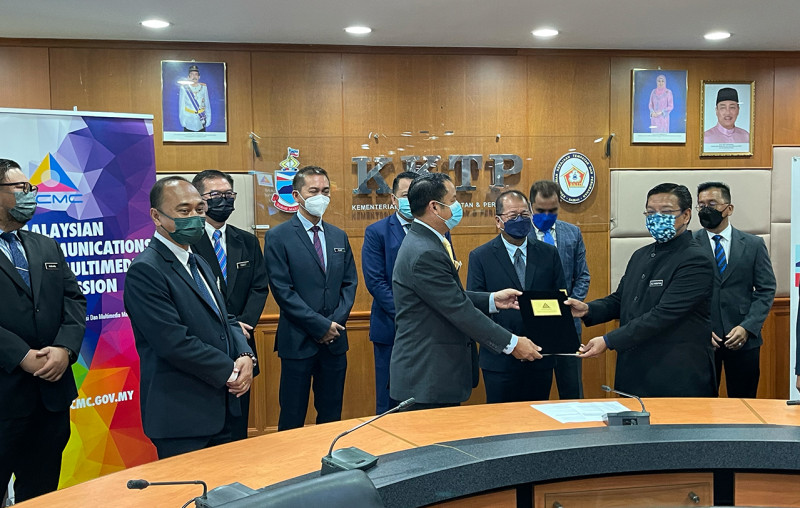

KOTA KINABALU – Several local governments in Sabah have signed a memorandum of understanding (MoU) with the Malaysian Communications and Multimedia Commission (MCMC) to regulate telecommunications towers in the state.
This will allow the local governments to access the Communications Infrastructure Permit Management (CIPM) to prevent leakages from telecommunications towers operating illegally in the state.
Sabah’s Assistant Local Government and Housing Minister Datuk Isnin Aliasnih said the application of CIPM will allow the local governments to generate a new revenue stream of income.
“CIPM will ensure that there will be no more illegal telco towers. By registering them, in a way, this could help increase the income of our local governments.
“At present there are many illegal telco towers built across Sabah,” he told reporters after the MoU signing ceremony, here, today.
Also present during the ceremony were Sabah local government senior officials and MCMC chief operating officer Datuk Mohd Ali Hanafiah Mohd Yunus.
Eight local governments signed the CIPM memorandum, and they were represented by the presidents and executive officers of Sandakan Municipal Council, Tawau Municipal Council, Kudat Town Board, Penampang District Council, Putatan District Council, Tuaran District Council, Beaufort District Council and Keningau District Council.
On the Jendela programme, Isnin said, RM3.61 billion has been allocated between 2020 until next year to build 588 substations, adding that tenders have been opened for bidding.
Isnin said so far 79 substations of 588 substations, 2,337 of 3,500 transmission stations, 109,000 of 250,000 fibre optic premise passes and 20 of 138 broadband satellites have been completed.
“There will be no reason for Sabahans to climb trees to get internet service anymore,” he said in reference to Veveonah Mosibin, a Universiti Malaysia Sabah student who had resorted to climbing a tree to get internet access.
Meanwhile, Ali Hanafiah said the MoU is not a way to penalise illegal tower operators, it is also to avoid the duplication of towers in some areas, which are currently funded by private telecommunication companies.
According to him, MCMC wants to reach out to the illegal tower operators and work with them, given that demand on internet services have grown in Sabah.
However, in the process of including them in the CIPM, they will still be fined for erecting illegal towers, he said.
“We may not be asking them to remove their towers, but we will still fine them for not having the necessary permits to build them.
“We want these towers to be in the CIPM because the telcos had built them first before getting the permits in the past.
“They built them because there was already existing consumer demand,” he said.
Ali Hanifah also assured all the projects under the Jendela programme will be expedited in Sabah, adding that the fibre optic premise pass, broadband satellite and tower projects will be completed latest by March 2022. – The Vibes, November 23, 2021