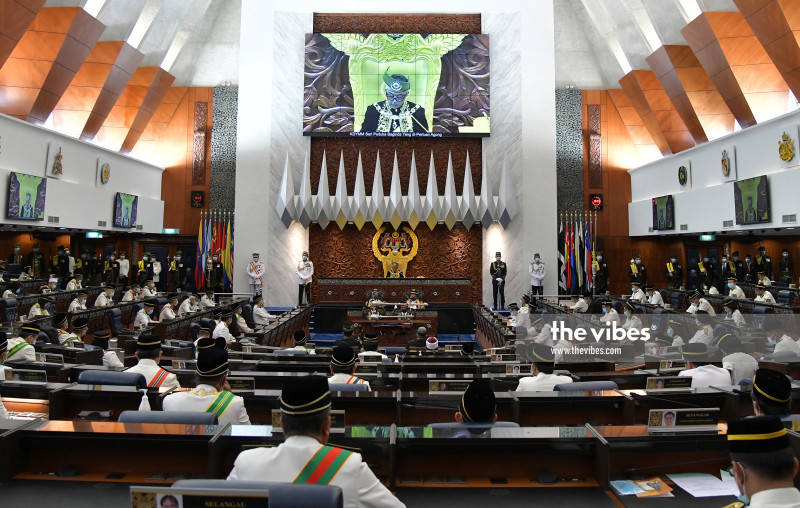

KUALA LUMPUR – The Dewan Rakyat successfully passed constitutional amendments giving greater recognition to the Malaysia Agreement 1963 (MA63).
In the Dewan Rakyat, 200 MPs voted in favour of the amendments during the second reading with 20 absentees.
Meanwhile, during the third reading, 199 MPs voted in favour with 21 absentees.
None of the MPs objected to passing the amendments.
The constitutional amendments are for the restoration of the original status of Sabah and Sarawak as equal partners in the federation of Malaysia, defining the terms of the federation to include MA63.
Sabah and Sarawak had been downgraded to mere states in the constitutional amendment made in 1976, which many East Malaysian MPs claim was a violation of the federal constitution as stated in article 161E.
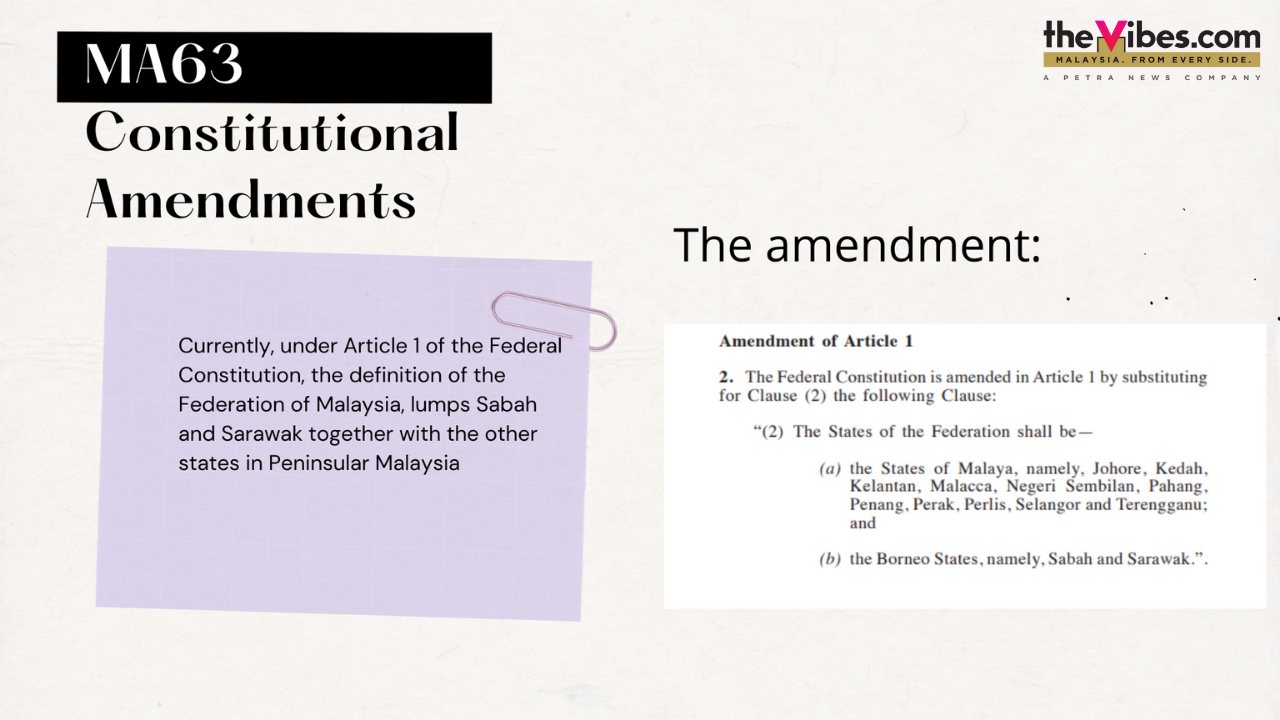
The amendments today will see changes to Article 1(2) of the federal constitution, listing Sabah and Sarawak as states of the Malaysian federation separate from peninsular states.
More importantly, the changes to the federal constitution would also see a redefinition of “federation of Malaysia” to give recognition to MA63.
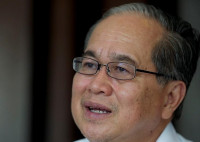
During his winding-up speech, Minister in the Prime Minister’s Department (Parliament and Law) Datuk Seri Wan Junaidi Jaafar explained that the legal redefinition of the “federation of Malaysia’ takes into account the Federation of Malaya Agreement 1957, MA63, and the agreement concerning Singapore’s cessation from the country.
On whether there would be more devolution of powers on public health and education to both Bornean states, Wan Junaidi said such issues will remain an important agenda of the federal government and are being considered by the Special Council of MA63.
Meanwhile, as for the recommendation to include Sabah and Sarawak as an “equal partner” to the Malayan Federation, Wan Junaidi says such a proposal was not included in MA63.
Instead, he suggested, it was actually included in the Cobbold Commission Report.
“Findings in the Cobbold Commission Report are not an instrument that ties the parties who agreed to MA63, and cannot override MA63 or the federal constitution," Wan Junaidi said.
Initially, in 2019, the then-Pakatan Harapan administration attempted to pass similar amendments in Parliament, but failed when a significant number of MPs from Gabungan Parti Sarawak abstained from voting.
However, this time, the government led by Prime Minister Datuk Seri Ismail Sabri was successful in passing the amendment, given that it was one of the conditions stated in the memorandum of understanding between his administration and PH, which is now in the opposition.
On October 18, the Special Council on MA63 – chaired by Ismail Sabri – agreed to the proposal brought forward by Wan Junaidi to redefine some provisions in the constitution within the context of MA63.
'Dignity for Sabah and Sarawak'
In a statement issued later, Wan Junaidi explained that when Malaysia was formed in 1963, some promises in MA63 were not included in the federal constitution and as such the agreement itself was not truly recognised.
“What we are doing here is to place MA63 in the federal constitution in order to form the real Malaysia in the context of the three agreements – Federal Agreement 1948, Federal Agreement 1957, and MA63.
“It gives dignity to Sabah and Sarawak as being part of Malaysia, as creators of this country,” he added.
.png)
Wan Junaidi said that by recognising MA63 in the federal constitution, the government can now refer to all the promises made in 1963 in detail and spell them out in the Inter-Governmental Committee report, which is the in-depth study of the Cobbold Commission Report on the demands of Sabah and Sarawak.
As a result of this, the federal government can no longer say the demands from Sabah and Sarawak are not in the constitution or in the law of Malaysia because they are already in the federal constitution, he added.
To questions on the tangible benefits derived from this, Wan Junaidi said not everything is about material and monetary benefits.
“This is about recognition of Sabah and Sarawak as the states in Malaysia – with a difference,” he said.
“An example of this would be having control over their own immigration borders, complete control over their own natural resources including oil and gas, forest and land, and all things found under the subsoil of Sabah and Sarawak.
“In fact, Sabah and Sarawak should also have their own judicial commission, which we still do not have, despite it being one of the promises under the agreement.
“As per the agreement, the Sabah and Sarawak governments, via their governors, should have the authority to appoint the commissioner, unlike any other states,” he added. – The Vibes, December 14, 2021
.png)