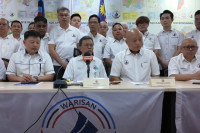

KOTA KINABALU – Sabah opposition party Warisan is mulling the formation of a special committee within the party to make its own studies and recommendations on floods in Sabah.
Its deputy president Datuk Darell Leiking said that conclusions from the committee will be adopted in the party’s manifesto, and will also be presented to the Gabungan Rakyat Sabah (GRS) Sabah government from time to time.
“As a responsible opposition, Warisan will set up a special committee the party’s divisional members all over the state will participate in, to monitor the issue of floods in Sabah and also the state government’s performance.
“The issue of floods and landslides in Sabah goes beyond politics. All parties need to do their designated tasks to ensure that this issue is mitigated, if not totally solved,” he said in a statement today.
Leiking said the committee will monitor projects such as hill-cutting and clearing, reclamation work, and drainage system management at flood-prone areas, among others – all of which have been identified as causes of flash floods.
He said that when Warisan was the state government, it had plans to reassign several state departments and agencies to state ministries.
For instance, three state departments, namely the Drainage and Irrigation Department (DID), the Environment Protection Department (EPD), and a new fully fledged Geology Department were to be assigned to a single ministry, which had yet to be decided then.
He said that the rationale behind assigning DID and EPD under a single ministry was to push the state’s investment and industrialisation in a planned and sustainable way.
Meanwhile, Leiking said, the creation of the Geology Department is necessary, seeing that Sabah needs dedicated experts to study water and soil movements so as to advise the administration about flood prevention.
He said this also has the effect of not being overly dependent on engineers in the Public Works Department, seeing that geology and engineering are two very different fields of study.
Leiking said it was unfortunate that Warisan was not able to proceed with the reassignment due to the change of the state government last year, but it will become a part of Warisan’s manifesto later.
He urged the GRS government to make solving the issue of floods a priority and exhaust all preventive measures to prevent catastrophes from befalling Sabahans as had happened at Kg Sugud on September 16.
“The problem with flooding is that most people, including the state government and local authorities, tend to forget about it when the dry season comes, but what most people do not realise is that those who living in flood-prone areas are in constant threat every single day of major floods that could happen anytime, no thanks to decades of unmonitored hill clearing and cutting, land reclamation work, and climate change.
“Hence, development funds or allocations received by the state government should be channelled firstly for the purpose of flood prevention measures.
“With global climate change and the increased rainfall we’re experiencing this year, I think 2022 will be no different, as monsoon and flash floods will continue to pummel us unless the state government makes flooding a priority to be solved,” he said.
The Penampang MP also said he is concerned that prices of goods from the peninsula will skyrocket in Sabah due to the floods in Selangor.
He estimated that the prices of goods, including processed foods, vehicle spare parts, and electrical appliances, will increase between 10% and 15% in Sabah.
Leiking pointed out that around the world, major floods or disasters always impact supply chains, especially in the manufacturing and logistic sectors.
He said this stems from a sudden increase in demand for vehicle replacement parts, coupled with manufacturers themselves being unable to operate efficiently, sending product prices soaring.
“The biggest loser of all would definitely be Sabah since we don’t produce our own vehicles’ spare parts and are highly dependent for the same from the peninsula. When demand is already high, additional shipping and land logistic costs in Sabah will exacerbate matters. We have seen how this impacted our local farmers in relation to the price of imported herbicides,” he said.
Leiking, who is also a former international trade and industry minister, said that the GRS-led state government is obliged to ensure that the prices of goods remain under control.
He said that the ruling coalition must constantly engage with business communities in Sabah, especially those dependent on supplies from the peninsula such as distributors, micro-businesses operators, and small and medium industries to understand their predicaments or dilemmas on this matter.
“If the price hike does happen, Chief Minister Datuk Seri Hajiji Noor and his cabinet should not blame traders or suppliers because it is the role of the government in the first place to prevent profiteering through strategic engagement, monitoring and enforcement with all the stakeholders.
“At the end of the day, ordinary Sabahans are the end consumers we’re supposed to protect,” he added. – The Vibes, December 30, 2021