

KOTA KINABALU – The statement by Plantation Industries and Commodities Minister Datuk Zuraida Kamaruddin that orangutans kill people at first sight is not entirely accurate, according to experts and conservationists in Sabah.
Contrary to the minister’s view as well, orangutans do not come under the authority of the Wildlife and National Parks Department (Perhilitan).
Speaking to The Vibes, Benoît Goossens said that her views are not even worthy of a response.
“She should request a thorough briefing from experts on the subject.
“To start with, call the authorities in Sabah, since Perhilitan has no authority over orangutans,” said Goossens, who is with the Danau Girang Field Centre.

Human-killing orangutans and lions in Malaysia were among some of the claims made by Zuraida, which courted fierce public criticism.
Zuraida was seen in a video taken on January 5 claiming that she found books used in Arab schools saying that Malaysia’s palm oil industries are killing orangutans.
To that, she said that it is more likely for the primates to kill humans first.
“I was talking to our ambassador there (in Mecca), and he told me that in schools in Arab countries, which his students go to, the books paint our palm oil industry in a bad light and say we kill orangutans.
“In Malaysia, if you see an orangutan, it will kill you first, you won’t kill it first. Right?” she said.
Zuraida added that there are procedures for coming across wildlife in the jungle, and then implied that there are lions in Malaysian forests.
“Perhilitan has its policies. Do you think they simply go and kill orangutans?
“Even lions and tigers will not kill when they see you. There is a procedure to tranquilise them and then take them to the zoo or whatever.”
The Plantation Industries and Commodities Ministry later said that the video was taken out of context.
It said that Zuraida made the speech during a closed-door event organised by the Malaysian Palm Oil Council recently.
“Unfortunately, the clip was edited in a way that does not do justice to the context of the minister's speech.
“In fact, some have tried to spin the minister's words, which were merely said in jest, to cast aspersions on her and the ministry,” the statement by the ministry read.
It said that the minister was merely sharing her experience during a recent trip to Saudi Arabia, where the Malaysian envoy there touched on matters he learnt regarding palm oil.
One of the people who shared the video was PKR vice-president Rafizi Ramli.

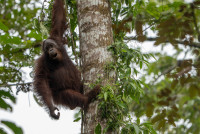
Another expert told The Vibes that far from being hostile, orangutans are quite docile and non-aggressive.
“They normally move away when humans present and sometimes vocalise from above the trees, which they rarely or never come down from.
"Orangutans are not a threat to humans," said the expert veterinarian who requested anonymity.
He noted that orangutans are intellectual and are capable of showing considerable ingenuity and persistence, particularly in manipulating mechanical objects.
“They have demonstrated cognitive abilities such as causal and logical reasoning, self-recognition in mirrors, deception, symbolic communication, foresight, tool production, and use.
"In the wild, orangutans use tools, but at only one location in Sumatra do they consistently make and use them for foraging. In this context, they defoliate sticks of appropriate size to extract insects or honey from tree holes and to pry seeds from hard-shelled fruit,” he said.
Translated directly, “orangutan” means forest people. The apes are native to the rainforests of Indonesia and Malaysia and are found only in parts of Borneo and Sumatra. During the ice age, however, they ranged throughout Southeast Asia and South China.
The mammals live mostly atop trees, where they build nests, and move from one place to another on the trees.
Research published in the Current Biology journal notes that deforestation, driven by logging, oil palm, mining, and paper mills, has killed 100,000 orangutans since 1999.
Instances of orangutans being poisoned, killed, and tortured have also been reported in Sabah, mainly near oil palm plantations, although local wildlife authorities have rarely made public the deaths of this endangered species.

Biologist and environmentalist John Payne said that although he understands the intended views of the minister, it shows that the national level has not defined a sensibile and accurate policy on orangutans.
This is due to the dire lack of knowledge and understanding of the mammal. Work ongoing in eastern Sabah shows that orangutans, oil palm, and forest conservation can be compatible at a landscape scale.
“Sadly, the palm oil industry doesn't realise this. They should engage the authorities in Sabah, as well as expert practitioners,” he said.
Over the years, Malaysia's palm oil industry has been scrutinised by the European Union, resulting in the industry being painted in a bad light.
In response to this, the Malaysian Palm Oil Council has taken on the role of improving the global image of the country’s oil palm sector.
Environmentalist Alexander Yee advised the minister to read up more before making such uncouth comments, saying her role is to help the industry, not destroy it.
1Stop Borneo Wildlife’s Shavez Cheema said he has never heard of cases of orangutans being violent to humans.
Shocked by Zuraida’s comments, he said the minister should not be issuing misleading and wrong views. – The Vibes, January 21, 2022
Additional reporting by Rebecca Chong












.jpg)