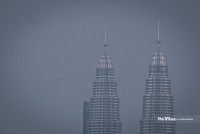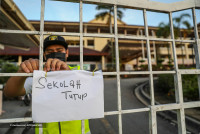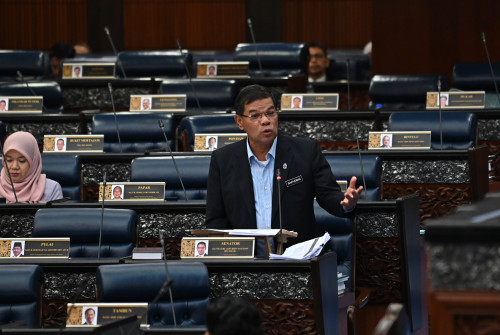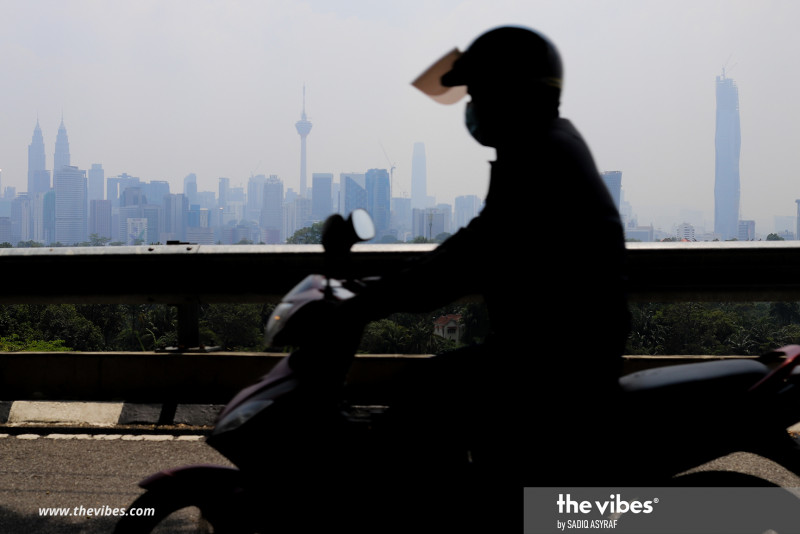

KUALA LUMPUR – Despite facing the scourge of haze pollution for over three decades, Malaysia still does not have any specific law to address or prevent the problem, experts and authorities concurred at a special meeting on the issue today.
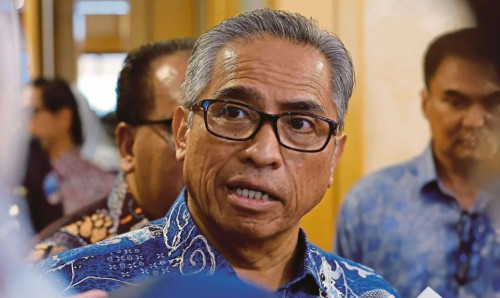
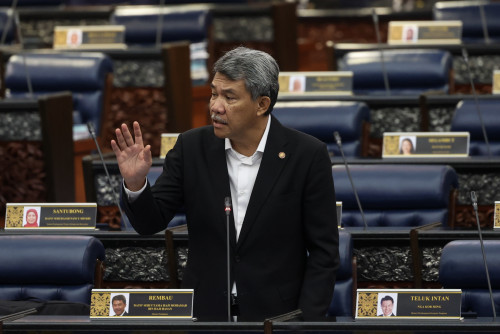
Datuk Mah Weng Kai, a commissioner of the Malaysian Human Rights Commission (Suhakam), warned that the issue of haze in the country has, in fact, worsened over the past twenty years.
He said the absence of laws will only allow more such problems, especially with large projects that can be damaging to the environment in the offing.
He also expressed concern about a lack of enforcement against such activities via a legal framework and legislation on environmental issues.
He added that another barrier Malaysia faces in protecting itself from threats against clean air is the blame game that Malaysians tend to drop on Indonesia whenever haze happens.
“I believe that this is a problem that should be shared equally, as there is also slash-and -burn going on in this country,” he said.
Mah was speaking at a press conference at the conclusion of a two-day roundtable discussion titled Right to Clean Air: Addressing Haze Pollution in Malaysia, organised by Suhakam.
The event was supported by the Cerah Anti-Haze Action coalition and international environmental group Greenpeace.
The discussion was organised following a complaint sent by the coalition to Suhakam in December last year.
It had urged for Malaysia’s governance – in relation to domestic and trans-boundary haze pollution – to be examined so as to protect the people’s right to clean air.
Participants helped to identify causes of the problem and discussed plausible solutions that can be taken.
Report to be sent to govt, stakeholders
Mah said that the outcome of the discussion will be compiled in a comprehensive user-friendly report that will be shared with relevant parties and the public to encourage new policies to be formulated.
“We will be sending it to the government, the various ministries and agencies, and all stakeholders who are involved in this problem.
“Hopefully, there will be firm policies put in place to face these issues,” he said, stressing that action is needed to ensure citizens benefit from clean air.
He added that this must be a public interest issue and will not just be limited to a few people to act upon.
“Everybody will have a say in this,” he said.
Be proactive, not reactive
United Nations Security Council ombudsman and former chief justice Tun Richard Malanjum said that the occurrence of open burning is still widespread in Malaysia, especially in Sabah and Sarawak.
He said the country is still ill-equipped to tackle open burning on a huge scale, while also being backward in enforcement and legislation.
“I think as a society, we are very reactive instead of proactive, because we only make a lot of noise when the haze is around and become completely silent once it is gone,” he said in his keynote speech.
“As long as we do not have a proper Act to tackle this trans-boundary haze problem, I think we are only good at talking when the haze comes.”
Malanjum also pointed to the Malaysian Bar’s proposal for an amendment to Order 70 under the Rules of Court 2012, saying that had it been approved, Malaysia could have had a “quantum leap” in environmental protection.
He explained that the proposed amendment was intended to address archaic environmental laws by altering them with a rights-based approach.
He said this would allow people to enforce their right to a healthy environment, in alignment with international norms.
Official Secrets Act: hindrance to public involvement?
Meanwhile, constitutional law expert Prof Datuk Shad Saleem Faruqi pointed out that courts in some foreign countries embrace constitutional rights by ordering their respective governments to enact legislation and regulations aimed at reducing air pollution.
However, this is not the case for Malaysia.
He claimed that this might be due to the existence of the Official Secrets Act (OSA), which prohibits the public from acquiring any information as it is marked as classified by the government.
“There should be public participation in environmental impact assessments to ensure transparency, but sadly in Malaysia, the OSA stands in the way,” he said.
Shad stated that this has contributed to Malaysia scoring poorly on the environmental democracy index, as the OSA limits the public’s access to information on environmental quality.
He decried the inadequate measures for public participation in the decision-making process as “a sham”.
Despite there being some 30 pieces of legislation on matters related to forests, wildlife, rivers and environmental impact, these laws are not adequately enforced in the country, he further lamented.
“Malaysia’s constitution does not explicitly recognise any environmental rights, nor does it impose clear-cut duties on the federal or state government to create intergenerational justice in adopting development policies or in handling the environment,” he said.
“Until Malaysia has a constitutional amendment to incorporate all these into the fabric of our basic law, the courts must rely on a prismatic interpretation of Article 5(1) to safeguard these and the enumerated non-textual implied right.” – The Vibes, March 11, 2022