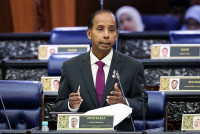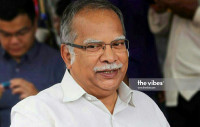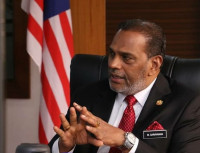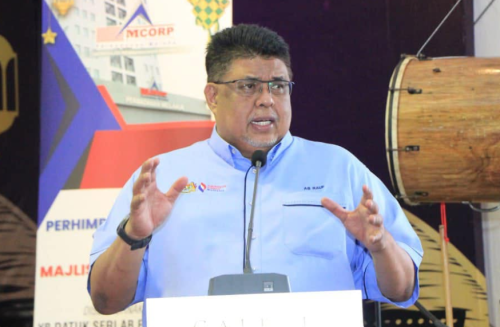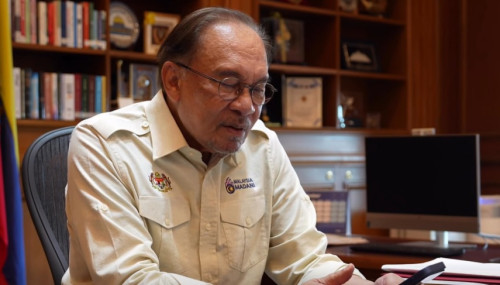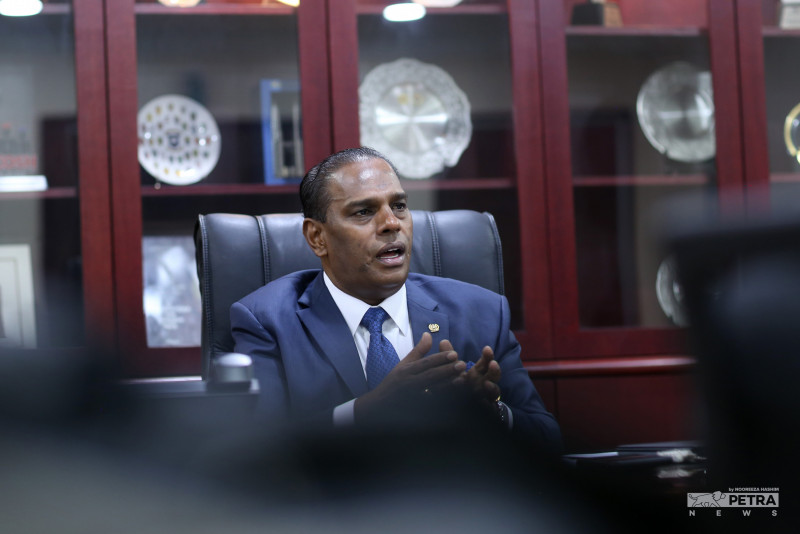

KUALA LUMPUR – Human Resources Minister Datuk Seri M. Saravanan appears to have put his predecessor M. Kulasegaran in his place by claiming to hold a far superior track record than the latter when it comes to their ministerial performances.
This comes on the back of a war of words between the two political leaders in the past few days over the issue of forced labour.
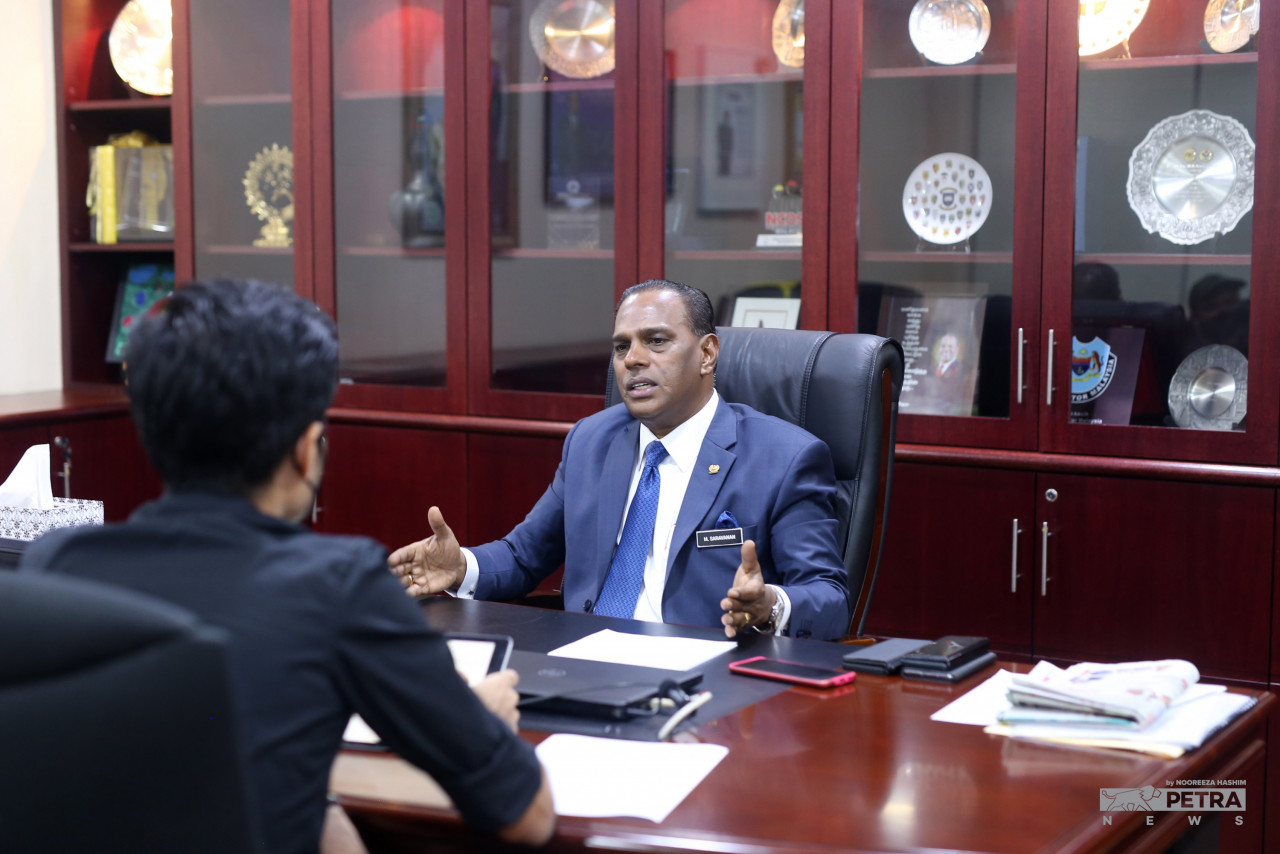
Speaking to The Vibes, Saravanan said that since assuming his ministerial post in March 2020, the state of forced labour in Malaysia is now in a much better place.
Among other things, the MIC deputy president said when he first took over the portfolio, issues of migrant workers’ welfare, including wages and accommodations, had not been addressed.
These, he said, have now either been tackled or are in the midst of improvement.
As of today, as compared to what Kulasegaran has done, I am so much different. Apple for apple, there’s a huge gap, when you consider how he has wasted his two years (sic) in office.
“Anybody can witness this. So yes, if you are comparing me to him, I’m far better,” he said.
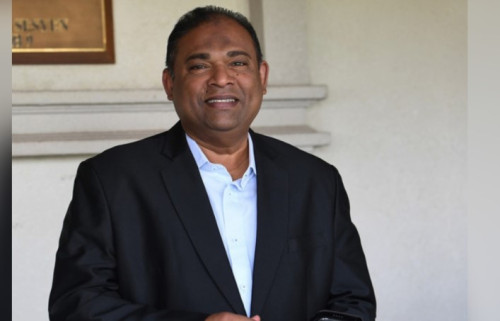
Kulasegaran, who is DAP’s Ipoh Barat MP, was appointed human resources minister following Pakatan Harapan’s (PH) victory in the general election of May 2018. He remained in the post until the PH government collapsed in February 2020 to be replaced by Perikatan Nasional.
According to Saravanan, among the steps he has taken to improve the issue of forced labour here are the introduction of the e-wages system to monitor migrant workers’ salary payments and the enforcement of the Employees’ Minimum Standards of Housing and Amenities Act 1990 to provide proper living conditions.
Apart from that, the Tapah MP noted that he has introduced centralised labour quarters (CLQs) for migrant workers, ratified Protocol 29 of the International Labour Organisation (ILO) on forced labour, and introduced a National Action Plan on Forced Labour.
The ratification of Protocol 29, which was formalised by Saravanan at the ILO headquarters in Geneva on March 22, is regarded as an official move by Malaysia to fight forced labour on an international level. It meant that effective measures would have to be taken to prevent forced labour, protect victims and ensure their access to justice.
“Previously, DAP was sitting in this same seat for two years, but there were no enforcements,” Saravanan said.
“They have done nothing – not one of the (items) that I’ve accomplished. If he (Kulasegaran) has done all these, then he has the right to question me,” he said.
Not 100% satisfied
Saravanan and Kulasegaran have been locking horns since last week after the minister urged the ILO and the United States embassy here to notify his ministry about any investigations into forced labour in order to find solutions, rather than have products manufactured in Malaysia blocked from entering the US.
Kulasegaran scoffed at Saravanan’s remark, calling it laughable and a poor attempt at covering his own inability to eradicate the longstanding issue of forced labour. The duo has continued to exchange words over the media since.
Saravanan said while he has performed considerably better than his predecessor, he will not rest on his laurels just yet until forced labour is entirely eradicated here.
I won’t say I’m 100% satisfied. There’s more to be done... I want to do far better than this, but it involves a process. I cannot implement it overnight, I need time.”
He said that he is chiefly hoping to get all migrant labourers in the country to be placed in CLQs for better monitoring.
According to Saravanan, the success of the CLQ implementation alone would see Malaysia fulfil up to five of ILO’s 11 indicators of forced labour, including conducive accommodations, retention of identity documents, and withholding of wages.
“We have also signed memoranda of understanding on labour issues with three countries, namely Bangladesh, Indonesia and Vietnam. Soon, this will include Cambodia, Nepal and India.”
Debating with Ramasamy, ‘broader spectrum’
Saravanan also did not mince his words as he took a swipe at Penang Deputy Chief Minister II P. Ramasamy, who has similarly lambasted the former over his handling of forced labour and recently challenged him to a debate.
The Tapah MP had on Sunday said he accepted the challenge, on condition that the debate be confined to Ramasamy’s criticism of his request for information from the ILO and the US on allegations in relation to Malaysia. He had said that he is available for the debate at 2pm on May 22.
The DAP man has, however, declined to accept the date that was fixed unilaterally and insisted that the debate also cover the broader spectrum of forced labour.
Asked if he was still open to negotiate on the conditions of the debate, Saravanan said while he does not mind, he does not see a need to engage with his critics who themselves do not have any success stories to be shared.
“He (Ramasamy) accused me of something (related to the enquiry made to ILO and the US). And I said that was malicious. So, the argument should be confined within that.
“He doesn’t want to,” Saravanan said.
Why should I waste my time talking about the unrelated broader spectrum, unless he has examples of success stories like addressing all foreign labour issues in Penang?” Saravanan said.
“But cases of forced labour in Penang are increasing each year.
“So, there’s no point talking to him, because what he says will be academic. He is not successful.”
Claiming that Ramasamy does not have “locus” on the matter, Saravanan said: “It’s not like he has written a book recognised by the whole world.”
Saravanan justified his request for information on forced labour accusations in Malaysia, as he believes that the issues raised by the US are beyond Malaysia’s control.
These include matters concerning debt bondage, which he said relate to agents from the source countries of the migrant workers.
On Sunday, Ramasamy had questioned whether Saravanan was putting conditions on the debate due to having “cold feet”.
He said that what was meant by broader matters was simply on the definition of forced labour – why it exists in the first place, and why the need to bring in the US embassy and the ILO to address the problem.
He added that Saravanan should not fix the date and time of the debate on his own.
“If both of us can jointly appoint a moderator, then an appropriate time can be fixed including the topic of the debate,” Ramasamy said. – The Vibes, April 27, 2022