
KUALA LUMPUR – Economists have cautioned EPF contributors wanting to withdraw their funds to tide over the current economic downturn to ensure proper financial planning first and avoid suffering difficulties later.
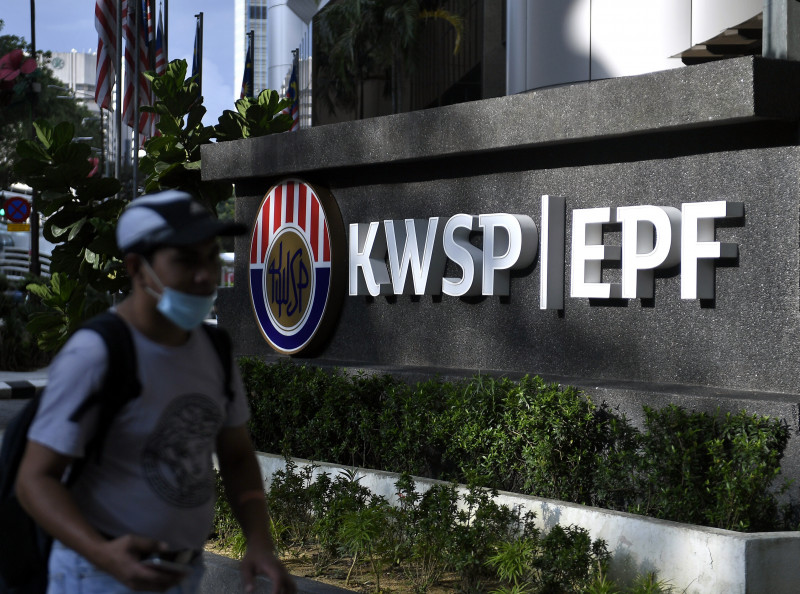
This comes in the wake of EPF announcing that it has widened the scope of its i-Sinar facility to cover active members who have lost their jobs, were given no-pay leave or have no other source of income.
EPF expects i-Sinar to benefit two million members, with an estimated advance amount of RM14 billion to be made available for withdrawal.
Prof Yeah Kim Leng told The Vibes that even though it is within the rights of the contributors to use their EPF savings during hard times, they must also look for ways to increase their retirement fund once the economy has normalised.
“Early spending has a trade-off. They are bringing forward their future consumption to the present. So, they have to increase their savings when they have the capacity,” he said.
He said it would be worrisome if a contributor’s income does not increase and his ability to save is impeded, as this would lead to an “old-age (financial) crisis”.
“It is important that they do proper financial planning to ensure that they are able to top up their retirement savings when future economic conditions permit them to do so,” Yeah advised.
The senior fellow and director of the Economic Studies Programme at the Jeffrey Cheah Institute on Southeast Asia also said that the long-term risks of EPF withdrawals will be less harsh on those still in their 20s compared to those who are in their middle age.
The youths have more time and potential to make up for their current losses, while those in the 40s and above face a higher risk of seeing their retirement savings becoming meagre and insufficient if they are withdrawn and not replaced, he said.
Yeah noted that EPF’s own study found that the majority of its contributors’ retirement savings can only last them for roughly three years, and they then depend on financial support from family members.
He warned that unreplaced withdrawals and lack of higher future earnings among contributors will also impact on the government, as it would then have to set aside a larger social allocation to assist the aged poor.
However, he predicted that the withdrawals will not create any major impact on the country’s current economy.
He observed that the majority of those planning to withdraw from their first EPF account have plans to pare down their debts or borrowings from relatives or money lenders, instead of using the cash on basic consumption, purchase of property, durables and investments.
Use savings for a rainy day
Meanwhile, analyst Tan Sri Ramon Navaratnam pointed out that savings are meant to be utilised when times are tough, but agreed that Malaysians must focus on saving up once again after the crisis is over.
“The principle is that you save for a rainy day and EPF provides a very good facility in saving for a rainy day, especially after retirement,” he said.
“But the storm has arrived… Much as we want to save, when the day comes that we can’t put food on the table, we better resort to our savings.
“In that situation where you are hungry and you have savings to buy food, it seems irrational not to use the savings to save yourself,” said Ramon, who is chairman of the Centre for Public Policy Studies at the Asian Strategy and Leadership Institute.
He added that the government must also educate the contributors on the future impact of withdrawing their retirement savings now.
However, he suggested that it is unrealistic to expect EPF contributors to be able to increase their savings once the economy normalises.
He explained that in order for contributors to save more, the minimum wage ceiling must be raised. A comprehensive review and revision of the national economic policy is also required.
Government obliged to meet popular demand for withdrawals
Singapore Institute of International Affairs senior fellow Oh Ei Sun stressed that survival is more important than savings. He shared Yeah’s view that without adequate savings contributors would face difficulty in their old age.
“As citizens lose their income during these difficult pandemic times, there is very little for the government to do except sprinkle one-off handouts here and there. Most momentarily impoverished citizens would have to fend for themselves and their families,” he said.
“EPF, with its mandatory monthly contributions, thus becomes a rather attractive “savings” pool for its members to tap to tide them over,” he added
“This of course comes at a cost to their long-term well-being as they advance in age towards post-retirement with scarcely other income sources.
“But at present it comes at little cost to the government (as the contributions are from the employers and employees) and there is a popular demand for it (withdrawal). So the government would have to oblige,” said Oh. – The Vibes, November 18, 2020